
Opaque Bodies
Dorota Gawęda and Eglė Kulbokaitė “Spit and Image” at Basement, Rome
Can we speak of “opaque bodies”? The question emerges from a broader look at many contemporary artistic practices—especially those operating across performance, sculpture, moving image, and digital ecologies—in which opacity appears almost as a response to overexposure, forced transparency, and the constant demand for bodies to be legible and, in some sense, available. An opaque body is, in fact, a body that exceeds its own image; and precisely because it does not coincide with concealment, it is bound up with complexity. In this sense, opacity becomes a kind of generational device, arising from a context in which visibility is systemic: I am thinking of algorithmic surveillance, the performativity of social media, and the proliferation of images consumed at the very moment they are produced.
Opacity is the form the body assumes when it resists being consumed, translated, or reduced to data. Many artists—predominantly Millennials—work precisely within this zone of friction, where bodies and images appear blurred, reflected, or duplicated; where gestures contingent upon corporeality are often stripped of context; where images do not return an identity so much as mechanisms of absorption and re-proposition of cultural tropes. This is a condition that concerns not only form, but also content: opacity becomes a way of thinking the body as both a traversable surface and a performative agent. All the modalities I referred to above are ways of withdrawing a body from transparency, while also restoring to it a complexity that immediate visibility would otherwise elude.
The question with which I opened this text and this reflection concerns, among others, the practice of the artist duo Dorota Gawęda and Eglė Kulbokaitė, of Polish and Lithuanian origin respectively. It allows us to read their solo exhibition at Basement Rome, “Spit and Image”, as a field of non-transparency: an environment in which the body is never fully available to the gaze. In the selection of works on view, as in their broader research, opacity is not necessarily a visual quality, but rather a performative condition: it takes place between the body and its representation, within a grey zone that is not always easy to frame. At times, it is almost impossible not to think of Édouard Glissant in these passages, who defined opacity as a right to non-transparency; or of Georges Didi-Huberman, who thinks of the image as that which appears while simultaneously withdrawing.
For Gawęda and Kulbokaitė, the work always begins with text: with narratives, stories, and discursive materials. This attitude stems from the feminist and post-internet reading group Young Girl Reading Group (YGRG) (2013–ongoing), their first truly collective project, from which their entire practice developed and through which their identity as a duo was established. Performance, sculpture, film, props, surfaces, and architectures are all elements of the same ecology, traversed by gestures, images, and narrative residues. Sculptures become props within films; films generate autonomous sculptures; performances are translated into videos that blur documentation and staging. Everything belongs to a system of references, echoes, and proliferations.
The notion of double-becoming—seminal to their entire practice—understood as a collaboration based on reciprocal transformation, becomes a fundamental key. The bodies that appear in their works are not complete entities; rather, they refract and somehow proliferate throughout the space made available by the artists. For this reason, I think of this exhibition as a system of corporeal opacity. “Spit and Image” allows the bodies present or evoked in each work to proliferate like ghosts moving across media, spaces, and surfaces.
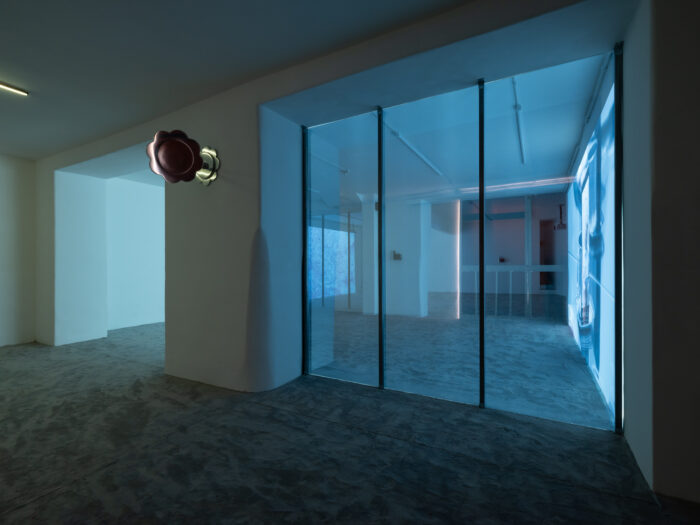
The opacity expanding here is not only contemporary, nor merely familiar to the artistic practices of Gen Y; it also belongs to a broader reflection on the genealogy of the image. Gawęda and Kulbokaitė’s research into opacity originates in the Enclosure series: digital prints on fabric that are visible only from certain angles, fleeting images that require movement and that also implicate the body of the viewer. In their exhibitions, architecture becomes a filtering device for refracted vision. The parallelepipeds—which in this exhibition function as screens, limiters, and obstacles to vision—bring us back to a reality in which barriers are not only physical, but also digital and algorithmic. Opacity is therefore a form of resistance to systemic visibility.
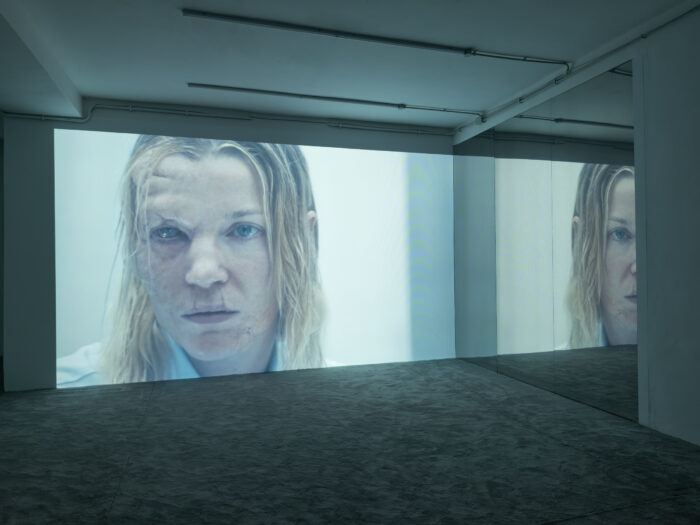
The two videos, both from 2025 and sharing the title of the exhibition, are part of an expanding series: a corpus that works on the figure in the landscape, and on the relationship between body and environment, in which the former exists in a state of constant proliferation. In Spit and Image 1, the performer is captured by a system of mirrors that generates panoptic points of view, multiplying her image until it becomes unrecognisable. There is a subtle reference to anatomical representations, usually imagined as complete maps of a body, when in fact they dissect and abstract it. Early scientific photographs were not, in fact, indexes of reality: they offered a trace of it, and often had a phantasmagorical quality.
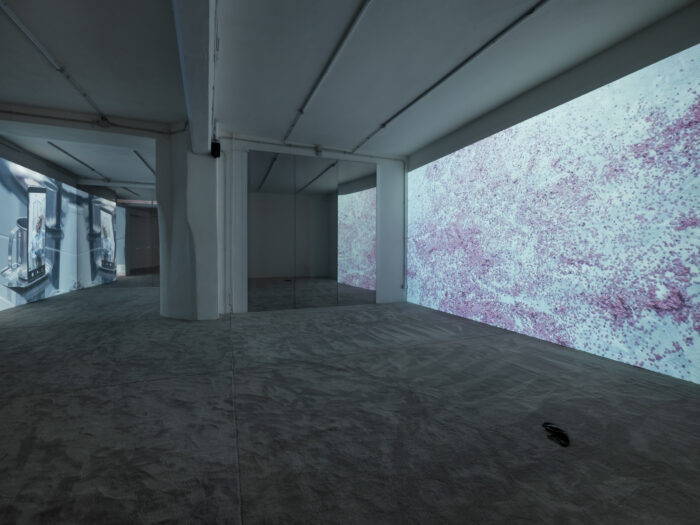
The video develops from research conducted in Bologna on wax anatomical models at the Museo di Palazzo Poggi, a key site for eighteenth‑century ceroplastic practices, taking up the figure of Anna Morandi, sculptor and scientist, who created models resembling votive objects, aestheticised fragments, tactile narratives. The protagonist of the film observes a fragment of her own body as Morandi observed the dissected brain: both are gestures of knowledge, but also of estrangement. The body is normal and anomalous, scientific and aesthetic, alive and dissected. The duo’s research into Surrealism and the parallel spiritualist movement opens onto a genealogy of the image that searches for echo, for the ghost.
In Spit and Image 2, the figure immersed in urban fog is unable to recognise herself among her own doubles: the environment itself becomes a device of opacity, a medium that dissolves identity. The video was shot beside the National Library of France, a site of institutional knowledge production. The dancer, by contrast, produces another kind of knowledge by miming micro-choreographic trends from TikTok, yet never revealing her face: her body operates through repeated gestures within a dimension of horizontality. Her movement traverses the city and is reflected in glass, duplicating itself into colouroscopic images.
The exhibition sets epistemological dualities into tension: archive and feed, library and algorithm, history and micro-narration. It is a reflection on the production of opaque knowledge. The carpet from the first film is reproduced within the exhibition space, creating a slippage from video into real space, and producing an echo between set and exhibition. Spit and Image may be read as a device that puts the transparency of the contemporary body into crisis: a performative condition emerging in the passage between body and image, and between presence and proliferation. In this sense, opacity, in Gawęda and Kulbokaitė’s practice, is not an aesthetic tool, but a way of producing forms of knowledge and moving through the history of images.
If, in the videos, opacity manifests itself as the proliferation of the image, in the sculptures it condenses instead into form, matter, and surface. This proliferation concerns not only the body, but also the sculptural objects dispersed throughout the space: some are natural extensions of the videos, while others enter into close dialogue with them. The sculptures from the Yield series, with their mirrors oriented like cameras, transform a nostalgic object tied to the exploration of identity into a device of surveillance. Yield, 2021 (2024) precedes the films, yet it already contains the core of their research: doubling and monstrosity as forms of knowledge. The hybrid, duplicated, and deformed face is itself a liminal figure.
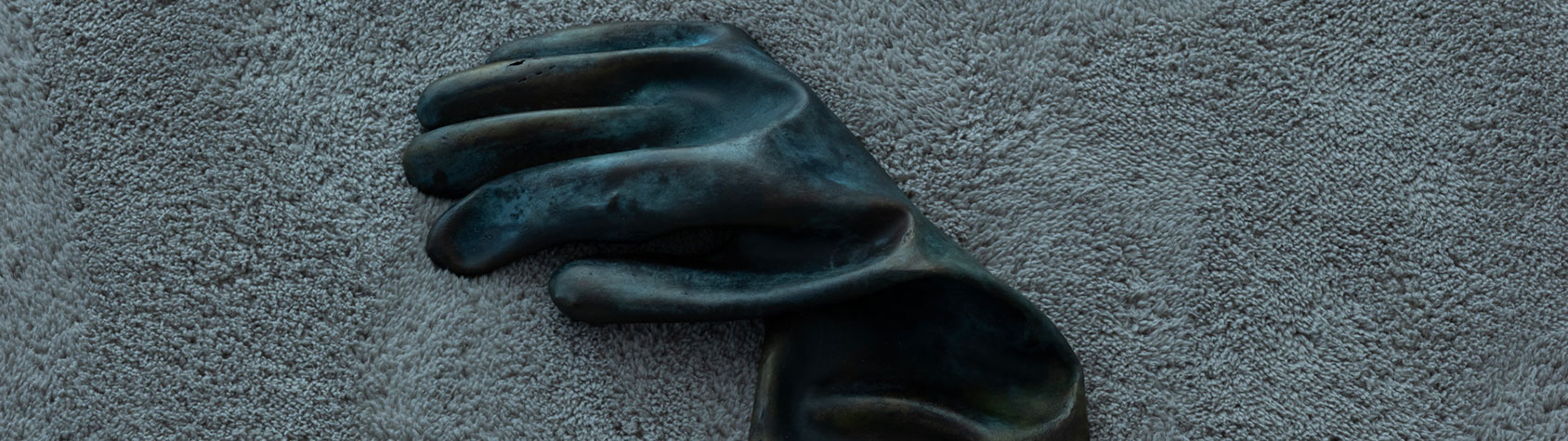
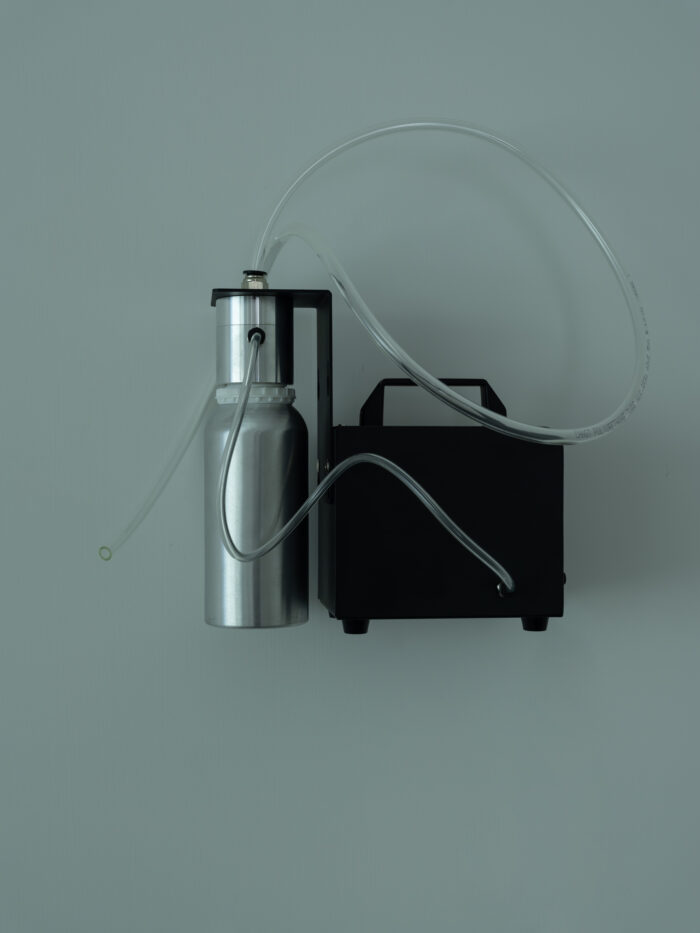
Or Mirror Mirror (2025), which traverses the body at a molecular level: breathing becomes a gesture of permeability, a way of being crossed by an olfactory image which, precisely for this reason, once again escapes transparency. Placeholder (right hand rubber glove) (2026), a patinated bronze cast made from the rubber gloves worn by the performer in Spit and Image 2, is shaped in reference to the Surrealist glove: an object that carries with it the history of the automatic image. In the passage from rubber to bronze—from an object born as an ephemeral, disposable material into a resistant, heavy, almost votive alloy—the glove preserves the trace of its original membrane, which once separated the skin from the environment, filtering, shielding, and protecting it. It returns this trace as a fossilised imprint, as the residue of an impossible contact.
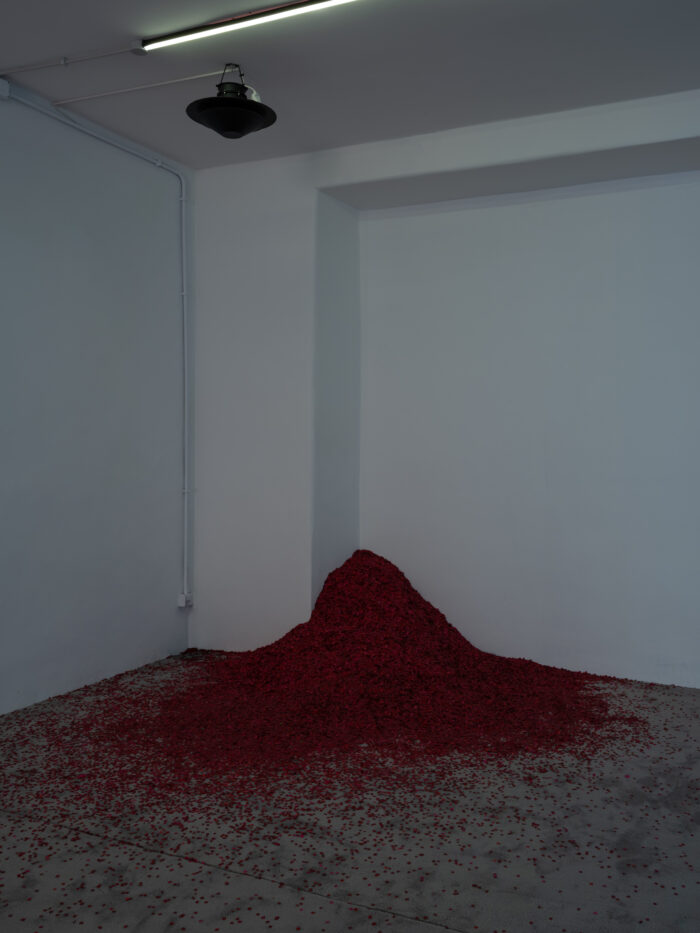
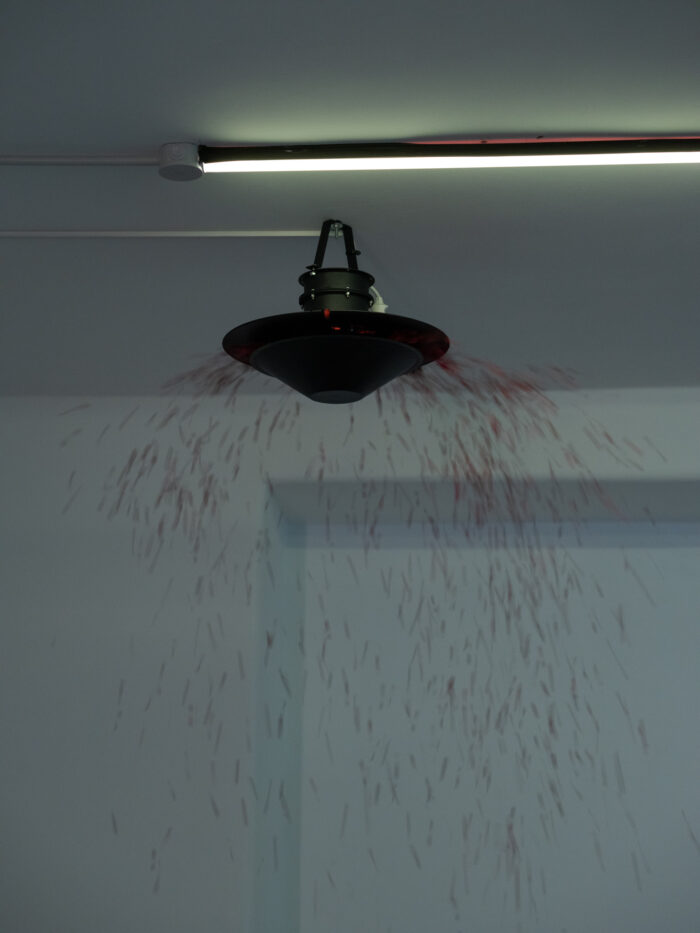
As in We all know what fog is (2026), the pile of amaranth confetti accumulating in the corner of the first room—fed by a ceiling-mounted confetti machine—although its formal reference to Felix Gonzalez-Torres is almost immediate, the sculpture opens a further reflection on particles as a metaphor for illness, and on fragmentation as a condition of the contemporary body. Its visual reference is the biodegradable confetti used during the Basel Carnival, which becomes an image of role reversal, mirrored worlds, and identities that disintegrate and recompose themselves. Carnival is a moment in which norms are suspended and madness is permitted: yet another form of social doubleness that resonates with the doubleness of their images.
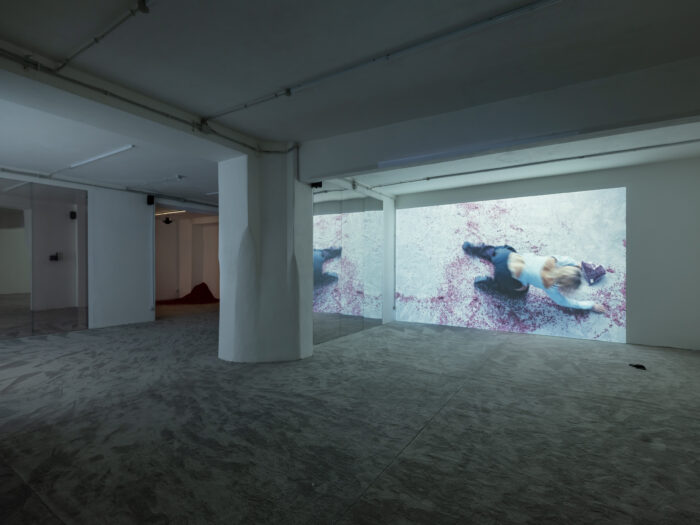
“Spit and Image” embodies a layered and complex reflection on opacity, which the duo deploys across cultural and medial registers. The exhibition allows the body to proliferate like the ghost of a porous image, approaching André Lepecki’s idea of the body as a field of forces: a site of friction between movement and arrest, visibility and withdrawal. A political device that defines itself through its capacity to resist, to slow down, to become opaque.