
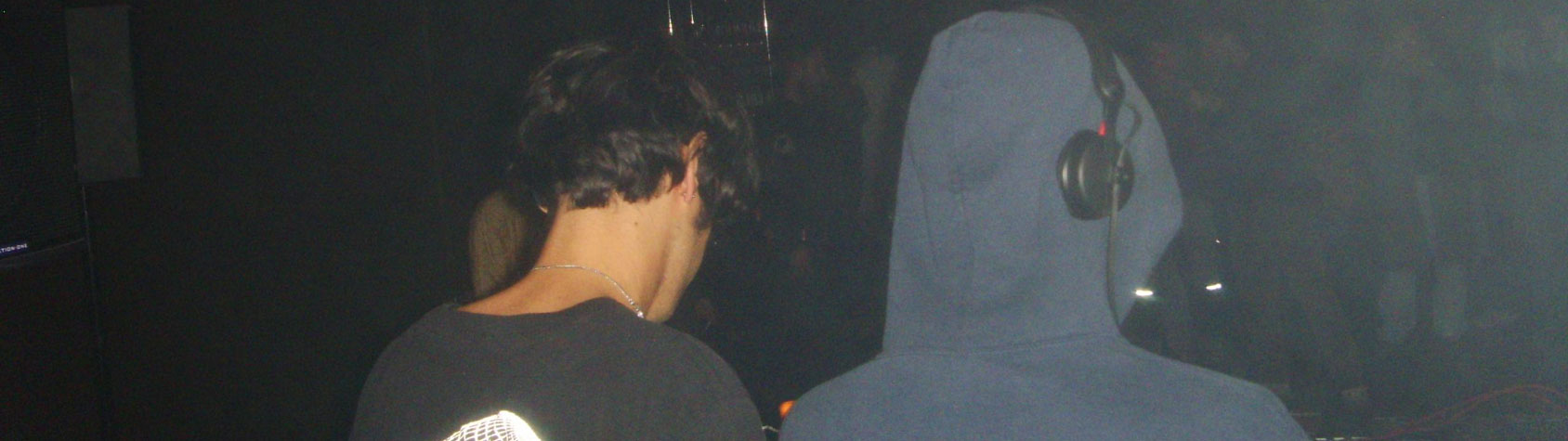
Nuova Scena Ambient
Ambient is a scam invented by Portamento to sell more club
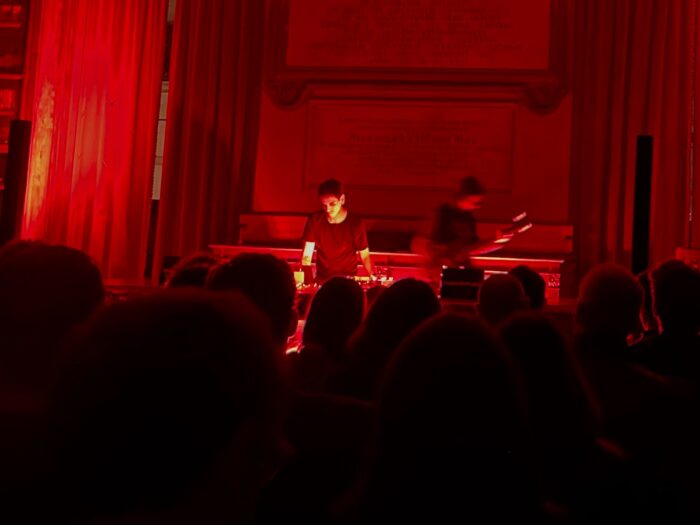
This interview with Portamento, more than an interview, has been a months-long conversation between friends, developed through meandering discussions on music that took place over meals, coffees, beers, studio sessions, and music events across Rome. More than an interview, it’s a window onto an emergent, scattered scene, with unlikely stubborn, resilient, ever-developing roots in a city where geographically disconnected realities are held together by human connection, where the lack of a “scene” intended as an exclusive clique brings forward what feels like authentic artistic expression. A scene that struggles with the limitations of the urban landscape, a scene crippled by restrictive local and national administrations, a scene that can’t find stable spaces to thrive in, a scene not always optimistic about its health, a scene that must confront itself with sometimes savoury nightlife characters, from the monsters of the Roman swamps, to the kind elves, feasting frogs, fairy-like animals and industrial machines that populate the city. A complex landscape of mythologies to battle and work with, a deep, layered iceberg of history that has formed throughout decades. As you read this, Portamento is getting ready to throw their ‘last’ party, a special edition of scivoliiiiii taking place at Trenta Formiche on Friday, May 29.
“Where the hell do you come from” was my first and maybe only true question that started this conversation. The answer was not simple at all.
Alvaro and Filippo met through mutual friends while playing in small rock bands in high school, alongside other friends, including Rodrigo, who is still one of Portamento’s closest collaborators. That band, like other bands that would follow, didn’t last long: it broke up when Rodrigo left for a study trip to the UK, where he has now moved permanently. After his departure, Filippo and Alvaro kept being part of different projects that never really went anywhere. Around the same time, they were in and out of electronic music conservatory. The two outlined their history through a continuous recursive process of newly emerging bands, half finished albums, abandoned projects, the timeline of which remains vague and mostly unimportant. More than a precise path, what has led Portamento to where they are right now is a constellation of encounters. A few key moments keep coming back in the various conversations as markers of their sonic personality. Around 2018 they began to work on artistic projects and sound installations as a duo, in particular for their artist and friend Agnes Questionmark. This was Portamento’s first true phase of experimentation with electronic music. Commissioned to produce soundscapes for works across Europe for Agnes, the gallery became the first true playground where ideas of ambient space-specific sonic experimentation could develop. Besides those commissions, a series of festivals and events in and around Italy made them feel the potential of experimental ambient and electronic music. Knowing that there was an audience, a potential someone who listened closely, someone who cared, pushed them to seek ways to carve out spaces for themselves back home, in Rome.
Through scattered stepping stones, experimentations, and unilinear narratives, Portamento has built up a hefty and varied musical portfolio: an upcoming album to be released in September on Conna Haraway’s Glasgow-based label co:clear; an unorganized, mostly unreleased archive of unfinished albums; an album produced for Hello Mimmi; scores for short films and several exhibitions, including Devozioni per Occasioni di Emergenza 2025 by Sofia Naglieri at Guggenheim Venezia in 2025, and Agnes Questionmark’s multimedia installation S.A.M at Biennale Malta 2024, and monumental performance CHM13hTERT in Milano at Spazio Serra in 2023. Alongside their music production, they have made a name for themselves as one of Rome’s most beloved club and ambient DJs, definitely also thanks to their events, scivoliiiiiiiiiiiii, which has been running for over a year across venues in Rome, with more than 26 events hosted so far. Artists, producers, DJs, event curators, but also avid partygoers, Portamento are always up to something. This interview is a composite of conversations scattered through the past year, documenting various points of transition. As we publish this text, they have just received back the masters of their forthcoming album and next week they are throwing what Alvaro and Filippo the last scivoliiiiii.
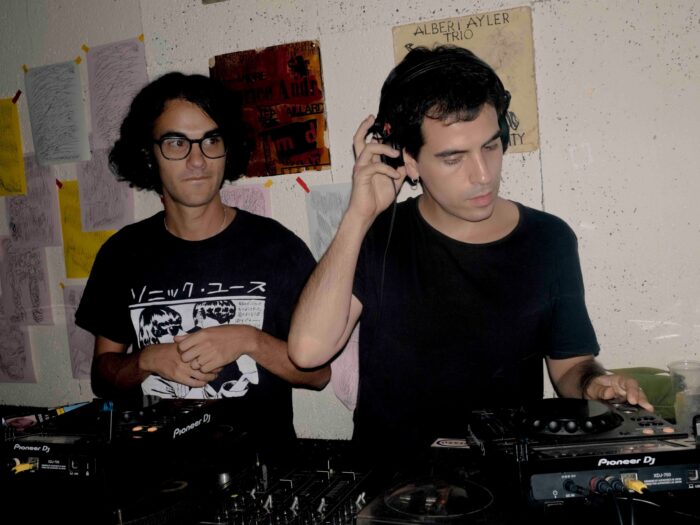
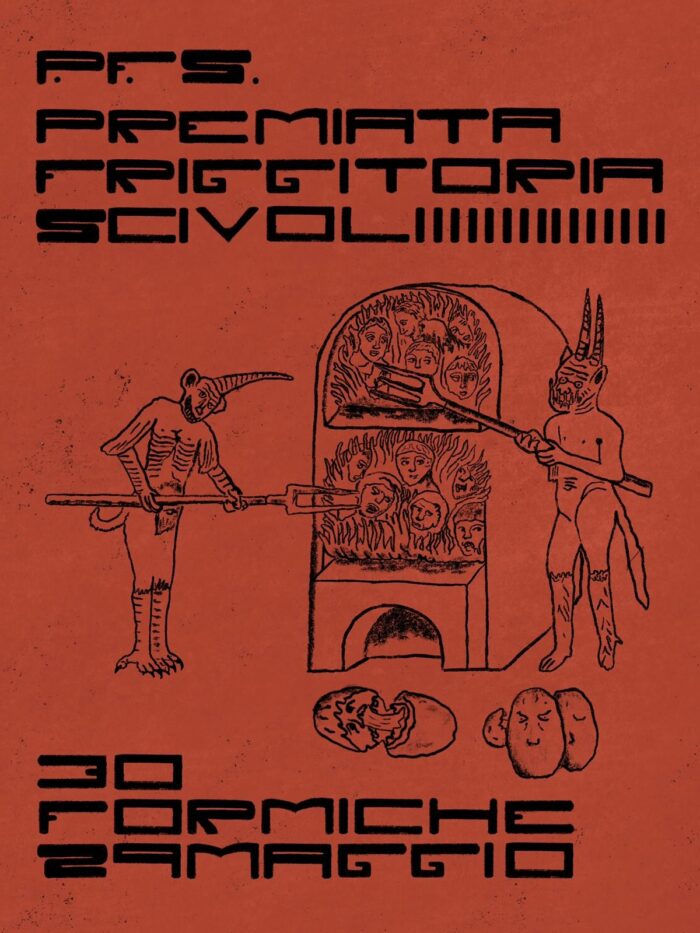
Whether of the season or forever, it’s not clear. Livia Lucarelli, who does the scenography of the events, reassures me that it’s what they also said last year before going on to put on another full season of events. But Portamento seems excited to close things up, at least for a bit. Besides, I am of the opinion, and so is Portamento, that throwing parties in Rome is a fall/winter endeavour. As soon as temperatures rise, the already elusive crowds of the capital begin to lose focus. Preferring open-air venues, preferring impromptu parties and city-wide events (Pasquetta alla Torre, 25 Aprile at Parco degli Acquedotti, primo Maggio at Forte Prenestino), it’s almost impossible to ask people to stay indoors. But this won’t mean the last scivoliiii at Trenta Formiche won’t be packed. All scivoliiii always are. I am biased, of course, cause this scivoliiiiiiiiii, on May 29, will be a friends and family one, a “Premiata Friggitoria Scivoliiii”, where I will be DJing in b2b with Moogy Maserati, alongside sets from Mifu, Wedding Scammer, Jira, Ragel, Livia, and of course, Portamento. Whether it’s the last one for a bit or forever, one thing about this upcoming party, like all that Portamento is involved in, is that dancing will be guaranteed.
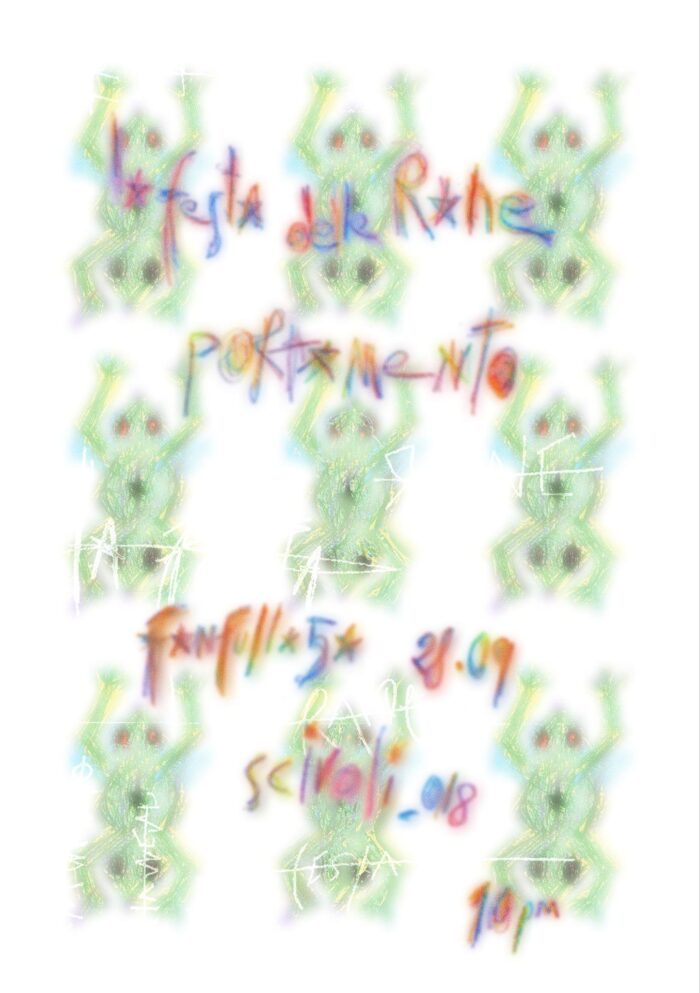
This is because, if there is one thing that Portamento knows how to do, it’s to make you dance. A notable characteristic, as the two are mostly known (and booked) for ambient music gigs. In part this is because of the music programming they champion, as scivoliii has hosted artists that explore and explode the concept of “ambient” music in all its declinations. Portamento has especially a soft spot for “ambient folk”, marking Rome as the gentle space to showcase national gems through live shows such as the eccentric instrumentalism and fairytale lyricism of the Festa delle Rane, legendary king of emo-infused ambient Chantssss, the cumbia-soaked trap influenced kind sound of Mifu, hybrid use of instruments by Etrurian Gothic project by Leonardo Metz and Luca Fitzgerald of Hyperacustica, live tape set by Roman ambient artist Boring Tables. Not only showcasing national treasures but also making space for great international acts like Devon Rexi, Innerinnerlife, Spivak, 990x, Otro, K-means and Dj Narciso. There’s no doubt that Portamento’s taste is one that definitely predilects ambient. But to truly get into the Portamento mindset, one has to stay until the end of scivoliiiiii. After one or two live sets, every scivoliiiiiiiiii night changes path. It almost feels like the ambient is a trick, a way to lure people in, making the events descend into something else. On their SoundCloud you can find both sides of Portamento, the ambient and the club. The two things are not in contrast, on the contrary, one part seems to feed the other.
M: Your events, scivoliiiiiiiiiii, have the loose structure of starting with ambient and ambient folk acts, only to go harder and harder to the point of full clubbing by the end of it. It’s like using ambient as an excuse to play club sets later. How does ambient help you party?
F: The two things are connected in a temporal journey that takes you from one point to the other. It’s also the reverse path of after-party music; you might think to play that music at the afters, but we thought: let’s invert it and put it at the beginning. It creates a space, an energy in the room for building up the club. It opens the door for you. Sometimes we care less about that and then we want to throw down the door and go straight to the party. It’s fun to play with expectations. This is also what happens at scivoliiiiii. The coolest nights we’ve done are the ones where you expected one thing and then you come out having had a completely different experience, where you “slide” into the oblivion of confusion without realizing it.
M: How did scivoliiii start?
A: I think it was summer ‘24, we started organizing small evenings at home, on my terrace, just little concerts with friends.
M: Who did you invite?
F: Friends and friends of friends. It was pretty open. We’d put up rugs, organize the space… then it would often all end up a bit chaotic, but it was fun. During those first evenings, we also met some friends who would later be part of the events like Wedding Scammer, DJ and event organizer who has often played at Portamento’s events and vice versa. That September, a mutual friend proposed something more concrete: they were opening a new club, Circo dei Cerchi, and asked us if we wanted to take over the Sunday there. I think we were a bit scared at the idea, as they were asking us to simply go there and DJ. But we asked ourselves: who would come on Sundays to listen to us who only play club music? We might as well do something different. And since the little parties we would organize with friends often ended a bit badly, we thought: let’s just try, it can’t get any worse.
A: Instead, things did go even worse at the beginning. On the first scivoliiiiii night, none of the USB sticks worked. It was a disaster. In the end, someone lent us a very slow USB stick, and it took us an hour and a half to transfer the tracks. The event had already started, and we were still busy uploading the music.
M: Who else was involved in those first editions?
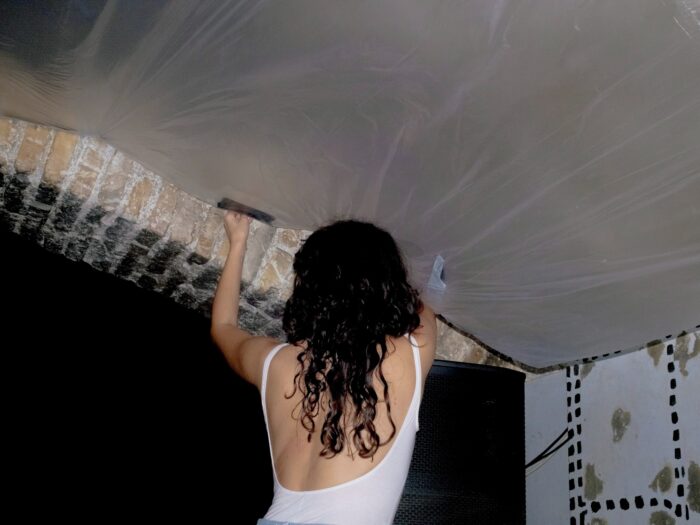
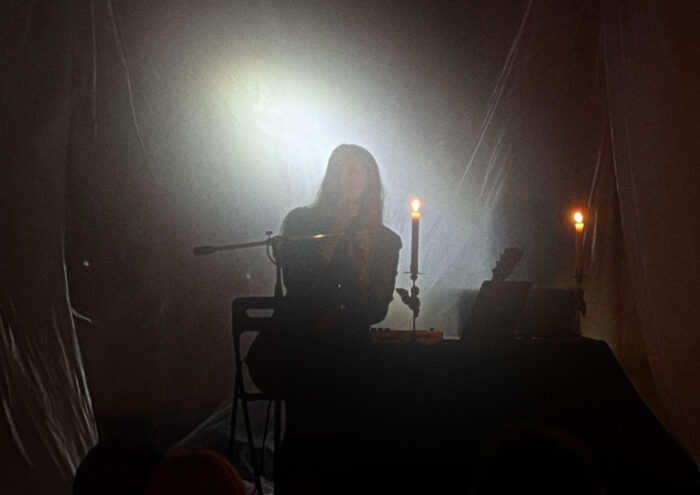
A: Rodrigo was involved from the start, making the event’s flyers which we would distribute around town. That’s how we met Livia, who does the set design of scivoliiiiii. The first experiments with scenography came the night when Chantssss played: rugs, candles, smoke. We also had two smoke machines. The effect was incredible. It went beautifully
M: Did you document those events?
F: Not very much. We sometimes think we should have taken more photos.
A: But maybe that’s also the nice thing: there’s not all this content from each night.
F: Yes, collectives often have a very specific and recognizable aesthetic in their event photos. We, on the other hand, have never wanted to standardize it too much. At first, we thought about having identical graphic design for everything, but then we realized that wasn’t really our style. Better to have something freer, even a little confusing if necessary.
A: I also think it’s funny that people who have never been to a night don’t know exactly what to expect.
M: What was your plan for the first scivoliiii at Circolo dei Cerchi?
F: The idea was to create a more ambient first part of the concert, with the possibility that the evening would then degenerate like the parties we had at home: something more fluid, more listening-oriented, and less rigidly club-like.
A: The clubs usually only have very standard club nights, but that wasn’t interesting to us.
F: We wanted something more “horizontal”: not the classic, very serious live show of experimental or electronic music, a bit dark and distant. We wanted something more relaxed, where you could also lie down, lie on the rugs, and listen. Some formative events that helped us define our taste and goals were Waking Life, and Cosmos in Lisbona, those were the first times we had the experience of an audience sitting or lying on the floor. I think when people are like that, they’re more inclined to really listen.
M: What kind of night is scivoliiiiiiiii today?
F: It’s still a bit ambiguous. Some people think we only do ambient music, others only do club music.
A: But actually, it’s simply music we like.
F: The term “ambient” interests us because for many it simply means a predisposition to listening: sitting, lying down, being immersed in the music. It doesn’t necessarily indicate a specific style. This gives us a lot of freedom in booking artists.
M: I think as a genre it has reached a certain point in its growth and development that necessarily it has taken on a different function. We live in an increasingly noisy and crowded world. If ambient is environmental music, which infiltrates today’s space, it takes the shape of that container. If you think about the ’80s and ’90s, ambient could be much quieter. Now it’s faster, more intense, immersive.
A: It blends a lot with other genres; artists who do ambient always mix other things. Ambient trap and ambient folk, scivoliiiiiiiiiii was born partly for that, moving towards more performative projects. With a more powerful stage presence. It’s also what we’re looking for for our live shows: to be more present and active during the performance, more disconnected from the computer, extending our work, opening it up.
M: Your experience of sound design for Agnes, having started with that, the sonic spaces linked to art, how did it influence you?
F: It influenced us greatly; it’s the basis of everything we do, sound-wise. Even the attention to the visual level, when we talk to each other and explain what we imagine, we do that through images. It leads you to think about sonic narratives in an abstract and free way.
M: Have you changed direction in recent events?
F: Yes, perhaps today we call for slightly different artists: stranger, more folksy, more experimental.
A: Less rigid, less “vertical.”
F: Funkier, weirder.
M: And what about the future of scivoliiiiiiiii?
F: Maybe we’ve reached a point where we’d like to make a small leap in quality. In a short time, we’ve organized a lot of events, almost without realizing it. It was also fundamental for us from an artistic point of view.
A: Yes, it helped us develop our own musical project a lot.
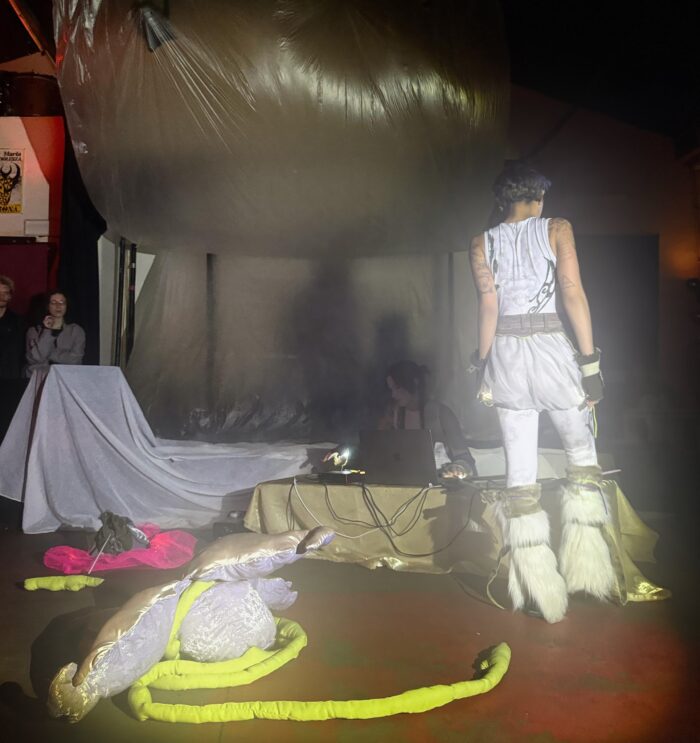
F: Now it would be nice to work on a slightly larger scale, not to do something “bigger” in a commercial sense, but to be able to experiment more. For example, with special lighting or more elaborate set designs. It would be a way to expand the project even further. It would be nice to work with a higher level of production.
M: Are the locations in Rome the limit?
F: Not necessarily. But space definitely affects greatly what you can do. But it’s also about changing the aesthetic of the set design, evolving the project. From a programming standpoint, I’d like to include more performances and mix things up even more during the evening.
A: But to do that, you need a space that allows it.
F: Exactly. Many venues are very defined containers: they already have a strong character, precise hours, limits on when you can do things. You can’t even play around much with the time of day or week. However, if we want to do bigger events, we need to find funding. In the end, we’ve done tons of small budget events, and I always enjoy it, but in terms of growth and the event’s expression, we’ve reached a limit.
M: Let’s talk about Rome. Last fall we experienced a sort of fertile time for music in this city. It has even been described as an “explosive anthill.” I personally think that we are very lucky to have found each other, to have truly connected. Our group of friends organically collaborates a lot on music event programming. I felt confident in starting my own events because I knew I could count on that friendship as genuine baseline of motivation and support. We go out a lot across venues like Trenta Formiche, Fanfulla, Brancaleone for the parties of friends, hang out at bars where they play dj sets, sometimes find ourselves in churches and off-site locations, there’s moments in which the list of great events are endless. On the other hand, we often are left dissatisfied with the logistics, the programming, the quality of sound systems, and the attention of audiences. It can’t be denied that there is something, a new ambient-esque scene that has developed in-between the cracks of the city. How does it feel to make music and events right now in Rome? How does this new interest for ambient connect with you?
A: In my opinion, it’s a very tense time, a very complicated time. The city isn’t helping us, we can’t find the right spaces for the next step or to do what we’d like to do to the fullest.
F: But still, there’s always something to do every weekend. There are so many of us doing so many things, and even the fact that we’re friends isn’t a given. The fact that there are so few resources makes you seek a certain kind of connection with others. I think we might also be in a time of transition.
M: Something has to happen now or never. To rust or to burn out. There’s energy, either we use it or we’ll get stuck and remain stuck, tired by the mechanisms of this city.
A: And it can lead to the desire to leave, separate, go somewhere else.
F: But if you think about it, there are so many of us looking for the same thing, something has to happen; if it doesn’t, we’re idiots. But we don’t know what we can do. We can’t deny the fact that the places we love and work are run by people who are older than us. They opened those spaces when they were our age. There seems to be no chance to do that now, it seems more difficult than 20 years ago.
M: Let’s talk about your album.
A: We are always saying, “We’re finishing the album.” I think we’ve said it for ten years.
F: Yes, we have made literally six albums. Many of them we left in the drawer. It took us a while to fully understand what we were doing. At first, we even tried incorporating singing. There were some melodies, but we weren’t really sure we wanted to make complete songs. We made demos with vocal lines, but they remained sketches. They were songs with a structure and a melodic line, but they stopped there, because we weren’t sure we wanted to write actual lyrics.
A: We gave up on the first real album we made because we waited too long. After a while, we didn’t like it anymore. It was called Seesaw. It’s not something we wouldn’t produce today, but it helped us grow a lot. It still had a pretty clear character.
F: We still remain fond of those works, even if we put them aside. When we started doing the scivoliiiiii events, we began to better define our sound, also because we could imagine it within a specific scene and context.
M: But now you have it and it’s ready to come out in September for co:clear. What were the ideas that led you at the beginning of this process?
A: The first session was in March last year, in Morricone’s studio, what is now the second track, Bound to Please, recorded with Morricone’s original Celesta. Resampled, chopped up, it sounds like a bouncing rubber band, or toy piano.
M: There’s a sense of continuity in the album, tracks that flow into each other. It’s very playful but dry, almost like an alien calling you. I’m particularly fascinated by the voice samples, where do those come from?
F: The vocals are by Holly Herndon, a super weird ASMR track, Lonely at the Top. It’s used throughout the album, except for the last two most recent tracks. She’s an American composer who works a lot with AI, not only as a musician, but as artist and researcher, she has a Ph.D. at Stanford University. In this track, her voice has a very ambiguous tone, it sounds like she’s in a metal room. At a certain point, the room changes, her voice gets closer. We’ve been using her voice for a while, in many mixes and live performances; it had become a sort of signature for us, so it made sense to start there. It also helps in the flow, it allows for songs to communicate with each other.
A: Then there are many other samples, from guitar pieces, breaths, reverberated eagle calls, Janet Jackson’s Morning. The eagle call also appears in Hello Mimmi’s 8 esercizi per il corpo e per la mente, which we also produced around that time. I think you can hear that we were working on those two things in parallel, they intertwined somehow.
M: What are some other influences or things that informed the sound of the album?
A: You can definitely hear our listening habits in there. Some Ulla, OPN, Mifu.
M: You can also hear the influence of the events you organize, and the sets you play as DJs. You both play ambient and clubbing sets, in some ways this album leans into the ambient dimension, but the sound is definitely informed by clubbing, in how you fill the space, in sensations of grandeur.
F: It’s rhythmic, there’s always a very clear pulse, like in clubbing.
M: But it doesn’t reach that full rhythmic point of clubbing.
F: No, I think this music is a bit trance-like. It’s like you are looking for a static euphoria.
M: What kind of space do you imagine these tracks in?
F: At an afters, an outdoor space with a huge sound system.
A: Waking Life at 6 in the morning, when the sun rises, like when we saw Grand River?
F: Yes, he was playing at 5 in the morning, when the sun was rising. There were tree houses, sofas in the trees.
M: What is the sonic narrative of this work?
F: All the sounds are very close, intimate, often even very harsh, a strange intimacy.
A: An imaginary world of moments in an extremely intimate relationship, but behind it there’s always something that contrasts it, a strong tension, very open and colourful moments, then everything closes and dries up.
M: Maybe also because I was influenced by the cover; there are fantastical, surreal, magical elements. Those drastic changes, the sparks, remind me of the human but also the alien, a direct relationship with reality. It’s not literal music, but there are tendencies that open the imagination.
A: We were looking for a dream, to suspend everything, very rarefied, gaseous, enchanted.
M: A trip of highs and lows. A bit of a dream, and a bit of a nightmare. I’m so looking forward to hearing it and hearing you play it live.