
Monumental Ether Bodies
Hara Shin with Hyperobjects at Spazio Supernova
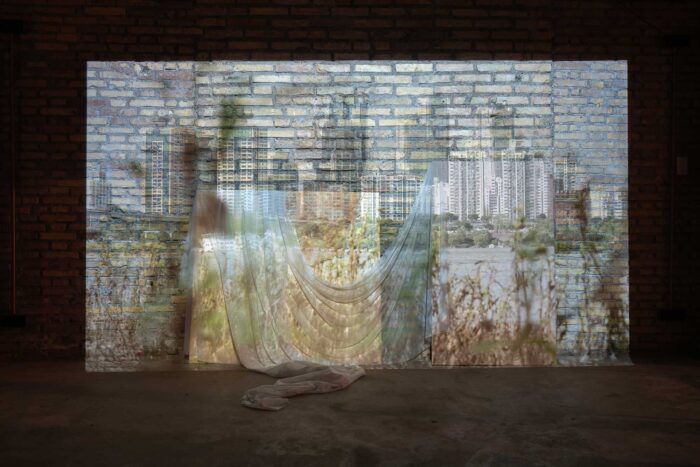
Monumental Ether. Bodies. is a solo exhibition by Hara Shin, curated by Camilla Giaccio Darias as part of Hembryo’s 2025 curatorial program, To create a small flower. Presented at Spazio Supernova in December 2025, the multi-channel installation invites viewers into landscapes marked by colonial and anthropocentric violence: the Kückenmühler Anstalten in Szczecin—once a laboratory for Nazi sterilization and eugenic engineering; the Tropical Botanical Garden in Lisbon—the former Colonial Garden; and the Tancheon Stream in Seoul—associated with the legend of the death of the Daoist immortal Dongfang Shuo.
Subjected to processes of urban renewal and symbolic cleansing, these sites now function as gentrified places in which violence and dispossession are spatially and historically neutralized. Yet unresolved histories often re-emerge abruptly in the present, thickening the air with militarized borders, racial hierarchies, genocides, and a planetary ecology collapsing under the weight of human exceptionalism. Sliding through layers of time, Shin’s work materializes the entanglement of bodies, memories, and the environment as a desire to transform how we (re)connect to our surroundings.
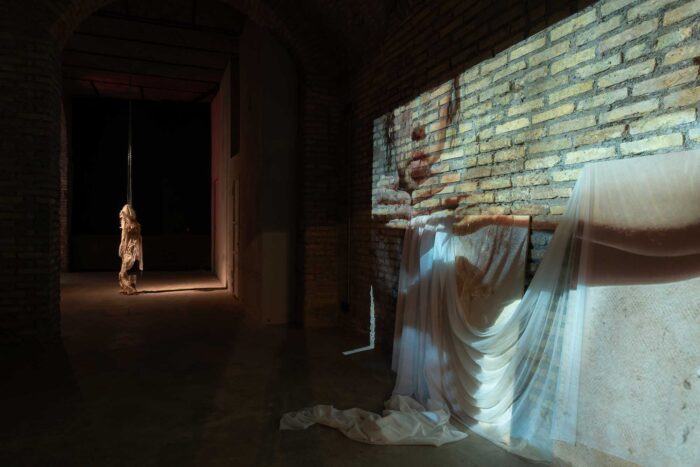
Bodies appear, overlap, and vanish—hands sliding across stone, water, bark, soil, and moss with inquisitive tenderness. Touch becomes an act of attunement to otherness: a refusal to forget, a negotiation with silence, a transcorporeal proximity through which the reality of the dead rises within the bodies of the living. Skin learns what archives deny. Humans and other than humans unfold as co-implicated narratives through which the ghosts of the past do not linger as shadows, but move as vital, haunting forces in the present. Landscapes and bodies operate as stratified, intergenerational memories, and viewers are invited to listen through the porosity of the skin.
Guiding us is the fictional character MOANA (M—Membrane; O—Outlander; A—Ancestor; N—Naming; A—Apparatus), a nomadic and permeable entity composed of memories in constant flux between past, present, and future. It is a fluctuating membrane resisting categorization, absorbing worlds, digesting them, releasing them transformed. Drawing from Oswald de Andrade’s Manifesto Antropófago (1928), MOANA evokes cultural cannibalism as a strategy of resistance: to devour what dominates.
By dismantling binaries between culture and nature, self and other, the living and the dead, Shin’s work foregrounds how multiple flesh(es) and histories intra-act through magical, erotic entanglements, opening the possibility of re-existence for what has been suppressed. It cultivates a transcultural sensibility of mutual becoming, opening a way to re-cognizing how bodies continuously slip into one another. After all, where does a body really end? If we expanded our sense of self across our surroundings, how would we know differently?
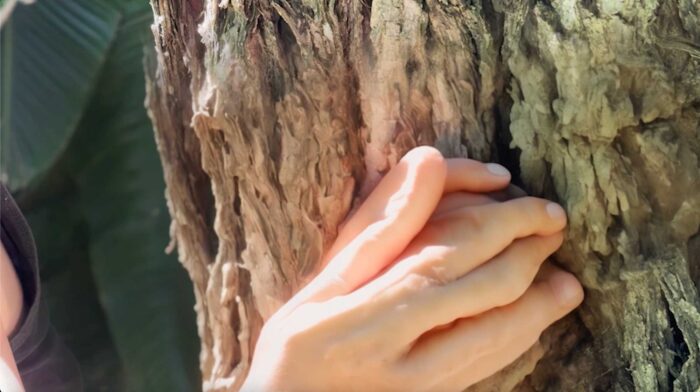
Camilla Giaccio Darias: In Monumental Ether. Bodies., we see bodies moving across sites marked by anthropocentric and colonial violence—from the Kückenmühler Anstalten in Szczecin, to the Tropical Garden in Lisbon, and the Tancheon River in Seoul. What drew you to these places, and how did you bring them into dialogue within your practice?
Hara Shin: Everything operates on its own time, its own lifespan. These three places did not enter my life as part of a single plan or unified research direction. They approached me slowly, at different moments, through different temporalities. What ultimately bound them together was a shared undercurrent: each site holds a form of death and anthropocentric violence that continues to circulate rather than remain confined to the past.
The Kückenmühler Anstalten—once a German watermill that became a Nazi sterilization facility—embodies the machinery of biopolitical control, where bodies were classified and erased in the name of “purity”. The Tropical Garden in Lisbon, formerly the Colonial Garden, is a calm, manicured space situated amid imperial monuments. Its aesthetics conceal long histories of extraction, scientific categorization, and botanical violence. The Tancheon River entered my work from a different angle: through the Daoist master Dongfang Shuo, whose legendary death is tied to its waters, and through the river’s contemporary contamination. Washing charcoal, washing memory—myth and toxicity coexist in the same stream.
What matters is learning to see how these places continue to operate in every present moment. Each site generates its own form of recovery. These locations are historical, yet not “history” in the sense of something preserved or stagnant. Their pasts remain alive, moving, and fluid. The violence embedded within them is unfinished; it continues to move through matter—soil, water, archives, bodies, infrastructures, and more-than-human entities. The installation Monumental Ether. Bodies. becomes a space in which these sites digest one another, forming a constellation rather than a chronology. No singularity, no purity—only hybrid identities and temporalities.
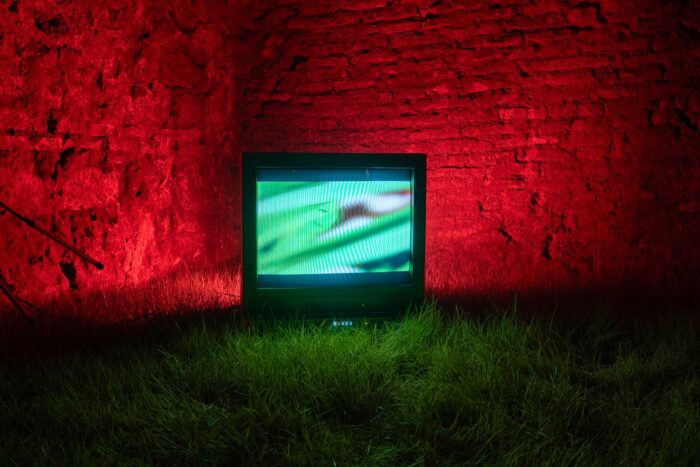
You often engage with Stacy Alaimo’s concept of transcorporeality, which understands bodies as permeable and entangled with their environments. How does your diasporic experience—coming from Korea and now living in Berlin—shape the way you approach different histories, geographies, and temporalities?
Transcorporeality, for me, is not only a theoretical concept; it is a lived condition. It describes how time accumulates in the body, how histories enter through breath and landscape, and how the geographies I inhabit continually reorganize my understanding of self. My work embraces multiplicity and it is also informed by my situated knowledge, which is diasporic, partial, and translated. I trust that incompleteness as a form of resistance to totalizing narratives. Diaspora also sharpens my awareness that identities—like bodies—are hybrid, shifting, and never singular.
In my work the body is shaped by atmospheric pressures—historical, linguistic, colonial, emotional—moving between continents. I live within multiple time zones at once: compressed futurity, monumental archival time, and layered mythic time. This displacement leads me to approach sites as permeable entities rather than fixed locations. Their histories seep into me, and mine into them. Borders between human and non-human, past and present, myth and documentation become porous. I do not stand outside these sites as an objective observer. Instead, I meet them through an entangled perspective that recognizes how matter moves between places, how violence circulates, and how memory migrates.
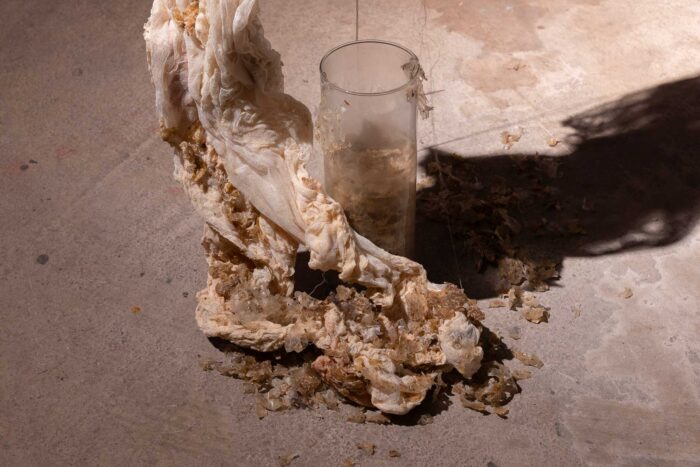
The speculative entity MOANA guides viewers through suppressed narratives. She is a hybrid beyond the human and non-human, digesting time and space as she testifies. You have mentioned that she draws inspiration from Oswald de Andrade’s Manifesto Antropófago (1928), which understands cultural cannibalism as a way to resist colonial assimilation. Can you share more about MOANA and what inspired her?
MOANA emerged when I needed a witness capable of enduring multiple temporalities at once—a being that does not belong to any single ontology. Her name—Membrane, Outlander, Ancestor, Naming, Apparatus—describes its modes of existence. It absorbs, digests, and reconfigures the worlds it encounters. Oswald de Andrade’s Manifesto Antropófago influenced me profoundly because it reframes digestion as both a political and aesthetic act. To “devour” the colonizer is to reject purity and to embrace mixture as a form of strength. The creativity that arises from continuous swallowing, digesting, blending, and transforming remains deeply relevant today.
MOANA is simultaneously an archive, a future, a body, and an apparatus. Through it, I approach resistance as a process of continuous transformation. It refuses domestication—she mutates, leaks, and absorbs. MOANA reminds us that identities shaped by colonial histories often survive by becoming multiple, ambiguous, and uncontrollable… I do not pursue erased histories with the ambition of restoring them. Instead, I work within the fractures between what is accessible and what remains opaque.
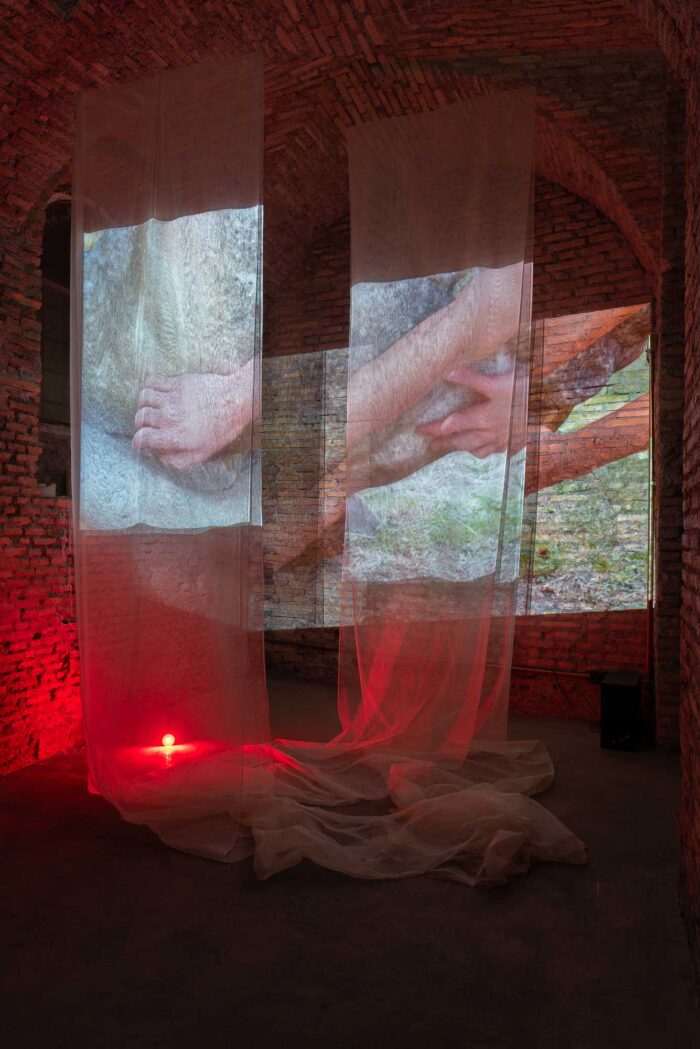
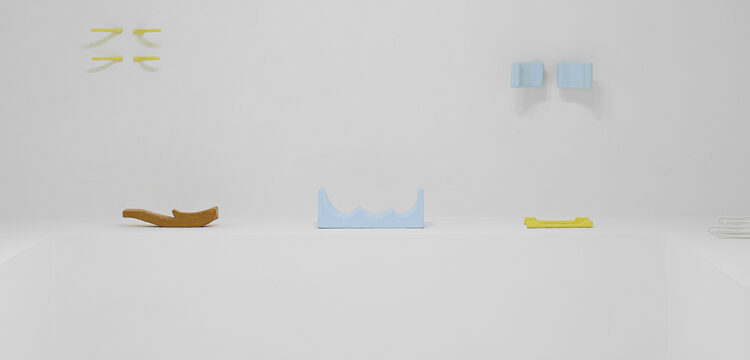
Temporalities and spaces overlap throughout your work—not only in the videos, but also in the exhibition space, where materials such as fabric, wood, latex, bioplastic, cloth, and water interact. Can you tell us more about your interest in these materials?
Nothing in my work—including the materials—exists in isolation. My practice moves toward multiplicity, and hybridity. I am drawn to materials that change over time: natural rubber latex that shrinks, water that evaporates, bioplastics that warp with humidity, and plant scents that respond to moisture and light. These substances embody temporalities that refuse fixed form. They deform, absorb, leak, and decay. They remind viewers that bodies and histories are never static or preserved like specimens in a natural history museum.
A body is an interface—an open system continuously shaped by air, architecture, sound, trauma, bacteria, myth, data, and climate. The body does not end at the skin; it extends into objects, infrastructures, and other living beings. To imagine the body as separate from its environment or detached from the temporalities that shape it is already a colonial gesture.
You have described the taxidermied body as a distinctly Western fixation on stabilizing what is alive or dead. How do you relate to death, especially through the lens of Asian cosmologies?
From my perspective, death is not an ending, but a transition—a circulation in which matter rearranges itself. There is no strict division between the living and the dead; rather, there is encounter, co-presence, and continual movement. This understanding resonates deeply with my practice. When we attend to the different temporalities and spatial sensibilities of human and more-than-human beings, every encounter—between myself and the things around me—carries a body, a memory, and a field of energies. Matter rearranges; consciousness migrates. The dead do not disappear—they change their mode of existence.
The body often speaks unresolved histories, ungrieved violence, and suppressed stories. These return through flesh, through symptoms, through landscapes. The body continually summons the past into the present, enabling new encounters. Bodies swallow, digest, and metabolize one another, generating complex networks of spacetime. When I describe taxidermy as a Western imperial obsession, I am pointing to the impulse to freeze life at a single moment—to arrest transformation for the sake of possession. I approach death instead as transformation, decomposition, and relationality.
Death is porous. It is an opening through which other forms of life, memory, and sensation can enter. My work emphasizes this fluidity rather than the rigidity of preservation. The colonial gaze does not exist only in museums or archives… In my work, I seek to dismantle it through unstable images—hybrid bodies, leaking materials, narrators who appear ambiguously yet insistently across multiple temporalities—shifting the viewer away from the position of detached observation toward a more entangled way of seeing.
Finally, you often refer to the concept of the “undomesticated” to challenge systems of categorization, bodily norms, and colonial taxonomies. What does it mean to embody or mobilize the undomesticated as an epistemic and aesthetic posture within your practice?
For me, the undomesticated is a refusal—an active resistance to colonial, patriarchal, and modern scientific systems that categorize and confine bodies. To be undomesticated is to reject purity, consistency, and compliance. It is to embrace what is wild, excessive, and unfixed, and to recognize that bodies—human and non-human alike—always exceed the frameworks that attempt to regulate them.
In practice, the undomesticated manifests through leaking materials, hybrid figures such as MOANA, fragmentary narratives, and installations that remain unstable or unresolved. These gestures unsettle classificatory regimes and invite us to reconsider which bodies are rendered intelligible. They also open space for alternative modes of sensing and knowing. Ultimately, the undomesticated allows me to imagine a world in which care is not grounded in control, but in coexistence and entanglement—a world where bodies are free to shift, spill, mutate, and relate on their own terms.