MAKE KIN, NOT KINGS
A conversation with Ami Clarke
This interview with Ami Clarke follows the recent install of her work Meeting the Lough On Its Own Terms (2026), that considers what the Rights of Nature might bring to Lough Neagh—the largest body of water in Ireland and the British Isles by surface area that was overwhelmed by algae blooms in the Summer of 2023 (and continues to be today).
Previous work such as The Underlying (2019) utilised sentiment and emotion analysis to take the temperature of public debate via mentions of Bisphenol A (BPA—a pollutant that acts like oestrogen, produced alongside plastic production since the 1930s)—awash in the world’s water systems, and communication systems alike, revealing interdependencies across social media, the environment, and finance, as it mapped the rise and fall of the 100 most polluting companies stocks and shares.
Clarke’s work often considers technological innovations, probing the new behaviours emerging through these, where humans necessarily find themselves part of larger cognitive assemblages. As such, the works probe questions of agency, within a complex mix of actors and agents, amid the flows of power running through data-processing, machine learning, AI, as well as more-than-human cognitive and non-cognitive processes.
The new work Meeting the Lough On Its Own Terms takes an interesting turn, revealing the roots to not only the story of emergence (intertwined with cybernetics), but also unpacking evolutionary narratives to reveal the conceptual conceits that bring us to the point of climate collapse today. Whilst local to Lough Neagh, the work brings together many of the systems currently undergoing collapse: ecological, financial, water, etc whilst proffering alternative world views opened up by the eco-crisis, essential to human survival.
The focus on a “multi-species” and “more-than-human approach” starts to recalibrate our relationship to nature, de-centring the human (not de-valuing) whilst celebrating the lough as we immerse ourselves underwater, to meet the microbial life, the eels, the pollan (fish), and the lough itself, amidst the multiple temporalities and scales that the climate crisis reveals.
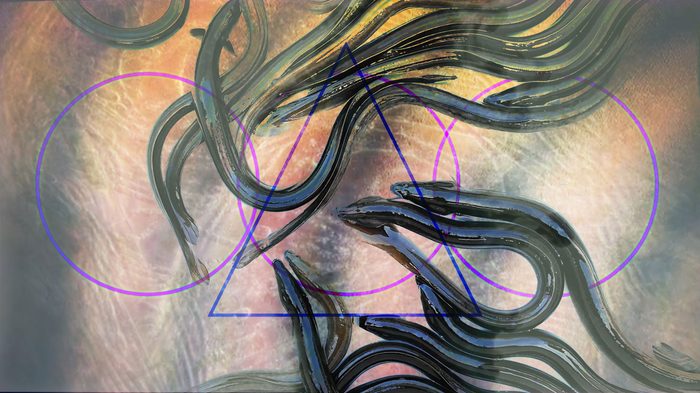
Harun Morrison: The triangle is literally a central motif in the primary video. Where does a triangle begin?
Ami Clarke: The triangle speaks of ancient relationships where humans were intrinsically enmeshed within nature, informed by geometries found there, that imbued older practices of living (“protocols” if you like) with a ritualistic and symbolic character borne of this time. A substantially more direct relationship with your food source, that intrinsically built in sustainable practice’s because there were no other options. There was no Tesco’s at the end of the street, for example. This is where the signage “bulk feed logistics” that you see on the back of a lorry (in the video work), is central to the dilemma we face, amplified by the fact that Britain currently imports a large percentage of its food (we are only 3 to 9 meals away from full societal breakdown, depending on who you ask).
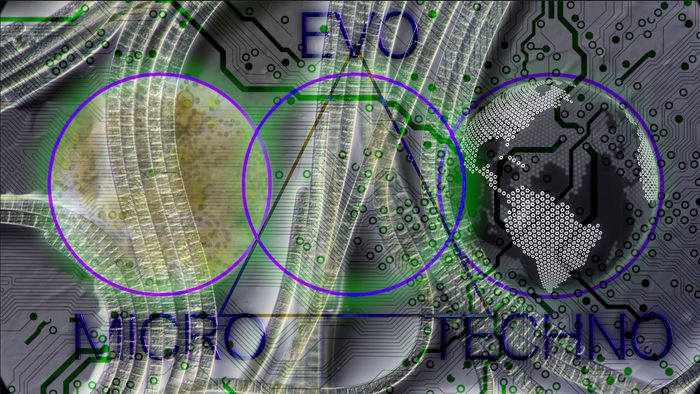
The triangle is interesting to me in the way that it hovers in the realm of diagrams and mathematics, whilst existing in the symbolic realm as an artefact of, seemingly, a distinctly human sort. This becomes even more interesting when we start to think of recent research claims into the multiple forms of meaning-making between the organism and the environment, that we may not be the only species that make use of signs and symbols.
When I first met James Orr, the director of Friends of the Earth, Northern Island (NI), we found a shared interest in ecological systems theory. James had read Fritjof Capra’s work at an early age, which chimed with my research in post-human and more-than-human studies, and cybernetics. These ideas, historically, were around at the beginnings of the environmental movement where a growing understanding of complex systems emerged through evolutionary biology into cybernetics. First defined in 1948 by Norbert Weiner, where feedback loops, homeostasis, autopoiesis, and so on, provided new ways of understanding the world around us, where interdependencies were revealed by seeing the world as multiple converging systems, biological, social, informational, computational, etc.
Recent work by N. Katherine Hayles brings together the concepts of “Evo, Micro and Techno” (evolution, microbial, AI), which she describes as a “Bio-techno evolution, a hybrid process in which information, interpretations, and meanings circulate through the flexible human-computational collectivities that I call “cognitive assemblages” in her book Bacteria to AI, that builds on the work by the evolutionary biologist Lynn Margulis.
Could you talk about the relationships you sought to establish between the three video channels?
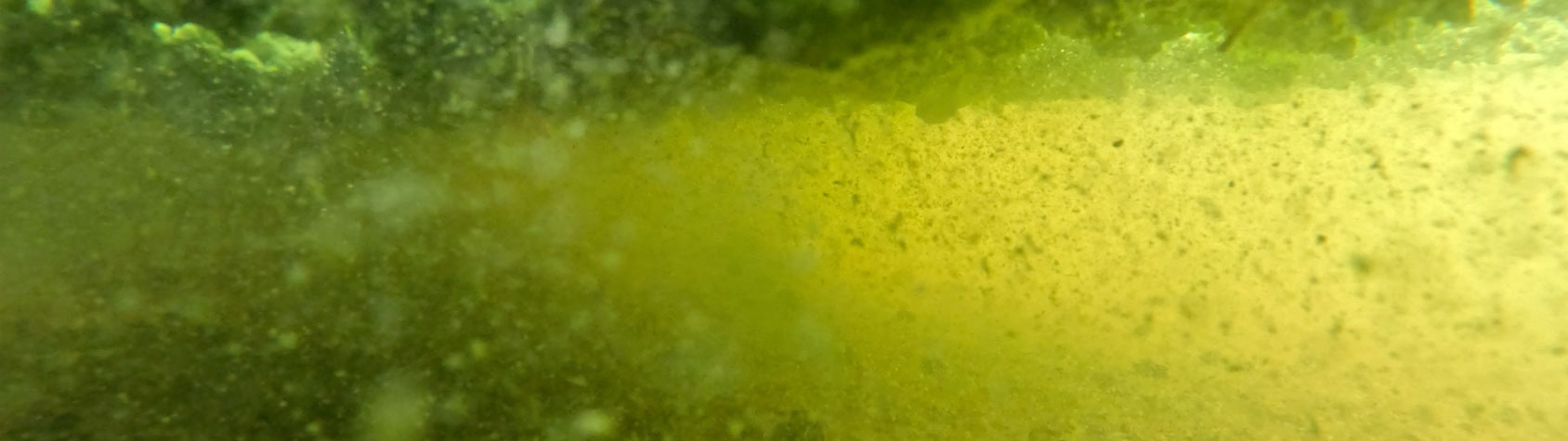
In August 2024 I spent two weeks on Ballyronan Marina where I was very kindly taken out on the water by folks local to the area, to research and film the algae blooms. The material I collected included drone footage, video from the vantage point of boats both on and under the water, and 4K microscopic footage of water samples from the lough, revealing the microcystis (the specific cyanabacteria—algae blooms—in Lough Neagh): a dangerous liver toxin.
The lower left hand video shows a year in the life of the lough, bringing together the complexity of all the different scales and temporalities of climate change.
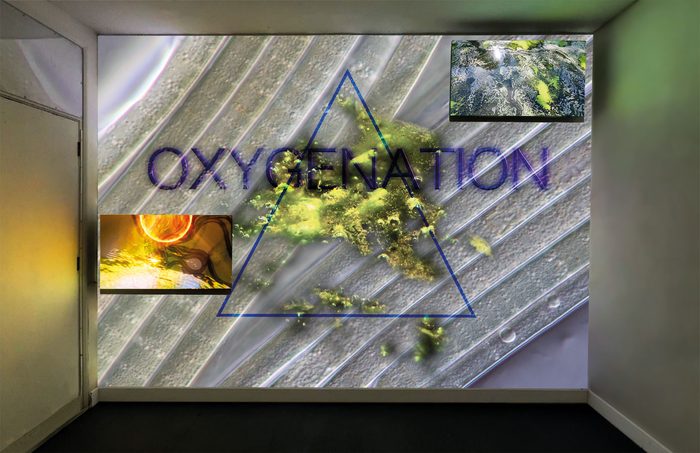
I was invited by Friends of the Earth NI to join them during the first algae blooms in 2023, and listening played an important part of the initial contact, which developed into the first diagram that drew together the issues that converge at Lough Neagh… which while specific, is symptomatic of many environmental challenges across Ireland and the UK (and further afield). The diagram I drew then informed a diagramming session at FotE conference (2023) at The MAC Gallery, Belfast where everyone came together to diagram what a healthy lough might look like, and how to get there.
By focussing on the microbial scale of the algae blooms (cyanobacteria) we can say (without dispute) that there is simply too much phosphorus in Lough Neagh. The question then becomes, how does it get there? Once we have identified this, we can start to dismantle everything that makes it this way.
The video takes us through an annual cycle of the eco-system at Lough Neagh, and how the increased amount of phosphorus from agricultural slurry that finds its way into the Lough, impacts upon finely tuned balances of cross-species interdependencies in the lough.
We can see the effect of this most readily in the dwindling numbers of the Lough Neagh fly (Tommy Greene, a local journalist writes about this in The Guardian). With less flies around: less midge larvae, and the eels that rely upon these as their main food source, starve as a result. Just last year the eels were deemed too skinny to fish, and a centuries old fishing tradition was stopped.
I started a collective writing project with Friends of the Earth early on, that gathered together something of the multiple stories running through the lough. The numerous origin stories and mythologies of the lough, of which Li Ban the mermaid and a crystal city beneath the waves, are but a few, entangle with the deep time of tectonic plates shifting, and the story of cyanobacteria that brought oxygen to the planet 3.4 billion years ago (without which we would not be here). These enmesh with more recent histories to do with the extractive forces of colonialism and, more recently: neoliberalism, that explains in some depth, why we are where we are today. What I mean by this is that neoliberalism is a financial apparatus that facilitates paying dividends to shareholders on the other side of the planet, ultimately taking precedence over the rights of a lough and the communities surrounding it, on the other side of the world. Once you see it in this way, it is difficult to un-see how absurd it is that for a lot of people on the planet, this is where we are at today.
The work attempts to share something of the complexity of the multiple temporalities and scales that converge in climate crisis, or the hydrocene, as it has recently been termed. In this case at Lough Neagh. Right now, in this extraordinary moment of multiple systems collapse, with regards environmental, financial, and so many other interdependent areas, with the subsequent impacts upon health and the inability for communities to support themselves economically, we are playing catch up with the evolutionary biologist Lynn Magulis’ work, much of which focussed upon early microbial life, such as cyanobacteria, that are the algae blooms at Lough Neagh.
Contrary to the Neo-Darwinists emphasis on the sovereign individual, competition, survival of the fittest, and the selfish gene, her work challenged the evolutionary narrative by revealing just how much evolution is driven by collaborative processes and cooperation (cellular response to the environment), and cross-species, symbiotic relationships bringing “symbiogenesis” to our attention. Humans are holobionts, and host to around 95% non-human DNA in the form of bacteria, most obviously seen in our microbiome that facilitates how we digest, and directly affects our mental health andsense of well being. Just the other day I heard an eminent scientist declaring that humans are “open informational systems,” as if this was a revelation, some 50 years on from Margulis’ work on this theory. We are in the midst of a paradigm shift to the microbial scale. Why does this matter? This is where Margulis’ work becomes integral to understanding what is happening at Lough Neagh, challenging the evolutionary narratives we tell ourselves about competition, and survival of the fittest, to suggest instead that survival resides in a social contract based upon collaboration and co-operation. She knew how important this shift in perspective was, declaring back then that it was time to move on from the neoliberal thought to the collective.
The larger video became a meta-study on cyanobacteria, and explores how systems thinking/ecological thinking is vital to understand how we approach climate change, whilst introducing useful concepts from Hayles and Margulis, that help us unpack where we are today, and how we got here.
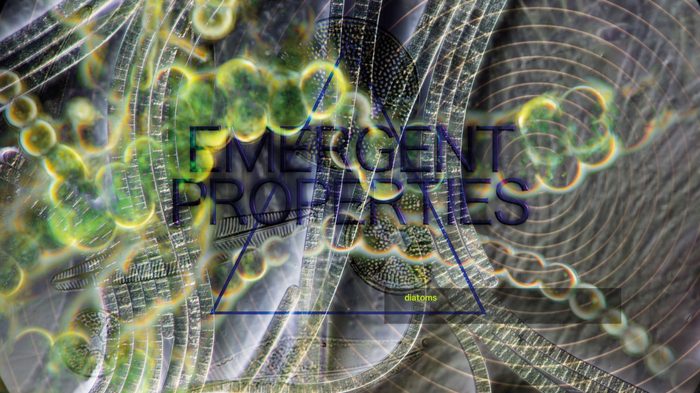
The sound and rhythm create a very chilled vibe, one of the “key words” / phrases across the screen is LINEARITY / CAUSE AND EFFECT—there is a sense the film could loop without end—could you speak about this effect you generate for the viewer and the role of sound in this?
The work takes us on a journey to witness the scale of the world from a microbial perspective, whilst gathering together all these different scales and temporalities, that speak to the complexity of our relationship with nature from microbial, to human, to the deep time of tectonic plates shifting. The three videos play in loops within the work, naturally going out of sync, they loosely cross-reference each other throughout the work. The sound takes us on a trip where we inadvertently arrive at a relaxed state of self reflection. We’ve held many talks and workshops within the installation of the work, and it is quite deliberate. We are talking about what is a very grim reality of an eco-system in collapse, and it’s really important that we don’t also collapse, as a result. The work deliberately takes a sensorial approach, which seeds ideas, whilst opening up further questions and conversation.
The emphasis on sound really comes to the fore in the title: Meeting the Lough On Its Own Terms, as understanding the lough as an entity in its own right, outside of human concerns.
James Orr (Director, FotE NI) likened the title to a “light bulb moment,” which became very useful to FotE as a way of framing the approach necessary to attaining the Rights of Nature for Lough Neagh. Currently it has no rights. So it became very important to think of it outside of human purview—outside of what it can do for humans. This emphasis of “sensing” the lough in different ways came to the fore.
Humans have quite a limited sensory bandwidth, so we need technology in the form of sensing equipment, to help us achieve insights regarding sensing different creatures, as well as bodies of land and water. These technologies can be high tech, or pen and paper.
During the collective writing project we were introduced to concepts of ancient Irish Brehon Law by the eco-lawyer Thomas L Muinzer, who writes about this in detail in the book we have just published. Further conversations with herbalists, druids and permaculturists, and folks from XR Group, Digital Arts Studios Belfast, drew my attention to how rituals acted historically, as early technological interfaces, scoring human/nature relationships, in very particular ways. We explored this further with several sonic ritual workshops with John D’Arcy and HIVE choir, from Sonic Arts Research Centre, QUB, FotE, PS2 gallery and friends. The live jam performance proposes new ways of “being” in the world “with other species” emphasising listening and sound, and hence making us attentive and vulnerable to each other, and potentially other species. We start the ritual by listening to pre-recordings of eels, microbes, hydrophone recordings of the deepest part of the lough, as well as interpretations of data from phosphorous sensors. The improvisational quality to this is interesting as a way of approaching how we might as individuals, contribute to a collective response. It foregrounds considerations of how human voice/s in a polyphonic approach might sit within the delicate ensemble of a multi-species perspective. I think of this as a technology close to ritual as it is about actualising the new calibration that you want to see brought about, that reflects a more decentered and symbiotic approach, whilst furthering a paradigm shift to the microbial scale.
What’s the role of algae here?
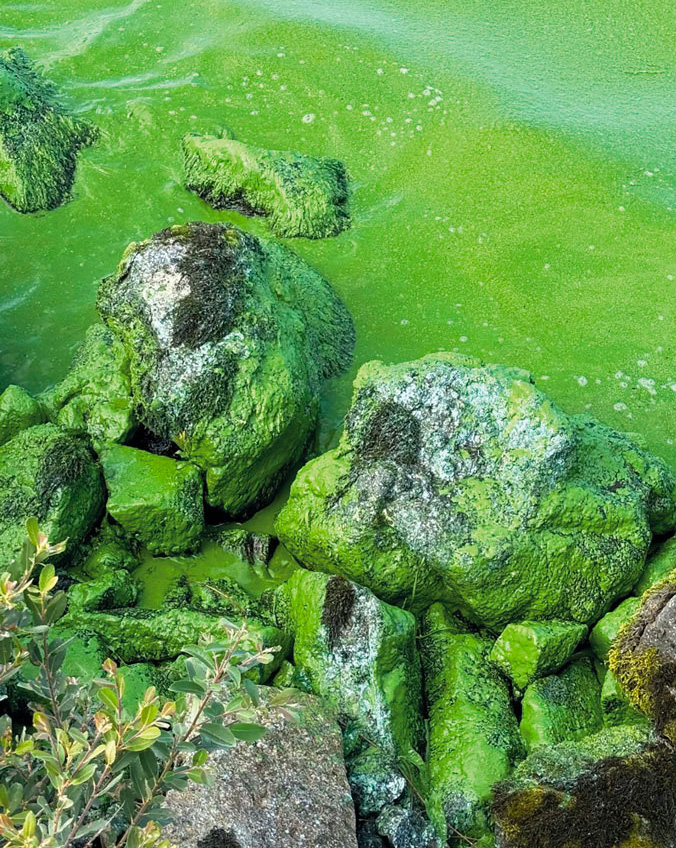
I first became aware of the ecocide happening at Lough Neagh via these bright green images of the algae blooms that looked like a B-movie monster, going viral out of Northern Ireland. It became clearer through Lynn Margulis’ work that these are in fact incredible organisms that were responsible for life on earth, as we know it today, bringing about the “great oxygenation,” as I mentioned previously. By focusing at the microbial scale, our attention focuses on the material conditions that make it this way.
Turbidity, as a concept, is useful here, which describes the means by which we can see a body of water by the density of particles floating in it. You see through water when it’s clear, but the underwater footage from the lough shows the density of particles, that reveal it as a “body” of water, by this lilting dance that the particles do, held within the volume of water. It’s fascinating, in a somewhat deathly way. The esteemed scholar and curator Bridget Crone wrote about this in Turbid Images and Bodies in the Field, writing:
“This is an imperfect image, tarnished, opaque and different to fathom, and perhaps felt more than seen. If turbidity might describe smoke, polluted water and other fluids with suspended matter, then it certainly describes the conditions that envelop us and our fellow inhabitants in the present. Yet at the same time, as is demonstrated by the work of environmental scientists, biologists and optical engineers, turbidity is not only a measure of the concentration of suspended particles in fluid, it is also image-making in its own right. That is, it is not image making in a sense that we are familiar, but image-making in the manner that it indexes and thus displays measures of pollutants… the shift from a human image maker to matter producing its own image, as is indicated in the term, ‘turbid media.’”
The amount of phosphorous in Lough Neagh, plus increasing temperatures, brings about the algae blooms. The first diagram then led to a schematic where the “microbial meets the Neoliberal at Lough Neagh.” Here, we can see how the government scheme of Going For Growth, by adopting neoliberal financialisation of farming, has contributed 52% more slurry into the Lough, since 2012. The schematic traces the flows of power via the flows of slurry, where, as mentioned previously, dividends paid to international investors renders a lough toxic on the other side of the planet.
Whilst the work focuses on Lough Neagh, it speaks to much broader concerns regarding how environmental neglect affects both democratic processes, and public health, as neoliberal policies entangle with algae blooms. The material emphasis on the nutrients in the lough, raises awareness, educates and empowers advocacy for more effective environmental regulations and democratic processes leading to establishing the Rights of Nature.
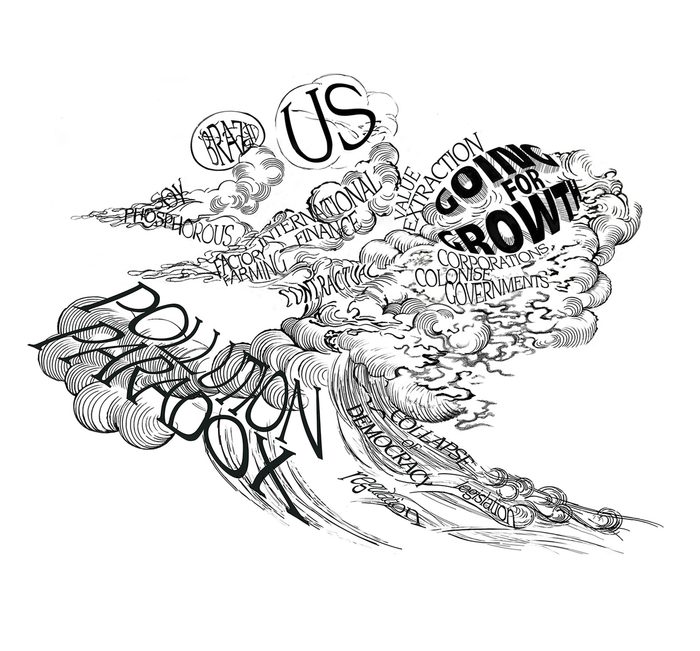
Ami Clarke, Follow the Slurry, Follow the Money. Courtesy the artist.
In terms of local resistance to corporate water pollution do you see any progress?
There is a yes and no answer to this. Since 2023, the level of scrutiny and research regarding how the lough became eutrophic (a body of water rich in nutrients like nitrogen and phosphorus causing mass algae growth, which blocks sunlight, and uses up the oxygen in the water), has vastly increased. Local community groups and activists, concerned citizens, and so on, are really well informed, often collecting their own data, as a means of witnessing what’s going on. Ideas regarding the Rights of Nature are increasingly commonplace.
At the same time as this increased awareness, there has been the urgent need to hold a march recently, protesting against the government’s decision to approve yet another huge factory farm. So clearly there is something very wrong here. A disconnect.
In response to this, an approach has been devised that requires three parts to it, for any hope of it to succeed. The first of which means establishing the Rights of Nature in law. Second, a democratic approach in the form of community ownership of the lough, which in effect acts as a form of collective stewardship, guided by those who live around the lough. Third, a voted for Citizens’ Assembly which would then advocate for the changes necessary, via the legal remit of the Rights Of Nature, to bring Lough Neagh back into a healthy balance for all species living in and around it.
The written word is very prominent, certain words create portals or gateways to new ideas. Could you take us through your writing process?
I tend to think of words in terms of how they resonate, in relation to one another, and hence, think of writing as a rhythm, and as a means of seeding ideas… earworms, if you like. “MAKE KIN, NOT KINGS,” for example..
The work draws upon a collective writing project and conversations over 2.5 years with Friends of the Earth NI and associates, druids, herbalists, campaigners, and eco-lawyers engaged with ancient Irish Brehon Law, to tell of the multiple stories running through the Lough from a decolonial, more-than-human, microbial perspective. I likened this to sediment settling, becoming disturbed again, and then settling again in a different order, with a different emphasis. And this being a constant process. A constant re-iteration of multiple stories.
How can we expand beyond human language, to acknowledge the different “umwelt,” the different sensory and perceptual worlds that Jakob von Uexküll refers to that organisms experience based on their specific biology, senses, and needs. Recent research suggests that other species, such as trees, plants, and cyanobacteria, utilise bio-chemical signalling as a means to communicate. In the film Symbiotic Earth about Lynn Magulis’ work (directed by John Fieldman), the molecular biologist James Shapiro suggests “cognition is action based on sensory information” that N. Katherine Hayles picks up on in her book Bacteria to AI.
Posthuman research, more accurately described by the description “post-natural,” was positioned deliberately in a way meant to afford scrutiny of the claims made for humanism (which grew alongside of colonialism in the UK), has been useful in critically analysing what it means to be “human” and never the more so than now, with conversations about what is meant by artificial intelligence dominating the mainstream. Never has this research been more useful to us. In particular: by reclaiming a way of approaching these new technological advances with an ethically driven intersectional perspective, rather than via a rather non-questioning transhumanist approach, driven by a teleological drive to some increasingly bizarre version of the übermensch. Because we know where that has led us in the past, don’t we?
Could you speak to the presence of Eels in this work?
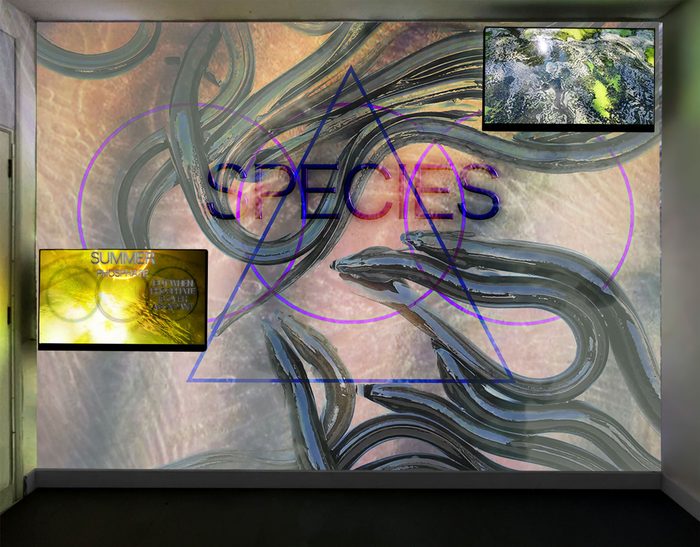
Eels eels, the mysterious eels… Eels are central to the story of emergence. Aristotle claimed they emerged wriggling fully formed from the mud. The Lough Neagh eel is a highly regarded NI export, for several centuries. The eels are now so thin they cannot be smoked, and hence fishing has had to be stopped (sweet relief for the eels, you might say).
They bring our story into a planetary scale as they migrate all the way to the Sargasso Sea. There’s a headline quoted in the work that expresses this human fascination with eels: “Mysterious Eel Sex In The Bermuda Triangle,” spawning there, and then the baby eels, we think, most probably use the Gulf Stream to return back home to Lough Neagh in the spring. The gulf stream (AMOC: Atlantic Meridional Overturning Circulation), it turns out, is integral to the moderate climate enjoyed in Ireland and the UK.
This is where we’re at today.
The silvery eels are on their way.
SYSTEMS COLLAPSE: Meeting The Lough On Its Own Terms by Ami Clarke is produced through partnership with Friends of the Earth NI, Digital Art Studios, Sonic Arts Research Centre QUB, PS² (Belfast), and Banner Repeater (London).
Meeting the Lough On Its Own Terms by Ami Clarke.
Developed in partnership with Friends of the Earth NI, Digital Art Studios, Sonic Arts Research Centre QUB, PS² (Belfast), and Banner Repeater (London).
A sound and video installation, including the works:
(back wall) Meta essay in Cyanobacteria.
(vid 1 bottom left) Lough Neagh ecologies: seasonal interdependencies across multi-species narratives
(vid 2 top right) Under/Over the waves.
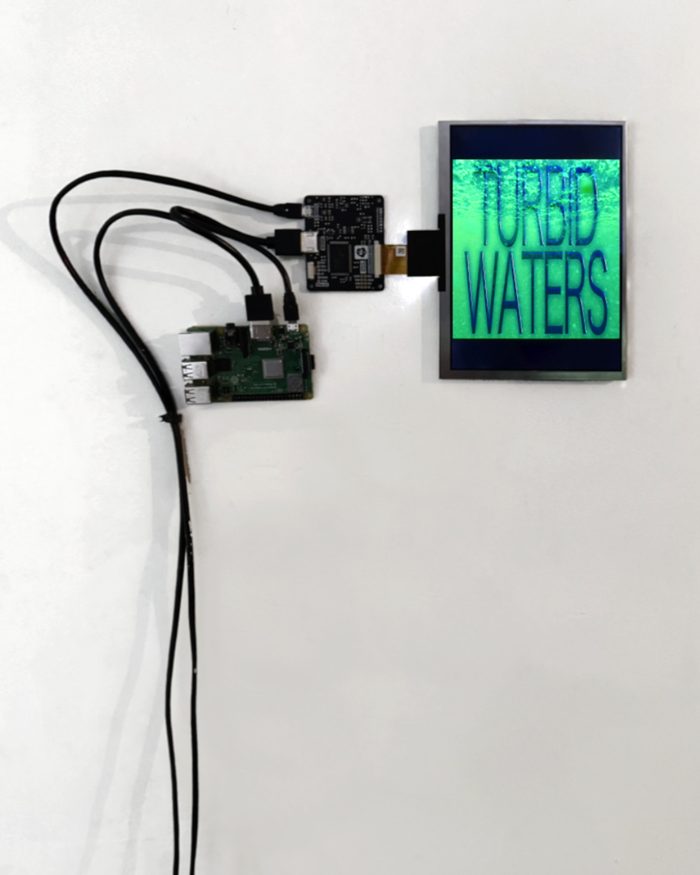
MAKE KIN NOT KINGS — social media post, monitor, raspberry pi, cabling.
Follow the Slurry, Follow the Money. Digital drawing.
Sonic Ritual — a live polyphonic ritual (audio performance) developed with John D’Arcy (Sonic Arts) HIVE choir, Friends of the Earth and local communities (performed within the work during exhibition).