Like a Lizard Shedding its Tail
On Nico Angiuli’s “Ghosts”
“This project is like a lizard shedding its tail.” These were the words Nico Angiuli used to describe to me the Fantasmi (Ghost) project, carried out in the province of Lecce, spanning the Le Costantine Foundation Forest, the House of Mediterranean Cultures, Casamassella, and the hamlet of Uggiano la Chiesa. An organism, therefore, designed to cyclically confront destruction as an opportunity—far from paradoxical—for change and regeneration. In this sense, losing a part of our own individuality, both physical and intellectual, means being able to detach ourselves from certainties and fixed points, going with the flow of time so that it becomes possible to question our own boundaries, that are often imposed and endured, and at times imagined and then internalized. Like a lizard that, by its very nature, learns to cope with the consequences of loss, the artist invites the diverse individuals who compose the local community to step beyond the boundaries of their own lives, rethinking how they exist within a multifaceted present and interact with the reality around them.
The project consists of an environmental sculpture, urban interventions, photographs, and performance pieces. But the artist’s exploration stems from an experience of mutual understanding with the residents of Casamassella. These images, in fact, are not the result of a systematic—and, above all, pre-existing—plan, but rather reflect the outcome of a stay that recognizes the territory and its community as a partner rather than merely a backdrop. Angiuli doesn’t set out to reach a specific goal. We could say that in Fantasmi, the result is the creative process itself, as a blend of intimate stories, walks through the village, and endless, repetitive yet indispensable bar chatter.
There is no shortage of moments of solitude either. Moments of varying lengths, in which the artist loses himself only to find him once again along paths paved with stories, lives, and—indeed—ghosts. These are entities that resist the hegemony of visibility, eluding the collective gaze. They are voices that assert their right to exist, escaping the imperative of classification and the realm of evidence. For this reason, listening to them means bridging the gap with everything that remains outside, on the periphery of a society that refuses to slow down, to interrupt the constant, suffocating cycle of productivity, in order to pause and engage in dialogue with these ghosts, who tend to gather and emerge into the open in the evening, as the sun sets, despite their elusive nature.
It might seem like a cheesy or typical stereotype, but that’s not the case at all. Dusk doesn’t just represent the absence of light, but a threshold that, once crossed, leads to the massive depopulation of South Italy. It’s a region marked by a constant, forced exodus that drives the local population to seek their fortune elsewhere, far from their homeland. However, for Angiuli, the empty and silent streets of the evening also represent a political gesture—perhaps an unconscious one—in that this retreat into his private, domestic sphere could be seen as a rejection of the availability and social performativity associated precisely with the evening hours, as if daytime productivity were necessarily followed by a restlessness to act and to be seen.
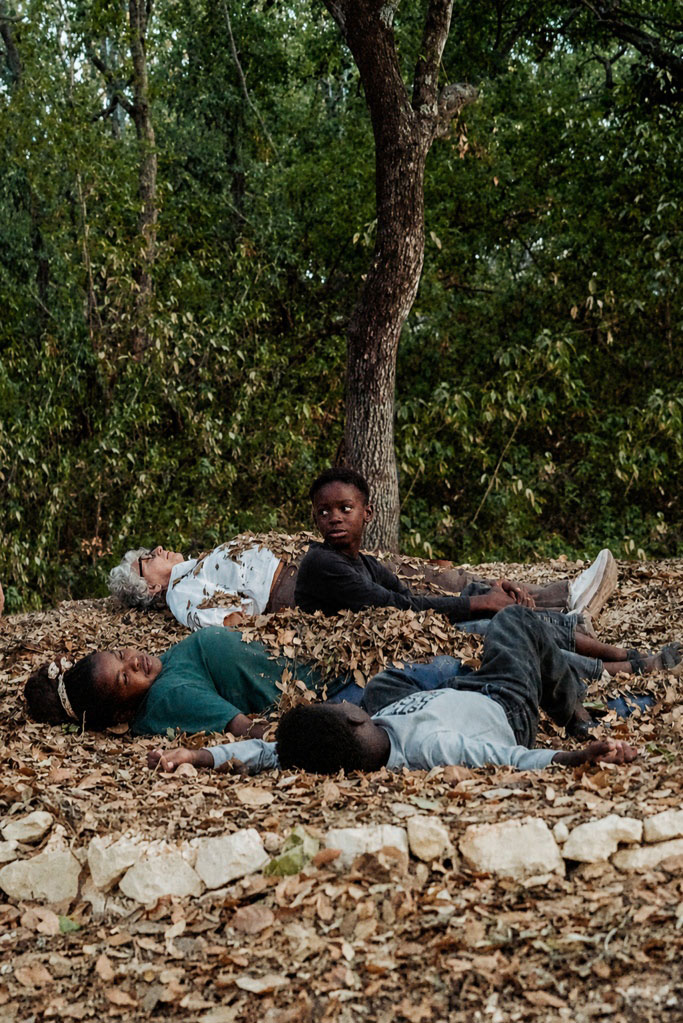
The gradual fading of light marks a symbolic transition between public space and the private sphere, between exposure to the world and domestic seclusion. The streets emptying out, the shutters closing, and the lights coming on behind the windows paint a picture of places undergoing a slow process of depopulation, marked by emigration and the gradual disappearance of people. Yet, within this daily retreat, a possible form of resistance also emerges: a silent withdrawal from the contemporary imperative of constant connection and visibility. The evening thus becomes an ambiguous space, where abandonment and choice, loss and freedom overlap. In the silence of the evening, withdrawal does not necessarily equate to a lack, but can take on the significance of a political and existential gesture. That is, the right not to be there, not to show ourselves, to inhabit time without having to constantly make it productive.
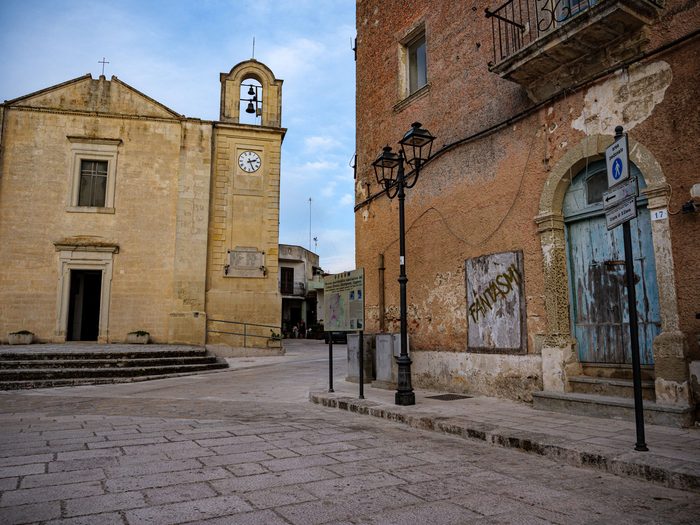
It is no coincidence that the artist speaks of “smarginatura” (going beyond the margins) when referring to the desire to break free from the constraints imposed by contemporary society. It is an act of crossing boundaries, a tension that manifests itself by transcending the limits of visibility and productivity, and by evading the logic of control, recognition, and efficiency. This means crossing thresholds, cracking open the boundaries that separate everything that is socially accepted from what is cast out, ignored, or rejected. This breaking of boundaries creates a movement outward, toward the shadows where forgotten lives and silenced voices lie. In Angiuli’s works, this takes the form of a critical and generative practice that examines not only the act of crossing boundaries, but also the possibility of destabilizing them, revealing their political nature, and imagining other ways of inhabiting the world, beyond what the present allows us to see, produce, and recognize. Through the “smarginatura”, we can try to transcend the limits imposed by our social role, rendering not only our physicality but also our own identity opaque and elusive.
In this sense, ghosts engage in acts of boundary-crossing necessary to obscure the full visibility of their existence, rejecting the obligation of transparency. Similarly, these absent presences seem to aim to portray a territory through what cannot be seen, what does not conform to the dictates of tourist narratives, which are often romanticized and limited to specific marketable aspects of a land that is decidedly more complex and layered. These are experiences that do not align with the rhythm of work, the aesthetics of visibility, or the imperative of constant performative availability. Angiuli’s phantasmal works present themselves as political and interpretive acts, as opportunities to observe the present in a different way. In fact, it is not a matter of escaping or, in a certain sense, fleeing from the contemporary world, but rather of interrupting its rhythm, of rethinking its legibility and the ways in which it interacts with the community and the surrounding reality—almost as if it were an obscuring reinterpretation of Debord’s concept of “dérive.”
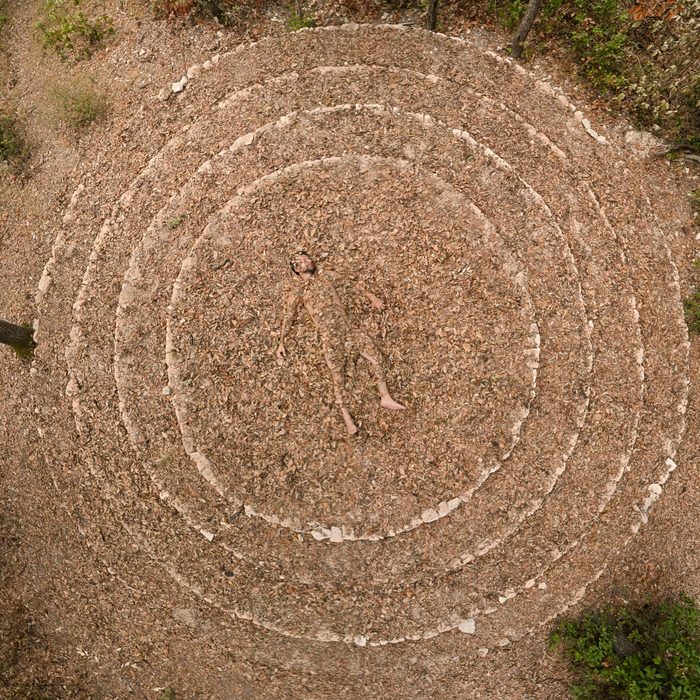
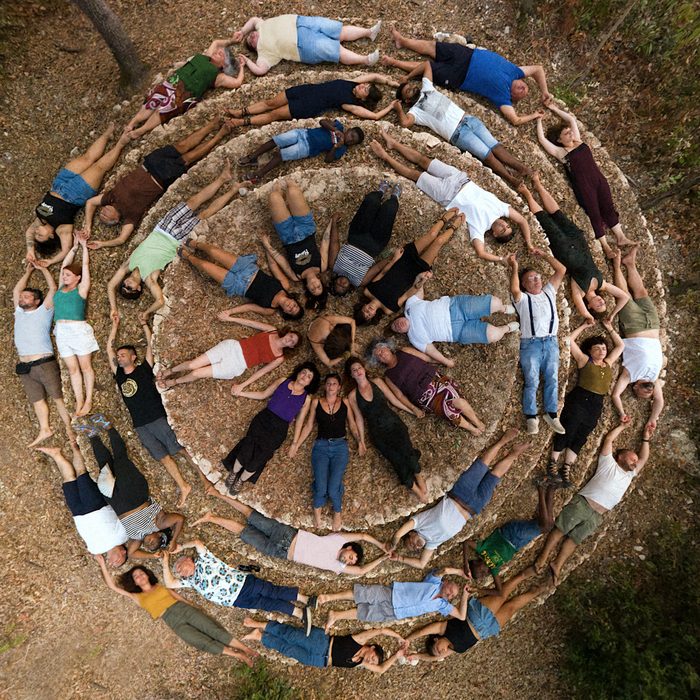
The concentric circle motif is one of the central elements of the project. This circularity may symbolize the constant pursuit of lives that are often overlooked or ignored in the fleeting nature of time. These are stories of different experiences that seem to invite viewers to reject the frenzy of the present and surrender to an awareness of the time and space they inhabit every day. Beyond being merely an aesthetic motif, this circularity asserts itself as an existential stance. A pattern that seems to elude the uniqueness of the line and the causal urgency of the present. Within these concentric circles, different lives brush against one another and recognize each other, in contact with nature, thus weaving a dense and ever-changing web of relationships, in which fears become opportunities for dialogue and empathy, and in which every ending necessarily signifies a new beginning.
Circularity invites us to slow down and reflect on the value of waiting and, indeed, of sharing, in an effort to restore time’s depth and space’s shared dimension. The human body no longer assumes a dominant position in relation to nature and the surrounding forms of life. Furthermore, the relationships depicted in Angiuli’s works seem to reveal the fictitious nature of the uniqueness typically associated with performance. Not a single, unrepeatable moment, but simple, constant, almost instinctive gestures that underscore how it is the act of being together—that is, the very act of daily sharing—that makes the creation of the work possible.
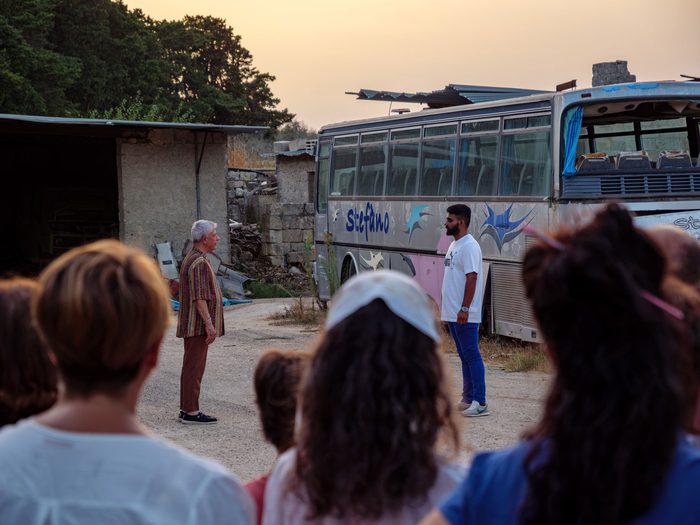
For this reason, Angiuli’s works are above all thresholds to be crossed in order to experience a possible relational, shared, and circular alternative way of inhabiting the contemporary world, collectively rewriting its stringent rules. These are not sensational political gestures, but rather daily exercises in subtraction, designed to avoid being constantly observed, classified, and evaluated on the basis of our own performative efficiency. Therefore, Angiuli’s Fantasmi do not represent something that simply disappears, but rather take the form of wandering beings that persist in continuing to exist, eluding the demand for productivity. They are presences that dwell on the threshold of the visible, forms of life that silently and steadfastly resist the obligation to appear, to produce, and to leave a trace of their passage. That is why talking about ghosts does not necessarily mean referring to the crushing weight of an absence, but rather to the possibility of a different kind of presence, that is opaque, intermittent, and irreducible.