
Dangerously Leaning Out Together
Lavanderia a Vapore’s tendency to design a collective fanta-future
Lavanderia a Vapore is a dance venue and a research centre for contemporary artistic experimentation. It occupies the premises of what was once the former psychiatric hospital in Collegno, on the outskirts of Turin. It is recognised as a Dance Residency Centre by the Ministry of Culture and the Piedmont Region; at the same time, it is a member of the EDN (European Dance Development Network), alongside other European dance centres, and part of the ENCC (European Network of Cultural Centres), within a network of centres committed to local and community development.
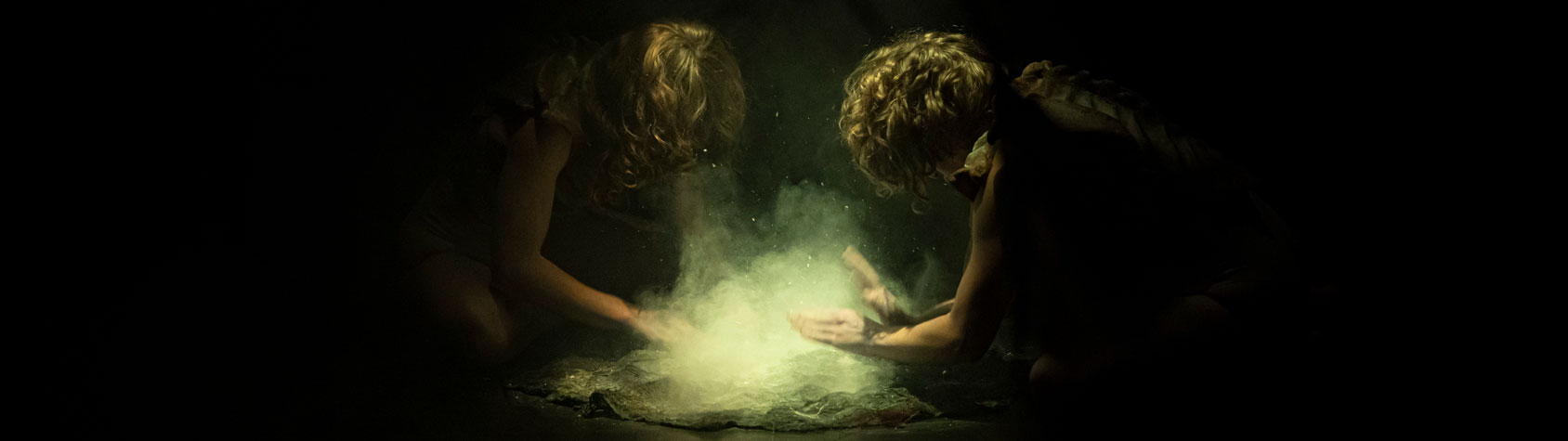
Over the town of Collegno, there is a perpetual bank of fog that, at its thickest point, conceals a red-brick architectural complex almost completely. Neither wind nor heat can fully disperse this curious group of suspended crystals. But if you wait, you can watch the cloud-like mass drifting in and out of the arches’ top windows, always open as to invite the fog to come in and take a look around. Once you’ve found the entrance to the main building, you find yourself inside a vast aisle where patches of light blend with the play of shadows and colors, soft and everywhere. If this is your first visit, someone will surely come to welcome you. They will warn you to be careful how you move, especially beyond the first quarter of the aisle, where visibility worsens, and you must navigate by relying on your hearing. As you venture in, look up and watch the wisps of fog moving inside out and back again. They swim through the sky of the aisle, smoothly flowing down to eye level, and then lower, almost to the ground, where you are now looking at groups of people lying on the floor. Bend down so you don’t trip. The people lying there talk to one another; some are engaged in physical exercises, others dance amidst the misty landscape, which actually no longer resembles the spectral moor of a Gothic novel. Now, the air feels comforting, welcoming. You are served an herbal drink, and as you watch its leaves floating, you feel as if you are in a space that is more liquid than solid. [1] The humidity warms your skin; the air moves lightly between bodies that make it shift and shape various unfinished forms. As you take courage, you learn to crawl comfortably along the ground, aided by various slippery rugs and gentle slopes in the terrain. Once your eyes have adjusted to the haze, you can finally see past the thick air, and finally can notice enormous wooden bleachers and mobile scaffolding rising in the space like the skeleton of a cathedral in the desert, emerging from the mist of a swamp—or perhaps an abandoned theater. Disassembled structures, waiting. From above, the skeletons of two enormous grandstands on wheels, oriented transversely, tower overhead; in front of them, no stages or backdrops, only a few wings moving on slippery surfaces and the modules of a barrel-vaulted ceiling transported by suspended tie rods.
On the upper rows of one of the two grandstands, a group of bodies is deep in conversation. As you watch them, you realize you can almost make out what they’re saying: you perceive an interference, like a radio signal that won’t tune in. You squint, concentrate, and manage to hear the words. But you’re so far away! The sounds are carried to you by travelling droplets of steam. Suddenly, a faint echo: a phrase escapes from the stands and amplifies loudly in the space. You are then called back by your guide: “Be careful with the steam from the Lavanderia! You must practice your gaze before continuing the exploration, or you will surely end up eavesdropping!”
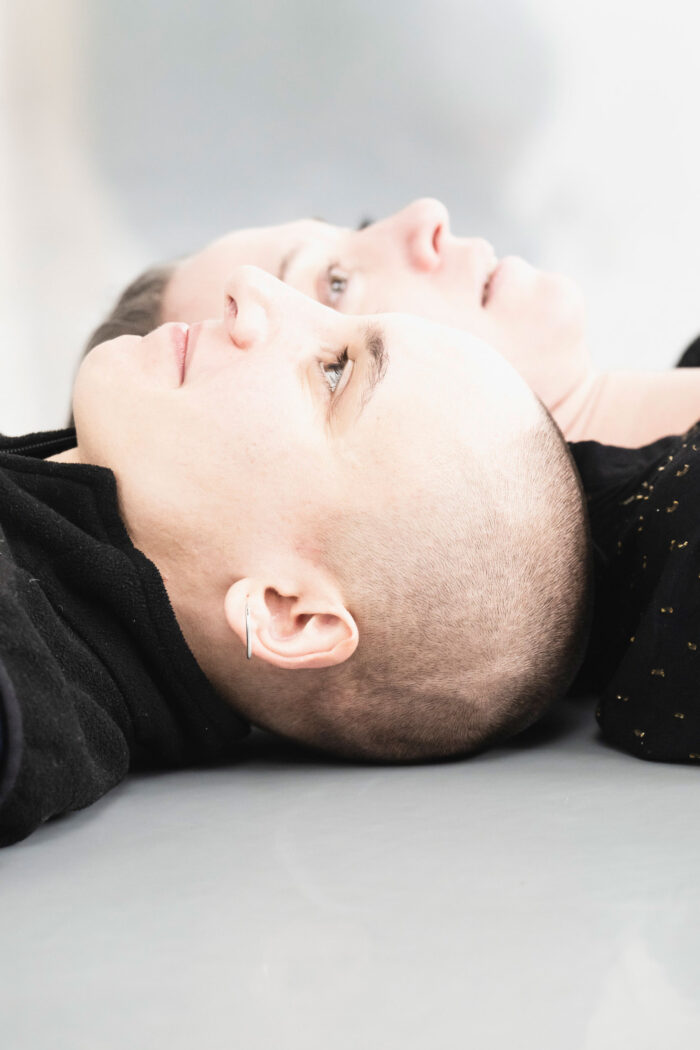
This image is a sort of sketch in becoming, a narrative construction site that, in between the lines, brings the spaces of Lavanderia a Vapore to light, as suggested by the clues left by Chiara Organtini while reflecting aloud on a vision of potentialities. It is situated toward the end of this century and is presented to us as a speculative narrative: a projection of a future that unfolds from elements deemed key, with no certainty on the manner or even on the possibility of their realization. As science fiction writer Elvia Wilk reminds us, straddling fiction and the real world to imagine the future by constructing alternative realities can help us develop a “lateral” vision that, regardless of its actual feasibility, creates a possibility that exists alongside reality itself… [2] If this practice of imagining the future becomes speculative, it can be used both to understand aspects of our present and to operate on a scale that explores the visionary capacity of a society, its cultural system, its politics, and all the institutions involved in structural planning. In this sense, even if the vision of a Lavanderia made of steamy air and people lying on the floor seems relaxed and somewhat dreamlike, it conceals within itself a language of visual and bodily metaphors that its staff and artistic community are building together, year after year.
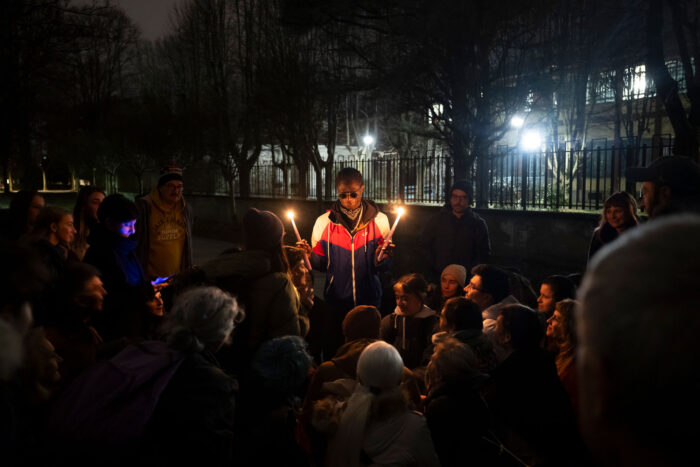
“What will your artist residency look like in fifty years from now?”, Chiara’s image takes shape as she answers the question she drafted in collaboration with the Fitzcarraldo Foundation (an organization dedicated to consulting and advocacy in the cultural sector) during a workshop for artistic residency operators, aimed at stimulating reflection on support for research in the performing arts across Italy. The score involved answering the question,: “What will your residency look like in fifty years?” by creating a postcard that imagined the evolution of various residency programs in the future. The question, however, is meant to be provocative, because it arises in a context where, for residencies, theaters, and cultural centers, imagining what will be done in fifty years is impossible without confronting the chain of structural issues inherent in the contemporary cultural system, including: the precariousness of the grant system, the uncertainty of the public sector, the ongoing struggle for recognition of experimental and multidisciplinary art forms, the scarcity of resources, and the criteria for their distribution. The implicit conclusion that follows is that artistic research is, paradoxically, embedded in a context that in fact limits creative speculation. Under these conditions, projecting oneself fifty years into the future seems a futile, superfluous exercise because it forces us to look ahead when what is actually needed is to remain anchored to the problems of the present we wish to resolve. In fact, however, if one wishes to engage truly in creative thinking, there is no worse vision of the future than one that shortens one’s perspective.
Taking a broader look, the difficulty in developing a constructive vision of the future has long permeated our culture, particularly its production. Collective imagination is increasingly steeped in narratives that reflect on the present by taking its most critical aspects, and unconsciously pushing them to extreme consequences, including intentionally extractive processes. [2] This process unfolds through genres that intertwine reality and fiction, employing drastic temporal leaps and, increasingly often, generating dystopian scenarios. As solar punk writer and essayist Giulia Abbate analyzes, the dystopian science fiction genre has been experiencing a flourishing creative period for more than fifteen years, even within mainstream culture, influencing in turn other branches of fiction with scenarios whose sole common denominator is the desire to depict a version of reality that is increasingly worse than our present. In doing so, it normalizes the feeling of being trapped in a state of unease with no escape route—neither practical nor ideal. How can we transform the inevitable need to create collective imaginaries for the future without drifting into nihilism and destruction? How can we create fiction that generates alternative futures capable of transcending the dystopia of the present?
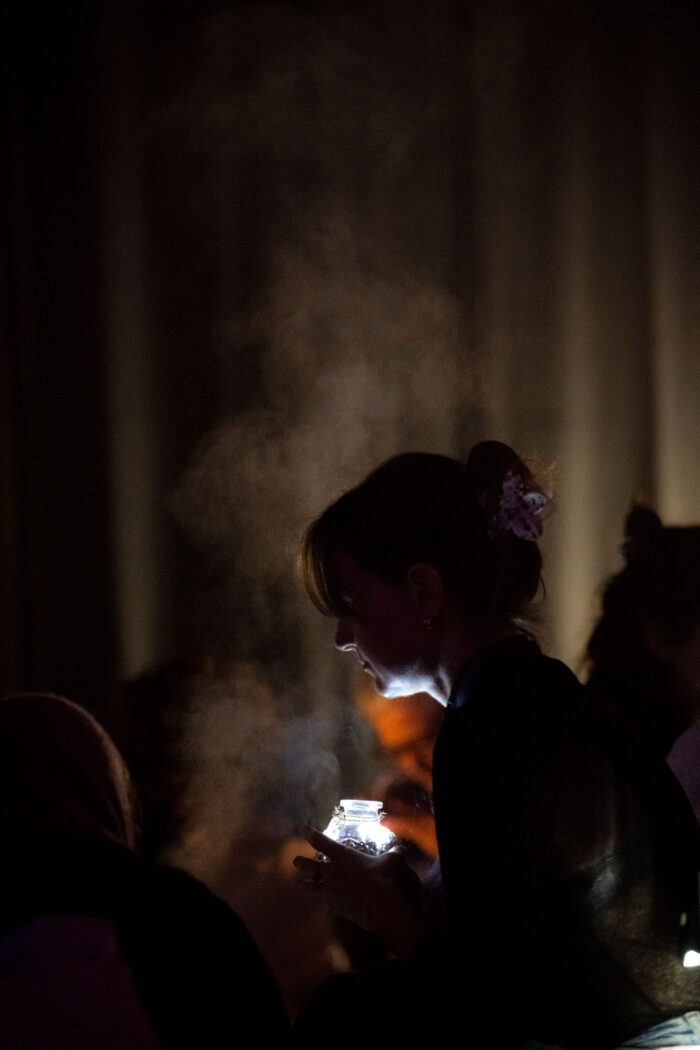
Lavanderia a Vapore operates through a structural framework reminiscent of a constellation: it consists of several highly luminous elements, connected by others that are more subdued and still in the process of formation. The system is organized so that the more established projects generate and help sustain the newly formed ones, thus creating a structure based on interdependent relationships among its parts. From a certain perspective, the projects cluster to form figures which, like asterisms in the sky, make sense when observed as a whole. The main figures are nothing other than the overarching themes of what dance means to Lavanderia: Artistic Language, Transformative Experience, and Rituality.
Within this celestial landscape, some projects function as true organisms that, through their life cycle, produce fuel to sustain Lavanderia. Among these, for example, Workspace Ricerca X is a platform for the development and support of artistic research and dramaturgy that co-curates events dedicated to bringing the artistic community together, including the projects Research Camping and Palestra del Feedback (feedback gym), both oriented toward active research and experimentation.
Research Camping began as a three-day event for sharing in-progress projects through a hybrid format, part festival, part research platform. The format’s goal is to create environments straddling fiction and reality, whose unstable form serves to share artistic research in the public sphere. La Palestra del Feedback, on the other hand, is a training program dedicated to learning methodologies for analyzing and providing feedback on choreographic material, to use them as a constructive tool for empowerment, and dismantle the practice of feedback as a judgmental moment, which is nothing more than an exercise of power by the commentators.
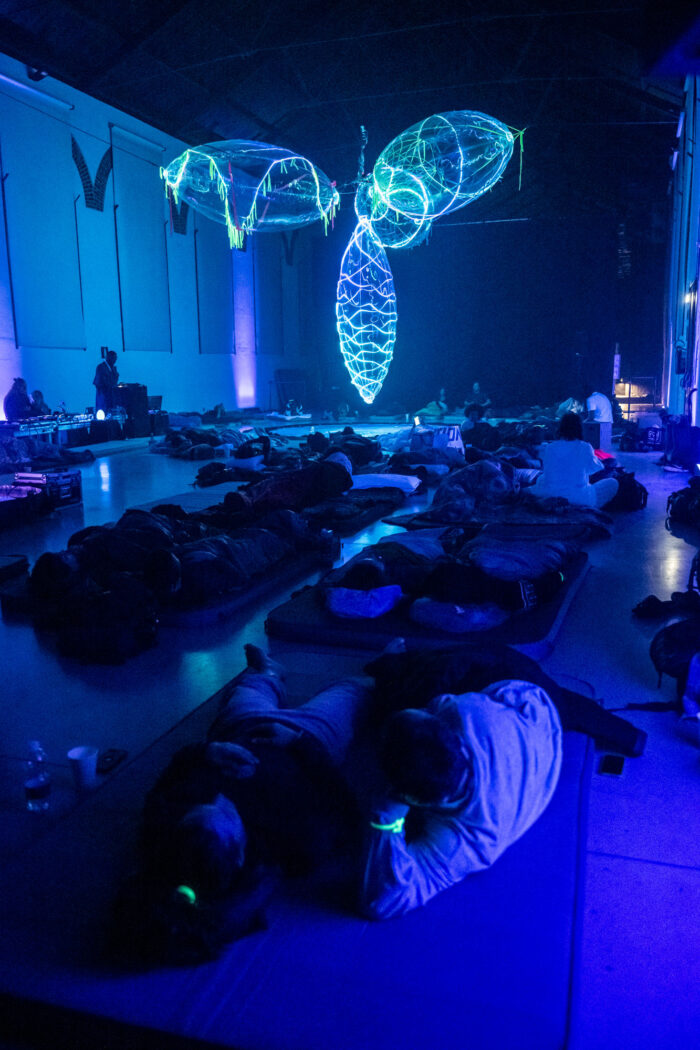
If we imagine Lavanderia as an entity in constant evolution, we can think of artistic research as the energy the body needs to grow. For the body to move and evolve, all processes must be well-oiled and functioning, and there must be continuous communication between the parts. In this case, an approach that tends to be non-hierarchical and horizontal—both in Lavanderia’s organizational structure and in the projects it promotes—nourishes the organism as a whole and facilitates the flow of information. The creation of collective research structures enables the development of methodologies for sharing and processing, which are necessary for creating devices and tools useful for performative practice: for example, Workspace Ricerca X oversees the Palestra del Feedback, which “produces” methodological approaches that can be reused in other projects, such as ARIA, which we will discuss later.
Since 2022—since Chiara Organtini became the project coordinator, Lavanderia has experimented with methodologies oriented toward horizontality and plurality, engaging with the organizational staff as well. The involvement of staff in artistic and research processes brings to the forefront a whole range of roles and skills that the curatorial narrative typically subordinates or excludes from the artistic “product.” In this way, a form of research takes shape, one that conceives of art as collective work, meant for the community. Furthermore, when the Lavanderia team is called upon to actively participate and carry out its functions within horizontally shared projects, it fosters a cross-cutting perspective and an exchange of complementary approaches. This highlights the importance of focusing on relationships—not only between artists or between the artists and public, but also within institutions—while also rethinking what an institution is. This process takes shape in the 2025–2026 program under the deliberately chosen title Sistema degli Affetti.
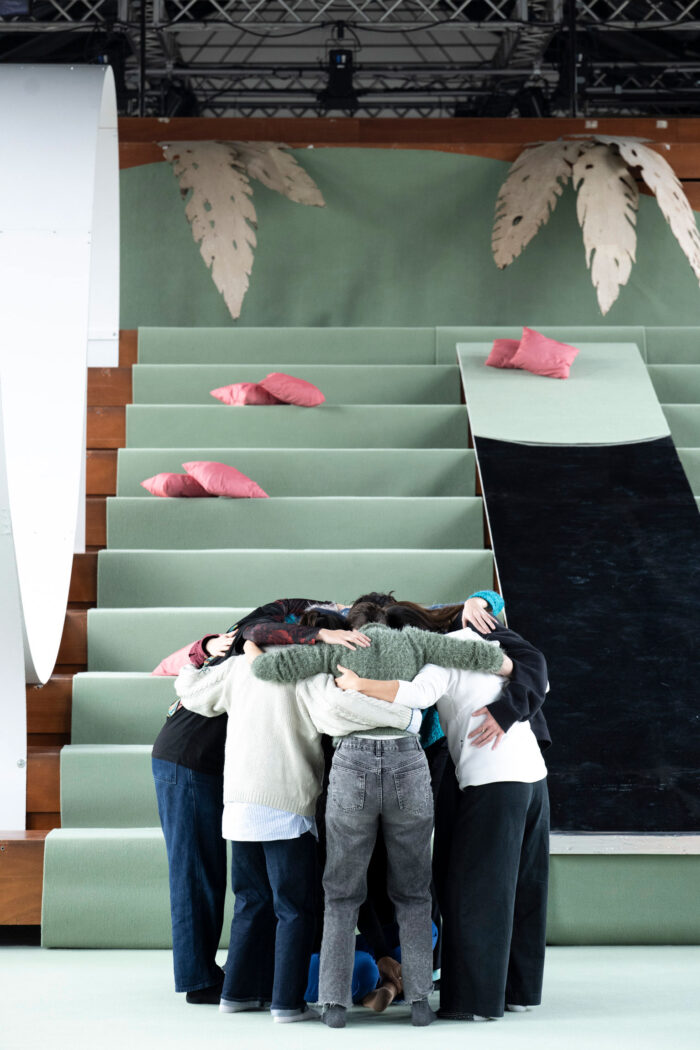
With the 2025 edition of Research Camping, Sliding Bodies, the foyer of Lavanderia opens to the public with real big slides that cut across the central aisle. Sliding Bodies, in fact, embodies a research project that “explores sliding as a posture and relational dynamic, as the anatomy of interdependence, thematically articulating the inclination toward what is other, unfamiliar, the circularity of sharing, and failure—the ultimate slip—as privileged powers to symbolically rewrite a new world that draws from the old, from the roots of togetherness, and ancient economies.” Inclination, here, is viewed both in its most conceptual sense and in its most purely physical one: it is both a mental reaching out toward something—the other—and a physical leaning toward another body. From a theoretical standpoint, inclination is a posture that propels us outside the self: the necessity of inclining the subject is dictated by the need to draw near to the other, both physically and ideally, to push oneself into a relational model aimed at rethinking subjectivity as exposed, vulnerable, and dependent—in stark contrast to an idea of a “self” that is upright, alone, self-sufficient, dominant, deadly, and overbearing. This movement is an attempt to dismantle the idea of an autonomous and closed subject, in order to affirm an open and relational subjectivity that conceives of relationship as the origin and constitutive element of the human, and of being vulnerable creatures who, when standing on the edge, let themselves go, lean in, and surrender themselves onto one another. The inherent intent in adopting this mental posture is also to avoid the risk to reduce the other to something inessential and formless, recognizing them both in their corporeality and in their otherness, through a movement that draws us toward a possible encounter.
The image emerging from the first section of this text is grounded in a shifting atmosphere composed of water, heat, and movement: the fog—or steam—that is set in motion and sets others in motion, transforming and revitalizing the bodies gathered together in the space. ARIA (air) is this atmosphere is materialized within the Sistema degli Affetti as an unprecedented collective residency project, [3] conceived to occupy the “low visibility” zone of Lavanderia’s project: a series of meetings dedicated to rethinking the structures and functions of the artist residency itself, in line with Lavanderia’s desire to create autonomous and conscious communities. ARIA is a hybrid creative group formed partly of artists selected through an open call and partly of individuals chosen from associated artists, members of the internal curatorial team, and members of the organizational team. [4] The group is supported by fundings and co-manages the curatorial, artistic, and organizational aspects of the residency, including the ever-evolving schedule, in which time is spread over an immersive seven-day block. ARIA is one of those projects that involves the staff in all activities, whether they be performances, brainstorming sessions, or games—on the floor, on cushions, in the park, in the pool, and in all the places and ways the residency traverses: there is no desk anywhere, in a sort of parallel reality where those inhabiting the middle ground between artistic, managerial, and organizational departments are an integral part of the project.
ARIA is a collective research group that brings together multidisciplinary practices and experiences, proposed and guided by the participants. It embraces and weaves together physical and movement practices, sensory and recreational experiences, exercises, meditations, moments of idleness, and free moments of reflection. It operates within the performative sphere, prioritizing transdisciplinarity, active participation, and an attitude of remaining within the processes, in research that does not aim to become accessible. Despite its packed schedule, ARIA is among those collective, self-managed systems interested in rethinking, rewriting, and overturning the “doing” rather than the final content: the focus is on shifting attention directly to “why” the group—the residency—needs to come together.
At ARIA, they rely on the potential of languages to translate—both verbally and bodily: from word to sign, from movement to image, all possible combinations. In a single moment, different languages and forms of expression may converge, following the participants’ backgrounds or sensory (dis)abilities: a question asked aloud may be answered with a tactile gesture, while a sign in the air may be translated into words—Italian, English, Japanese, or other geographical and cultural expressions. While language and expression serve a reflective and expressive purpose, their intersection within these practices generates allegories and associations that the group uses to find, launch, and lose itself, to venture out, to fall together, heedless of what comes next. If we’re lucky, the result might be an X-FILE—that is, an alien, unidentified object for which there are no words yet. [5]
Of the half-day we spent at ARIA, what got really stuck with us was the story about the cutting board metaphor. In 2025, the Circolo di Collegno (a people’s club) organized a culinary program that facilitated the exchange of recipes and traditions between the women of the local synthy community and the madames of Collegno. As part of its ongoing collective activities, ARIA decided to join the club for one of its shared cooking mornings. Apple pie was on the menu. The ARIA group arrived like a blob in transformation and completely off the map, which, without a clear mission, attempted to engage with this non-group, happily disunited in terms of geographical origin, ethnicity, and class. By chance, or due to inadequate material resources, the available cutting boards were not large enough to accommodate all those hands, forcing everyone to do things differently. So they ended up sharing the work tools, cutting boards included, which were then used to eat the left over apple scraps together. The cutting board thus became a means of drawing closer to others, a small, protected, and sensitive space that facilitates an improvised, spontaneous connection. ARIA is not a territorial mediation project and does not require legitimization through dialogue with local actors, but this experience of the cutting board gained value as a situation that was one of a kind: an X-File made of unusual proximities, knives, apples, and cinnamon.
The language we use to describe, narrate, and understand reality shapes its image—not only of the present, but also our memory of the past and our vision of the future. Amid the mists of Lavanderia, indefinable forms have slowly taken shape—situations that not only defy classification within conventional artistic disciplines or forms, but that must remain nebulous to fully develop. Precisely, the X-Files. B, [6] one of the artists participating in ARIA, argues that the X-Files do not exist to be called by name, and consequently, it is also pointless to try to define them in words. Over the past year, B has been studying to become a gardener and explains the metaphor of the vocabulary-herbarium: when we are in a meadow and take our time, we see many different plant species around us. Some we know, others we don’t, yet the plants whose names we don’t know exist regardless. “The point is to step outside this system that requires naming for things to exist,” says B. “Stepping outside” as a movement to lean forward, to look beyond the horizon, the glass, the screen. Or even, as a posture that leads us to step aside, leaning and moving slightly outside of ourselves, of the self. “I”: “a straight line, a simple rod, a strip, or, better yet, a bar lying on the horizontal surface of the page”—this is how writer Adriana Cavarero imagines the pronoun “I” rising three-dimensionally above the text, dominating it, casting a shadow like a tree, with a desert all around. But what is leaning if not the first move toward falling? It is being suspended, like a body in balance, experiencing the fragile moment before the crash. It is preceding a leap into the void, when one still does not know whether one will plunge or not: a fall of falling together, a filling, together, within the problem. A shared practice of lying down, on the floor of Lavanderia perhaps, conversing through the sounds and vibrations carried by the molecules of steam.
[1] Archivio Liquido is a project by Kadri Sirel and Eugenia Coscarella who, beside managing the documentation and digital archive of Lavanderia a Vapore, have developed an evolving archive whose contributions consist of sensory objects produced during Lavanderia’s public openings.
[2] Giulia Abbate, “Macerie”, in Leggendaria n.159 (2023).
[3] A collective residency is a residency in which the artistic groups and various professionals involved share a common project, or develop a shared process that focuses on collective approaches.
[4] The ARIA project features the artists Anna Basti, Adriana Borriello, B Bordoni, Francesca Cinalli and Christopher Serebour, alongside Caterina Mocciola and Flavia Zaganelli, with contributions from the artist Jija Sohn and the associate artists Doriana Crema and Salvo Lombardo; the staff of Lavanderia a Vapore: Chiara Organtini, Anna Estdahl, Angela Giorgi, Kadri Sirel, Carlotta Pedrazzoli, Eugenia Coscarella, Edoardo Urso, with the participation of Alessandra Valsecchi (Fondazione Piemonte dal Vivo).
[5] The term “X File” and its presumed meanings are concepts developed by the ARIA group. It refers to moments and situations which, when identified, reveal an intersection of practices, subjects, content, theories, dialogues, bodies and other elements, creating contexts that cannot be identified within anything we already know. A unique situation in which spaces, times, and intervening actors give rise to interactions that have greater value than the elements themselves, when taken in their singularity.
[6] B Bordoni, a performer and artist specialising in socially engaged practices, has collaborated with Lavanderia a Vapore on several occasions, including the conception, curation and facilitation of the series of events MIND WANDERERS | Practices of Collective Escape (2024).