
Before it Disappears
Imagining Worlds on a Sinking Island
Those portions of solid land we call islands have traversed human culture for millennia as both physical and symbolic sites. Their form is intrinsically ambiguous, at once separate and delimited, apparently isolated yet profoundly dependent on what surrounds them: the sea, currents, routes and flows. Precisely because of this constitutive tension between enclosure and connection, the island has established itself as one of the most persistent imaginative devices in the geographic landscape: a space onto which collective desires and fears are projected as well as a laboratory for possible worlds or a stage for stories of shipwrecks and salvation.
In its utopian dimension, the island is a place outside of time, a refuge for imagination and the promise of an “elsewhere”: from Neverland in Peter Pan to Thomas More’s Utopia, geographic isolation coincides with the possibility of suspending the rules of the outside world. In other cases, it becomes a true narrative machine, capable of concentrating myth, science, faith and misaligned temporalities, as in the island of the TV series Lost (2004). Elsewhere still, these places turn into sites of memory and return: Ulysses’ Ithaca as a point of gravitational meaning, or Lampedusa as a geopolitical threshold where hope and oppression dramatically coexist.
In an almost opposite sense, the island is also a space of entertainment and consumption: from the private shores of luxury tourism to the spectacularization of survival in reality TV formats like Survivors, where isolation becomes a competitive performance through trials and means of selection. Across all these declinations, the island stages the same contradiction: it promises separation and appears to offer an escape from the rest of the world, yet at the same time it becomes a conglomerate of relationships that intensifies exposure to the lives of those who moor there.
These strips of land are also suspended figures, fragments removed from historical linearity, in which the past resurfaces and the future is tested in advance. They are images that make it possible to think through rupture, discontinuity, and the possibility of other worlds without ever severing the bond with reality. For this reason, the island is never merely a place, but a spatial cognitive device from which to observe the world while holding it at a distance, knowing, however, that this distance is never neutral nor innocent.
It is within this symbolic and political tradition that today the island takes on an additional burden: the fear of submersion. In the age of ecological crisis and image saturation, the island is what emerges just as much as it is what is threatened to sink and return in the form of a ruin, conglomerate of archeological data or a digital simulation. An unstable image, reflecting the instability of our relationship with our endlessly imagined, endlessly deferred future, as it sinks before our eyes.
With the project The Island, Hito Steyerl takes up this geographic figure not just as a simple metaphor, but as a critical image: a figure both submerged and emerging in which past and future collapse, a place where the separation from the outside calls for an intensified responsibility towards the real. It is partly from this condition of apparent isolation that the exhibition takes shape, questioning the fate of images, technologies and worlds that we continue to imagine even as they disappear.
The site-specific exhibition, curated by Niccolò Gravina and presented in the spaces of the Osservatorio of Fondazione Prada in Milan will be open until October 30, 2026, brings together Hito Steyerl’s latest movie project, titled The Island, alongside a series of installations distributed across the two levels of the exhibition space.
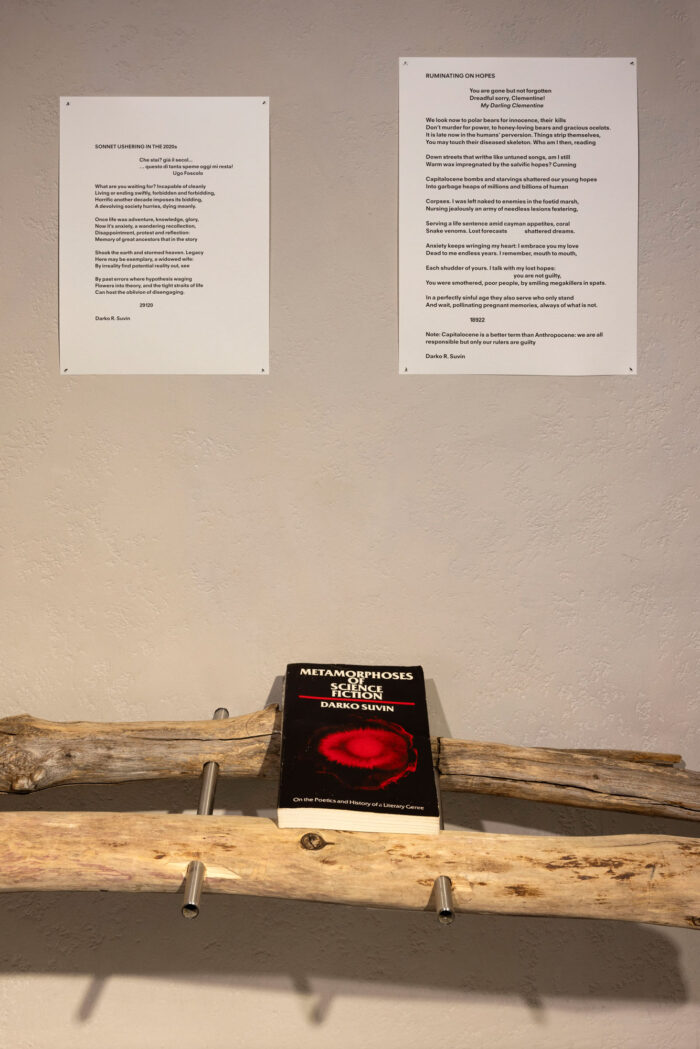
An artist, theorist, and documentarian, Steyerl (Munich, 1966) is one of the most prominent figures in research around contemporary visual culture and its entanglement with media, technologies and power. Her work spans movies, installations, writing, and lecture-performances, constantly moving between critical analysis and narrative construction. At the center of her practice are the material and political conditions of images in the digital age: from their accelerated circulation and the consequent loss of definition to the weaponization of the images within military infrastructure, surveillance systems, technological platforms and forms of algorithmic governance. In The Island, this trajectory reaches a state of extreme condensation, to the point that Steyerl herself has stated that she will be taking a break—at least for some time—from making other projects according to this mode, given the scope of its stratified layers and references.
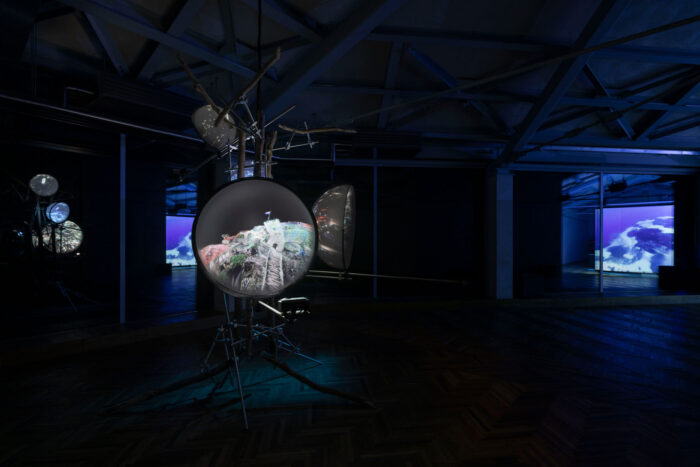
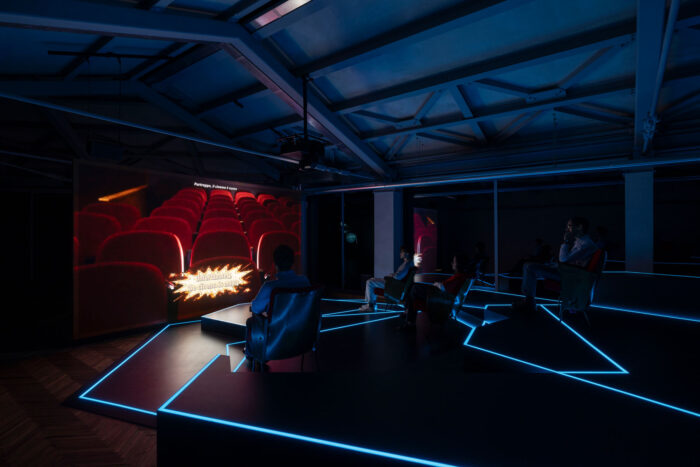
More than a simple exhibition, the work tries to create a cognitive environment—a device for thought—in which images, narrative, theory, and heterogeneous imaginaries resonate with one another, without ever recomposing into a pacified synthesis. Entry into the spaces of the Osservatorio takes place in a condition of near-total darkness, producing an immediate sense of perceptual disorientation. The only true guiding lights come from the video installations and a series of blue-cyan neon lights that trace a path embedded in the floor, an explicit reference to a cyber-futuristic aesthetic that transforms the space into an environment suspended between the—barely visible—real architecture and a digital scenario straight out of a sci-fi movie. This pathway already starts the narration, compelling both gaze and body to follow a trajectory, introducing another, artificial temporality.
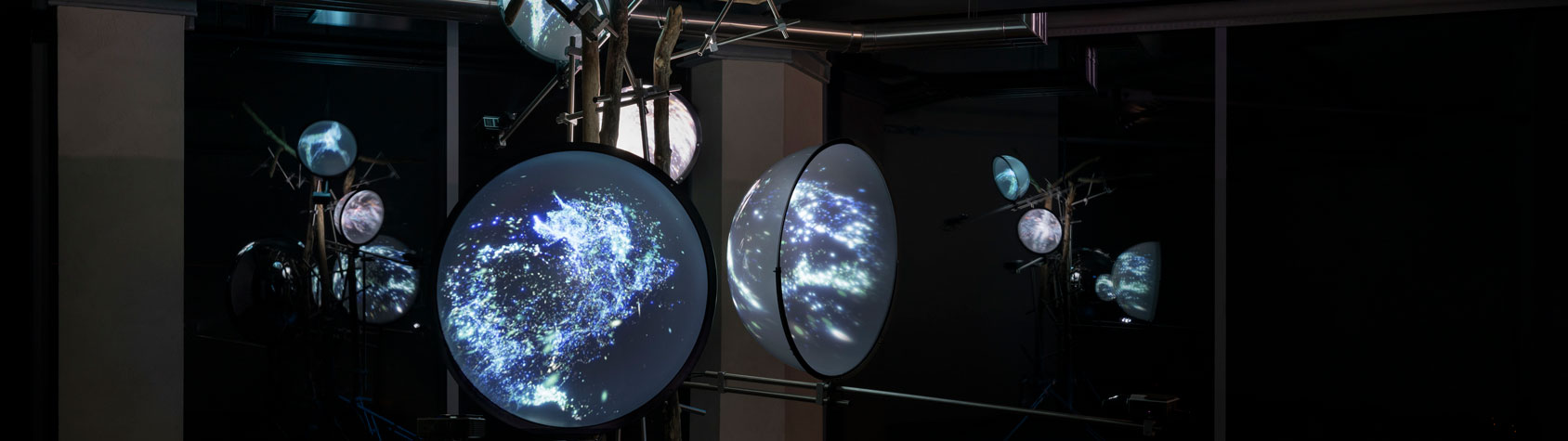
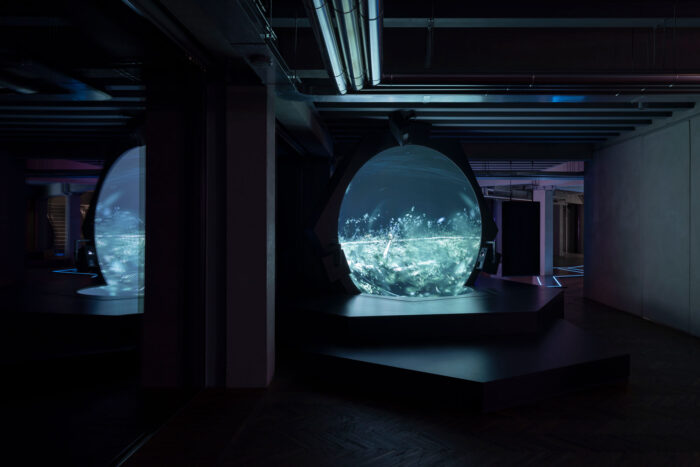
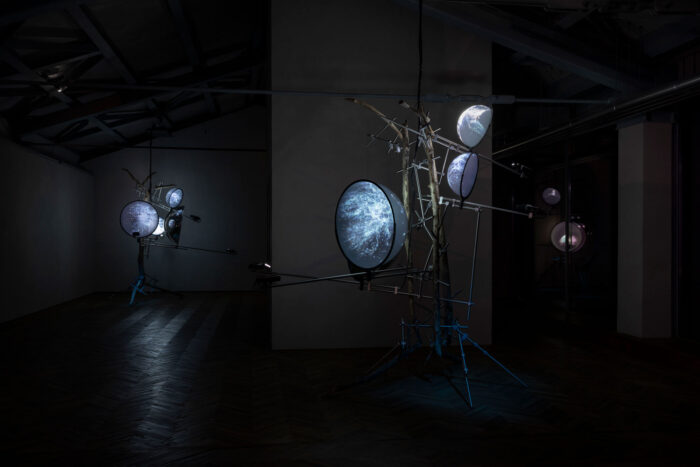
The first apparition is a large technological yet sculptural installation: a luminous sphere containing what appears to be a digital rendering of a heptagon-shaped archeological site submerged in waters inhabited by bioluminescent plankton. The quality of the image appears intentionally rough, almost glitched, with a polygonal rendering that betrays its artificial nature. Only upon closer approach does one realize that the sphere is not such, but a rather convex surface that produces an optical illusion of three-dimensionality. The simulated space, seemingly deep and traversable, thus reveals itself as an unstable projection, a volume that exists solely as a perceptual effect. The heptagon-shaped geometry simultaneously refers to the outline of the submerged island as much as it evokes the molecular structure and natural architecture of the light-emitting molecule called “luciferin” that makes the nocturnal bioluminescence of plankton possible. The heptagon also functions as a symbol, a visual and conceptual matrix capable of holding together all of the different research fields that make-up the project: archaeology, molecular biology, post-apocalyptic imaginaries, and contemporary image technologies, reinforcing the idea of a form of knowledge that emerges only through interconnection, never through isolated compartments.
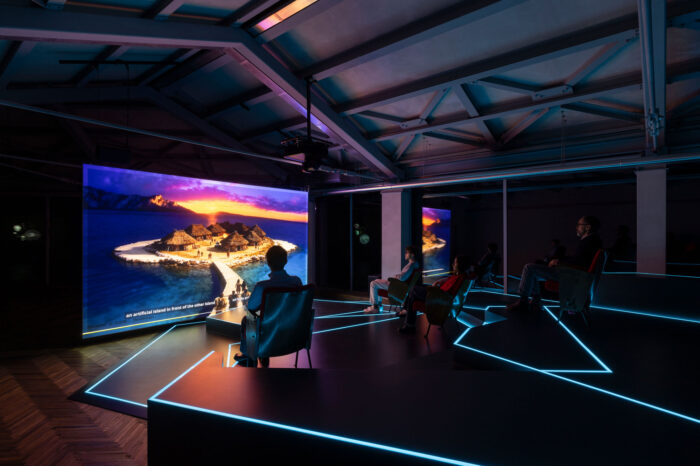
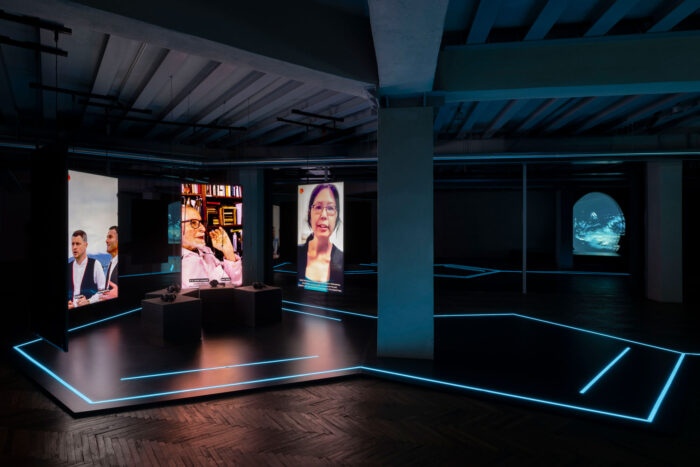
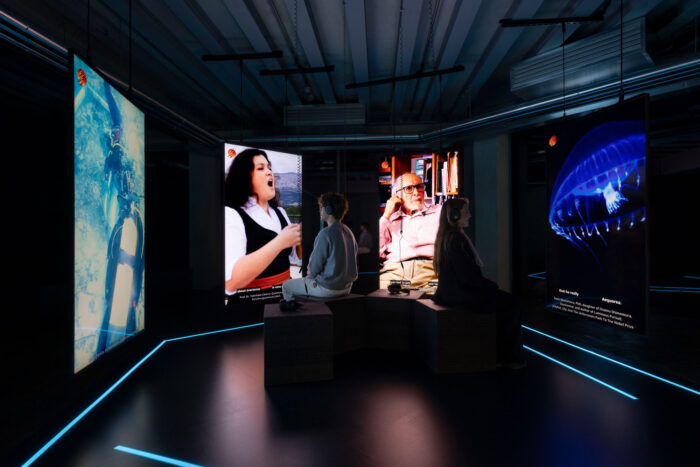
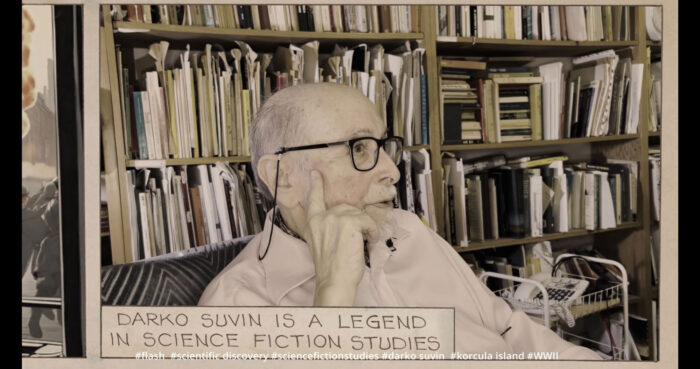
Following the luminous lines on the floor, the path leads to a slightly raised platform above which four vertical screens hang. Their format explicitly recalls smartphone videos, evoking the interface and modes of consumption of platforms such as TikTok. Each screen plays a different video: The Artificial Island about the recent discovery in Dalmazia of an artificial island dating back to the Neolithic period by the archeologist Mate Patriarca of the University of Zara; Fireflies focused on the discovery of the organic molecule of the bioluminescent plankton, an organism used as a detector of wave motion, known as Green Fluorescent Protein (GFP), studied by Japanese scientist and nobel prize winner Osamu Shomimura; The Birth of Science Fiction explores the foundational work and legacy of the literary critic and academic Darko R. Suvin that has addressed this genre from a political and philosophical standpoint; Flash! retells the fantasies and intuitions of a young Suvin that learned to escape reality and traumatic events through fiction as means of “cognitive estrangement”. These are not ancillary fragments, but true thematic nuclei that function as a preparatory device for the main work, offering the viewer a kind of perceptual and cognitive training to the layers and approaches that come into play in the main piece of the project.
This being the movie titled The Island, that we encounter once ascending to the upper floor. It is presented in an environment that deliberately recalls the movie theater in which Suvin first watched Flash Gordon’s Trip to Mars (1938). After the initial disorientation of the lower floor, this configuration introduces an apparent stability, a return to a humanly familiar posture of viewing. At the core of this work lies the heterogeneous constellation that brings together Suvin’s biography, the occupation of Dalmatia by Fascist Italy, organic chemistry, quantum physics, the recent archaeological discovery of the artificial Neolithic-era island submerged off the coast of Korčula, alongside the serial science fiction of Flash Gordon and the explicit use of images generated with generative artificial intelligence. The emotional and narrative register continually oscillates between serious and ironic, realism and surreal, rejecting any stable hierarchy.
In September 1941, Suvin—then 11 years old—was riding a tram in Nazi-occupied Zagreb when an attack detonated a bomb at the central post office. In that instant, his mind fled to Mars, taking refuge in the imaginary of his favourite science fiction world. Upon returning to reality, he was illuminated by the possibility of imagining other realities through the means of the fantastic, and everything appeared to be radically changed to him. This experience resonates with quantum mechanics, which studies sudden state changes and the simultaneous coexistence of different conditions, opening onto the hypothesis of multiverses. Steyerl adopts this paradigm as both a poetic and a political key by using science fiction as the true binding agent of The Island, a cognitive tool capable of holding together fact and fiction, objective reality and personal imagination. The movie constantly works through a productive fracture between real and imaginary, never resolving it, but rather exposing it as a structural condition of the present. The continuous temporal jumps—between prehistory, the twentieth century, the present and possible futures or alternative realities—also point to the idea of technocapitalism’s “junk time”: an altered, disarticulated temporality made of accelerated and discontinuous cycles that ultimately exhaust perception and experience.
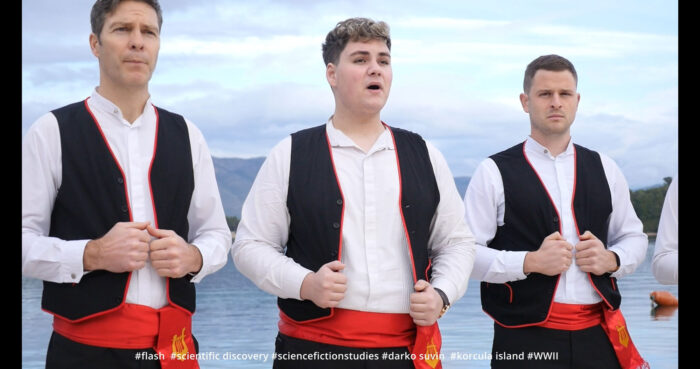
Within the intertwining of fields of knowledge, levels of reality, and human and nonhuman entities—science fiction, archaeology, personal narrative, artificial intelligence, history, folk tradition, and comedy—that coexist as interdependent layers, a special place is dedicated to the traditional choral singing (known as Klapa) that runs through the filmic narrative and takes on a decisive function: it allows for an experience of what quantum physicist Tommaso Calarco defines as “higher harmonics”—that is, emergent relational configurations capable of imagining more just and interconnected worlds, in opposition to the logic of fragmentation that characterizes the contemporary reality. Examples of this fracture can be found on social media platforms such as TikTok, where even incompatible worlds coexist without ever truly meeting.
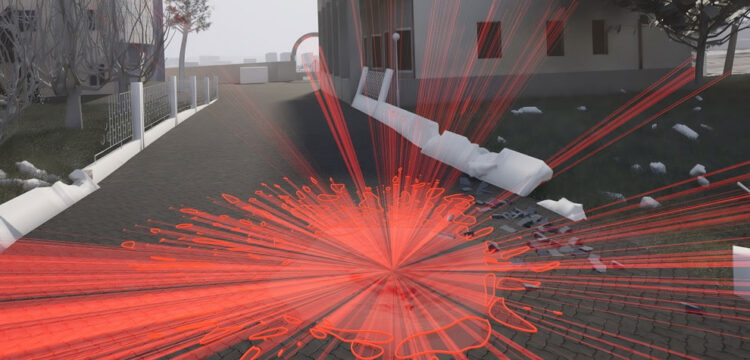
In Steyerl’s movie different worlds truly converge. The discovery of the submerged site off the coast of Korčula by archaeologist Mate Parica—made possible through the use of satellite imagery and drones—is an event that reverberates throughout the work as a true “image from the future”. It does so not only because it brings a remote past back to light, but because it anticipates a plausible scenario in which submersion becomes the fate of many cities and human settlements. The idea and imagery of submersion here takes on a double valence, both literal and symbolic. Archeological images are overlaid with AI-generated sequences depicting floods and inundated landscapes, evoking visual ecosystems saturated and compromised by what is often described as “AI slop”: an uncontrolled proliferation of synthetic images that is actively clogging and polluting contemporary visual culture. Watching this temporal short circuit unfold in the movie, the famous question posed by the Man from Another Place, from David Lynch’s Twin Peaks, implicitly riverberates: “Is it future or is it past?”. The archaeological discovery, filtered through advanced technologies and reworked by artistic fiction, opens up the impossible interrogation on what has been and what has yet to come.
A further layer is introduced through the figure of the Japanese chemist Osamu Shimomura, awarded the Nobel Prize for identifying and isolating green fluorescent protein (GFP) from the bioluminescence of jellyfish. His discovery had decisive consequences for biology and medicine, where GFP is used as a visual marker in cellular processes. Yet the reference is not only scientific: Shimomura grew up in Nagasaki and survived the atomic bomb, carrying within his biography the same tension between destruction and knowledge that runs through Steyerl’s entire project. The sea, the island, and the underwater landscape thus become sites of memory, trauma, and transformation.
The exhibition also addresses contemporary forms of technological authoritarianism, highlighting the role of artificial intelligence within propaganda apparatuses. It is difficult not to think of the images generated and circulated by Donald Trump on social media—such as those portraying him as an intergalactic emperor in a Warhammer 40,000 style—in which AI contributes to the production of a mythological imaginary of power, as grotesque as it is effective. To take science fiction seriously therefore means, as Suvin argues, recognizing its cognitive value prior even to its aesthetic one. Although it is among the most widespread genres of so-called “para-literature,” science fiction is sociologically crucial precisely because it is extremely pervasive and influential, sometimes no less significant than the “high literature” of the same genre. Transposing this discourse into the visual field raises important questions: is it possible to apply a line of reasoning analogous to Suvin’s on science-fiction literature to images produced by generative AI? What is the cognitive value of so-called AI slop? Why are these images so effective in spreading—through their symbolic force—and capable of orienting the collective imagination even when they appear weak or stereotyped?
Critically interrogating AI ultimately brings to light a symbolic and historical correlation with nuclear energy: both are technologies charged with a sense of urgency, irreversibility, and inevitability, and both demand a strong sense of historical responsibility. Drawing on Danish theoretical physicist Niels Bohr’s concept of “complementarity”, Steyerl poses a radical question: if the atomic bomb emerged from the tension between the destruction and the salvation of the world, what are we seeking to resolve—or to sacrifice—today through AI?
The movie’s final sequence is emblematic. The traditional music choir concludes its performance, yet the shot does not cut immediately. For a few seconds the singers remain motionless, suspended within an ambiguous temporality, neither fully inside the fiction nor yet returned to the real. One of the singers, on the right, steps forward—as if to exit the scene—only to withdraw slightly, realigning himself with the group. Only then does the video end. It is a moment of fracture, in which the narrative reveals its own edge, its own off-screen space. In the face of an ecological crisis already underway—an apocalypse that is not future but present—artificial intelligence emerges as an ambivalent technology: a possible instrument of salvation or the final scapegoat. Yet The Island seems to suggest that the only true agents of salvation remain ourselves. For this reason, it is necessary to escape paralyzing apocalyptic narratives and return to imagining alternative worlds. Perhaps we must do as that singer does: acknowledge the end of the fiction and, despite uncertainty, choose to step forward toward the real. As the voice of Tommaso Calarco’s AI alter ego states in one of the central sequences: “Destroy the image and you will break the system.”