
Art Is Not Neutral.
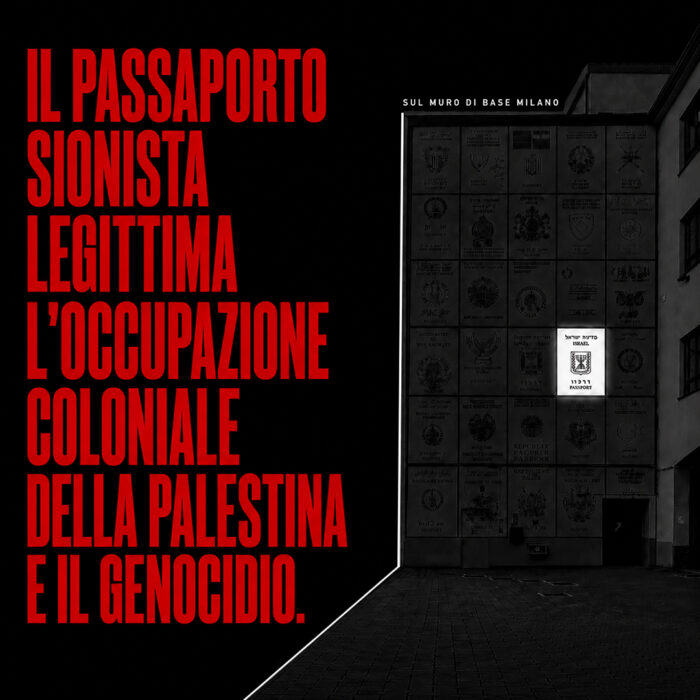
THE ZIONIST PASSPORT ON THE WALL OF BASE MILANO LEGITIMIZES THE COLONIAL OCCUPATION OF PALESTINE AND THE GENOCIDE OF ITS PEOPLE
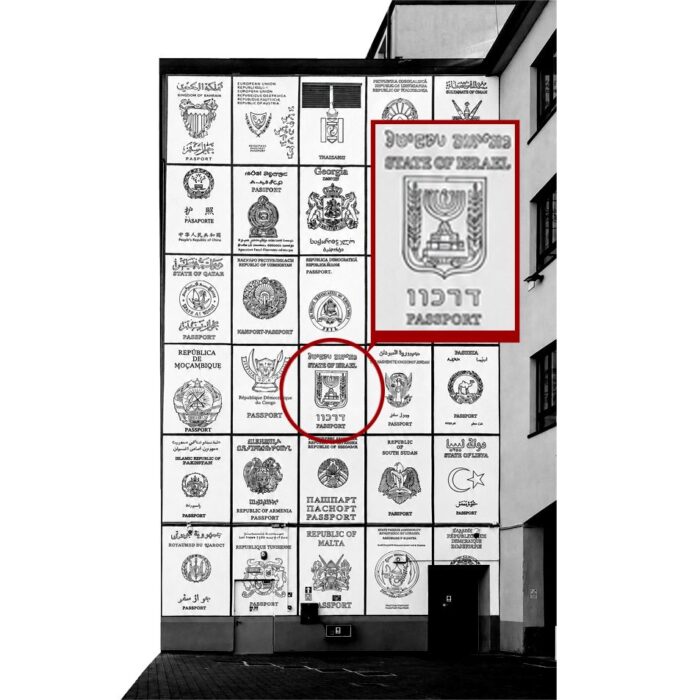
On Monday 15th of June, Galassia Antisionista, an art and culture workers assembly, together with Giovani Palestinesi Milano, Archive, AWI – Art Workers Italia, Serpica Naro, spazioSERRA and many independent cultural workers, have sent an open letter to MUDEC —the Museum of Cultures in Milan, BASE Milano, and artist Flavio Favelli, to highlight the problematic nature of the work titled “I Trenta,” commissioned to Favelli by MUDEC and currently displayed on the exterior wall of BASE Milano. The work depicts a sequence of thirty passports from various countries around the world: the Israeli passport is placed at the center of the mural. “We wonder what the cultural, political, and ethical significance is of displaying the Israeli passport without any critical analysis, without any contextualization, and without any public stance from the institutions that promoted and supported its creation. We are asking the institutions for a response to our letter and for a public stance in preparation for a formal complaint,” the letter says.The artists and cultural workers are calling on institutions to respond to the letter and issue a public statement, and they are willing to work toward replacing the artwork and radically re-examining it, so that the cultural space can rise to the challenge of the historical context we are currently experiencing.
PUBLIC LETTER
To the attention of Marina Pugliese, Director of MUDEC – Museum of Cultures of Milan; Giulia Cugnasca and Nicolò Bini on behalf of the Board of Directors of BASE Milano; and Flavio Favelli, author of the artwork.
We are living through a historical moment in which millions of people around the world are witnessing, in real time, the systematic destruction of Palestine, Lebanon, Iran, and their peoples.
For months, the International Court of Justice, within the proceedings initiated by South Africa; the United Nations Independent International Commission of Inquiry; numerous UN experts; and international human rights organizations including Amnesty International, Human Rights Watch, B’Tselem, the Lemkin Institute for Genocide Prevention, and Genocide Watch have denounced grave violations of international law and recognized either the serious risk or the actual commission of genocidal acts against the Palestinian population in Gaza and the Occupied Palestinian Territories. The International Criminal Court has issued arrest warrants against senior Israeli political leaders for war crimes and crimes against humanity.We believe it is impossible to treat as neutral symbols representing a state responsible for apartheid, colonial occupation, ethnic cleansing, and genocide.
The artwork I Trenta (“The Thirty”), commissioned from artist Flavio Favelli by MUDEC – Museum of Cultures of Milan and produced in collaboration with BASE Milano, currently displayed on the exterior wall of BASE Milano, depicts a sequence of thirty passports from different countries around the world.At the center of the mural is the Israeli passport.
The Palestinian diaspora community and numerous assemblies and organizations in solidarity with the struggle for the liberation of Palestine have repeatedly expressed their opposition and outrage regarding this operation. Every cultural institution must reflect on the meaning assumed by the images and symbols it chooses to display in public space. No artwork is immutable in relation to the historical context in which it is viewed.
Cultural institutions are not merely custodians of objects or images: through their choices they contribute to shaping meanings, memories, and collective imaginaries.
We therefore ask what cultural, political, and ethical meaning there is in representing the Israeli passport without any critical framework, without any contextualization, and without any public position being taken by the institutions that promoted and supported its realization.
Displaying this passport reveals a choice by the artist Flavio Favelli, MUDEC, and BASE to evade political and civic responsibility in recognizing the occupation of Palestinian territories, the colonial violence exercised by the State of Israel, and the struggles for the liberation of Palestine.
We also ask whether MUDEC and BASE are aware of the reputational damage that this choice risks producing.
How can institutions that claim to promote critical, inclusive, decolonial practices and to engage with the transformations of the present continue to display, without contextualization, the state symbol of a government accused by numerous international organizations of genocide, apartheid, and ethnic cleansing?
What message are artists, researchers, cultural workers, and members of the Palestinian community who move through these spaces receiving today?
What message is received by communities directly affected by this violence when they see the symbol of a state currently under proceedings before the highest international courts presented as neutral?
Is this the public image that MUDEC and BASE intend to project before the city of Milan and the international cultural community?
At a historical moment in which millions of people around the world are denouncing the genocide of the Palestinian people, the colonial occupation, and the apartheid system imposed by the State of Israel, continuing to display the Israeli passport means assuming public responsibility for this normalization.
The silence and neutrality of cultural institutions are not innocent positions.
The decision not to take a stance also produces political, ethical, and cultural consequences.As an anti-Zionist assembly of art and cultural workers, we call for an immediate public statement from MUDEC and BASE regarding the meaning of this choice, and we publicly ask:
– Do you believe that the Israeli passport can be presented as a neutral symbol?
– Do you believe that neutrality is a sustainable position in the face of the events currently unfolding?
– Have you undertaken any internal reflection on the meaning this mural holds today for the Palestinian community and for the many people who frequent these cultural spaces?
– What message do you intend to convey by maintaining the Israeli passport on display without any public contextualization?
As artists and cultural workers, we are willing to contribute to a process leading to the replacement of the artwork and to its radical public recontextualization, so that the cultural space may rise to the level of the historical moment we are living through.
We would like to cite several passages from the letter signed in March 2026 by ANGA (Art Not Genocide Alliance: No Genocide), a network campaigning for the exclusion of the Israeli Pavilion from the Venice Biennale, which we believe are highly relevant in this context as well:
“We remind you that Israeli violence also targets art and culture (…) Zionist forces kill, imprison and persecute Palestinian artists and cultural workers, raze museums, archives, cultural centers, schools, universities, libraries, galleries, historic buildings and monuments (…) and massacre artists, musicians, poets, journalists and writers.This is an attempt to annihilate not only the Palestinian people but Palestinian culture itself.(…)
No artist or cultural worker should be asked to share a platform with this genocidal state. As long as Israel continues to exist through genocide, ethnic cleansing and apartheid, it should not be represented (…).
Genocide cannot be tolerated by an institution that aims to investigate and celebrate the human values embodied by art. Ensure that your actions reflect this obvious truth.”
We urgently ask you to respond publicly to this letter and to take a clear position.
Sincerely,
Anti-Zionist Assembly of Art and Cultural Workers
Signed by:
Galassia Antisionista, Archive, Giovani Palestinesi Milano, AWI – Art Workers Italia, Serpica Naro, spazioSERRA
…and the following art and cultural workers:
Annamaria Ajmone, Sara Alberani, Federico Aldovisi, Francesco Alessandri, Lidia Barca, Francisco Bosoletti, Emanuele Braga, Rabii Brahim, Lucrezia Calabro Visconti, Silvia Calderoni (Associated Artist at BASE), Ilenia Caleo (Associated Artist at BASE), Sandra Cane, Igor Cardellini, Dayana Chaparro García, Luca Cingolani, Phil Collins, Giulia Crispiani, Virginia Dal Magro, Anna Daneri, Darna, F. De Isabella, Leonardo Delogu, Roberta Donatini, Massimiliano Fanti, Giacomo Fausti, Nicoletta Fazio, Chiara Figone, Maddalena Fragnito, Manuela Gama Malcher, Tomas Gonzalez, Wissal Houbabi, Gaja Ikeagwana, Basem Kharma, Edoardo Lazzari, Sara Leghissa, Daniele Licata, Giulia Luculli, Virginia Lupo, Andrea Martinucci, Ferdinando Mazzitelli, Sinisa Mitrovic, Rebecca Moccia, Felice Moramarco, Fedra Morini, Giorgia Ohanesian Nardin, Chiara Pagano, Serafine Pala, Alice Pedroletti, Annalisa Pellino, Francesca Petroni, Martina Ruggeri, Alessandra Saviotti, Davide Savorani, Marco Scontini, Anna Serlenga, Davide Sgambaro, Valerio Sirna, Laila Sit Aboha, Vashish Soobah, Noura Tafeche, Tareq Tamimi, Selam Tesfai, Valentina Toccaceli, Francesca Turrini, Federica Scalamogna, Giulia d’Antonio, Francesca Schinzani, Matteo Zanoni, Hilal Alexander Beraki, Ilaria Peretti, Sara d’Alessandro Manozzo, Ilaria Depari, Riccardo Iellen, Natalia Kondrat, Federica Bernardi, Cristina Kristal Rizzo, Luc Ndikubwimana, Erica Maria Acosta Villalobos, Eva Gratti, Yasmine Parisio, Matteo Strocchia, Karen Lisbeth Salas Avila, Jasmine Sit Aboha, Claudio Procaccini, Federica Bernardi, Gabriella Grasso, Rita Debora Toti, Ugo Giannangeli, Rosanna Carrieri, Laura Finardi, Raffaella Manzo, Leonardo De Franceschi, Flora Cappelluti…
Link and open form to sign the letter