
A Workshop of Events
after the collapse of collective ideas: Zbyněk Baladran and Vangelis Vlahos in conversation with Daphne Vitali
Taking as its starting point the exhibition The Workshop of Events by Zbyněk Baladran and Vangelis Vlahos at Gandy Gallery in Bratislava, this conversation between the two artists and curator Daphne Vitali sheds light on their work, collaboration, artistic processes, and methodologies, while addressing key issues that run through their practices such as the re-reading of the past, the ways contemporary historical events are perceived, the use of archival material, how history is understood and what it means to belong to a specific history. Moreover, they discuss what lies behind the vagueness and banality of signs, timelines and data-driven visualizations, the role of contemporary art in society, possible lessons from the past and the prospect of rethinking a common future.
Daphne Vitali: I would like to start this conversation with something we share in our artistic and curatorial practices, namely our interest in history and revisiting the past in order to reflect about the current times. As you mention, history is not fixed but continually assembled, a site of active making. Walter Benjamin proposed a revolutionary way of reading history, criticizing linear narratives of progress and the “history of the victors” that ignored the oppressed, focusing instead on individual experiences, the “constellation” of past events. He argued that history should be understood as a series of disasters and traumas, and that to understand the present and resist fascism it is necessary to engage with the past through memory. What does history mean to you and what is your approach as artists?
The exhibition text refers to you as “European and post-Eastern Bloc artists who have faced the challenges of the post-communist, post-colonial era and peripheral, struggling economies within globalization.” What does it mean to each of you to belong to a specific history and what does it mean to inherit? A question that of course assesses the historiographical concerns and condenses the interrelations of history, memory, identity, witnessing, etc.
Vangelis Vlahos: For me, history is not a fixed record of the past but a way of making the past intelligible from within the present. It is continually assembled through selection, interpretation, narration, and omission, and through how we connect what happened with what is remembered, what is valued, and what is at stake now. This is why the same historical moment can yield different, even conflicting, histories: the frames we adopt, the temporal sequences we construct, and the standpoints we speak from all shape what that moment comes to mean. History, then, remains a field of ongoing negotiation. Events matter, but they do not, on their own, dictate a single historical meaning.
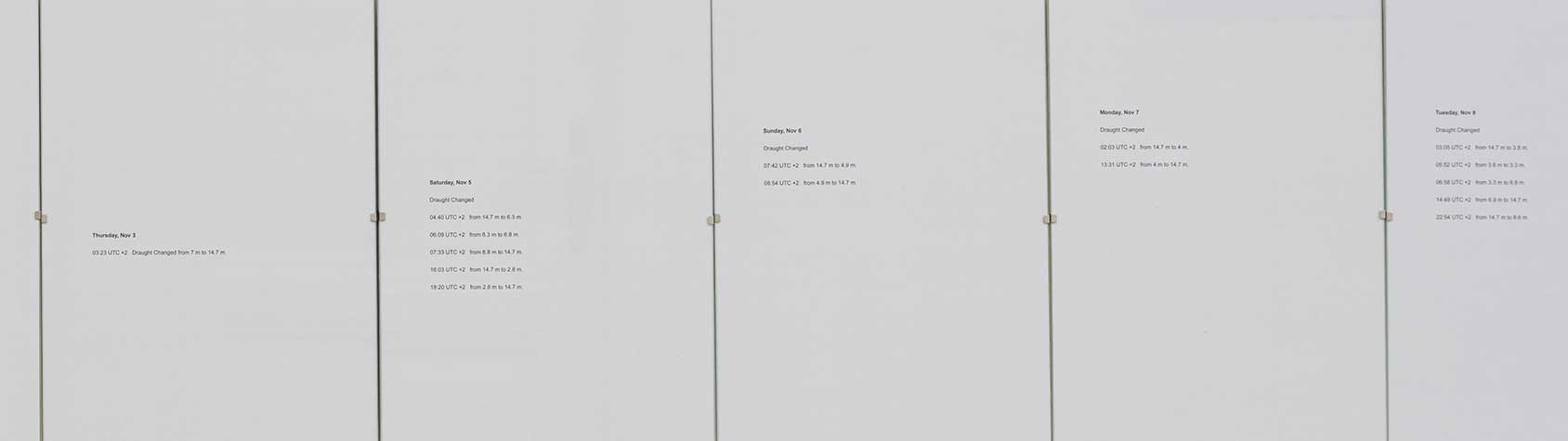
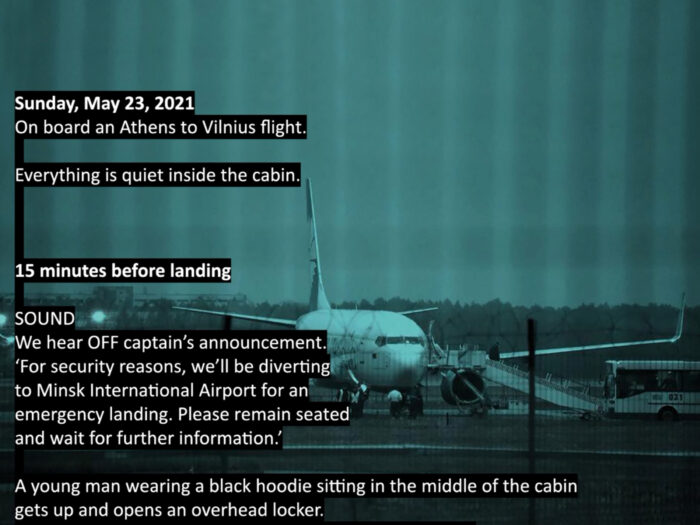
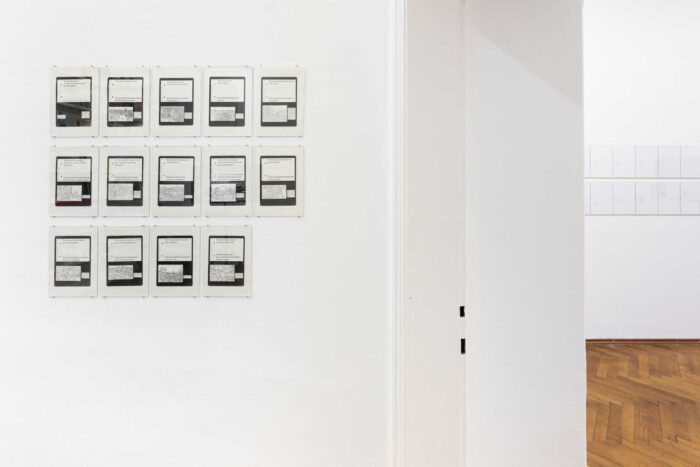
If history is assembled through selection and omission, it also raises the question of who gets to speak, and who is spoken for, when public discourse is already structured by dominant narratives and uneven access. I’m cautious around subjects that come shaped by strong images and ready-made readings. Aware of my own gaps in historical and political knowledge, I approach historically charged subjects through minor moments that fall outside dominant narratives. In several works I have returned to figures from Greece’s anarchist and anti-authoritarian milieu, including Pola Roupa and Aggeliki Spyropoulou, to contest the ways their public presence is shaped by institutional and media narratives. In a related but different context, No Event for Sunday, May 23, 2021 (2022), presented in Bratislava, refers to the case of Roman Protasevich, a Belarusian opposition activist arrested after his Athens-Vilnius flight was diverted to Minsk on 23 May 2021 following a reported bomb threat. Without naming him or anyone else, the work tracks, in textual form, how he appeared in media reports during the first 22 days of his detention, focusing on gestures, clothing, and interiors rather than on a full account of the event.
Belonging to a specific history is not, for me, a matter of claiming identity as a theme; it is more like living within a set of conditions that continue to shape what is possible politically, economically, and even imaginatively. Growing up under asymmetrical conditions, marked by debt, externally imposed reforms, geopolitical dependency, and the persistent sense of being evaluated from elsewhere, is part of what I inherit, whether I choose it or not. That inheritance shapes not only one’s memory, but also one’s way of looking: how one reads events, how one relates the local to wider structures of power, and how one comes to understand the present from a place that is never entirely at the center.
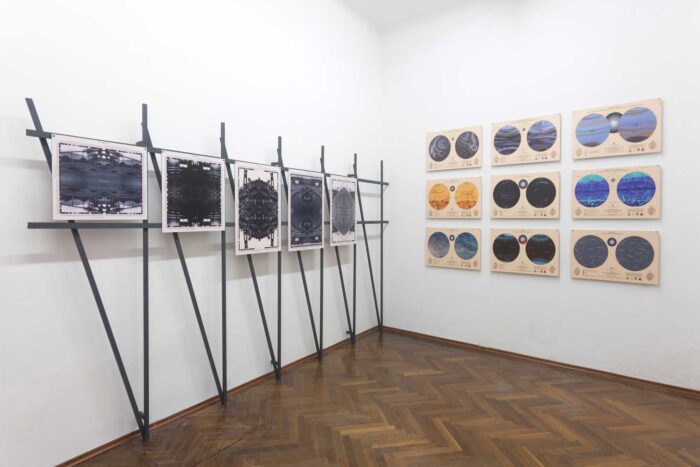
Photo isonative.
Zbyněk Baladran: I would probably put it simply: if someone is born somewhere on the semi-periphery or periphery of Europe, they are determined by that fact, because they cannot relate to the core countries in any other way than through historical ties. It is a somewhat unusual situation. I found this unusualness to be the core of my practice, also as a kind of intellectual therapy on how to relate to someone who is not interested in you.
I don’t know if I would want to be labeled that way (European and post-Eastern Bloc artist) but I am definitely an artist who can be classified that way. The perspective from which I operate as an artist is clear. At the same time, I have always felt that this straddling between the local and the international or cosmopolitan needs to be balanced. I think that the way I create is universally understandable to anyone from other places, and at the same time, I do not betray the context I come from.
Zbyněk, you are a visual artist but also educator, curator, author, and exhibition architect. Throughout your work you are interested in the notion of Western civilization and you often look at societal systems and rules especially in relation to the legacy of the political left. Moreover, you have often reflected on art’s effect on society but also on art’s commodification and you have tried to resist the art market by creating non-commercial works. How do you see art’s role in relation to society?
ZB: Art always has a certain function in society. It serves power and its ideologies to a greater or lesser extent. It is also possible to perceive its subversive role. I think that its ideological role within liberal democracies is currently culminating in the sense that it is becoming increasingly empty. I teach at the Prague Academy and I am increasingly aware that students reject the market as the prevailing framework, but they also perceive that no other ethos ideologically balances it. What remains for them is the creation itself and the artistic problems that await a future radical re-evaluation.
Zbyněk you were born in Czechoslovakia, a state that tried to create a society based on social justice and defined itself as socialist. However, this democratic state established in 1918 failed to fulfill its goals. Throughout the 20th century your country—as many others—experienced a troubled and horrifying history. Is it possible today to identify with the initial ideals and try to learn from failures? How can we think about the ideas of the socialist system anew? What can be critically re-thought in the current situation of Europe and the world? In other words, what can we learn from the 20th century for the 21st?
ZB: That’s a good question to ask in 2026. In previous years, I would probably have answered differently. Today, it seems as if the future remains clouded and devalued. But just as all social movements of the last two centuries have led different people to act and believe that their actions will lead to change, so today, after the collapse of collective ideas, it is possible to imagine that perfect individualism is internal slavery, and the only way out is through collective action. In my opinion, this is going to unfold in the coming years or decades. I cannot surrender to the idea that humanity is destined to a future of total failure—that’s unlikely.
Vangelis, you are one of the few Greek artists who have dedicated themselves to revisit the recent history of Greece and the politics of your country’s region. While you were mostly looking at moments and events in 20th century history so as to unsettle the dominant historical narratives and provide alternative or hidden readings, in your recent work you seem to be engaging with contemporary history and the present times in order to dig deeper into the present rather than the past. It seems to me that you are more interested in activating specific contemporary incidents related to Greece that have occurred a year or so before the creation of your works. What brought this shift about in your work?
Do you think that in Greece there is a condition of historical amnesia and/or an ignored and overlooked present?
VV: I began exploring Greece’s post-dictatorship political history in an attempt to develop a sociopolitical consciousness of that period. Born during the dictatorship, I grew up through Greece’s transition to democracy, yet in my family, politics was rarely discussed openly. In a sense, the early work tried to address that gap by returning to events and scenes that shaped the post-1974 landscape.
Since 2003, I have worked around incidents and political episodes from the 1980s onward, often touching on themes like terrorism, corruption, and foreign policy, approaching them through minor, or indirect details rather than through the “main” story. After the 2009 financial crisis, history seemed to be happening in real time. In that context, my research began to take place in closer temporal proximity to the incidents themselves. This synchronism between an incident and the moment of making the work allows me to stay with the event while its meanings are still being formed and contested. It helps keep frames, gaps, and contradictions tangible, and holds the event long enough to be observed rather than quickly absorbed.
I’m not sure I would call it amnesia. It feels more like a condition in which public memory is managed through ready-made narratives. Events are selected, framed, and repeated in the media, and the present is continuously overwritten. The present is not overlooked because it is invisible, but because it moves fast, is saturated, and is quickly framed. Working within this condition, I try to create a slowdown in the way I process the material, extending viewing time so the viewer has time to think, not just to consume.
One more common interest that you share is your research-based, archival practices. In order to investigate the past and the known or lesser-known past histories as well as major or minor events, you often delve into archives, newspapers, websites, databases, timelines, social media, acting as archaeologists of the present. In her book The Allure of Archives, historian Arlette Farge has written that archives are neither faithful to reality nor totally representative of it; but they play their part in this reality, offering differences and alternatives to other possible statements. In archives, historical facts from different eras and contemporary realities meet, overlap and shape the present. Archival material can have an active and creative afterlife.
Is the archive a field of dealing with facts, truth and certainties or is it there to be questioned and provide partial and uncertain information? How do you encounter archival material all these years?
VV: An archive is not a place of certainties, but a site where traces are gathered, classified, and made legible, and that process is never neutral. Archival material can be factual in the sense that it points to something that happened, but it is never complete or self-explanatory. It is shaped by what was preserved, what was lost, and by the frameworks through which it is accessed. In that sense, it is a field where “facts” arrive already mediated, framed, and unevenly preserved.
I often begin from a position of not knowing, of having an incomplete picture, and I try to keep that condition in play, not as an abdication of responsibility and engagement, but as a recognition that meaning is never definitively closed. I see my practice as a platform to think and learn rather than to “prove” something, and I’m more interested in raising questions than in producing definitive answers.
For me, archival material has to remain active. It has to be reorganized, sequenced differently, and read anew in order to produce fresh relations in the present. The very act of selection is already an interpretation that opens up some meanings while excluding others.
Rather than resolving contradictions, I try to construct an open structure where different readings remain possible and where the archive’s gaps are brought into view, whereas openness functions as a tool of destabilization. In that sense, the archive is not where uncertainty ends. It is one of the ways uncertainty becomes a method and opens the possibility of rethinking.
Over the years, my encounter with archives has changed as my research has moved from physical to digital environments, and it has increasingly been shaped by distance, whether literal, linguistic, or methodological. I often work with what is already out there (newspapers, online sources, and other public records), using familiar systems like timelines, lists, classifications, and technical data to test how meaning shifts when an event is translated through different structures.
Why do you think artists of your generation engaged extensively with the use of archives and how is this methodology related and linked to the parameters of the geographies where you live? Moreover, how do you feel about these practices today after the so-called archival turn had gained so much attention?
VV: Many artists of my generation turned to archives because the archive offered a way to work against linear, official narration and to rebuild history from fragments and overlooked details. In contexts like Greece, and in European “peripheries” marked by political ruptures, crises, and geopolitical entanglements, the archival method became a situated tool: a way to connect local histories to wider regional and transnational histories without collapsing them into a single dominant narrative. Despite how familiar archival strategies have become, I’m still drawn to the archive less as an aesthetic and more as a method, indexing, re-ordering, and translating material, for instance turning footage into text and scripts, to slow down perception and allow less obvious connections and marginal positions to surface. In other words, I’m interested in what the archival mode can still do as a process and an apparatus, rather than treating “the archive” as a mere form.
ZB: I think that diving into and using archives allows us to view the present as something that cannot be taken for granted. I always relate to the present. The archive is just a means of bringing to life a different way of thinking, something that disrupts established beliefs. For me personally, working with archives is a way of verifying how my thinking and behavior are, to a certain extent, a product of my environment, and a way of looking at it.
I started working with archives in 2003. I knew nothing about the archival turn at the time, but it falls within the period when, as a student, I began to question the story of the natural integration of Czechia into the capitalist system with all that it entails. Materials from the period of socialist Czechoslovakia in particular offered an excellent mirror in which certain old and new types of inequality were clearly reflected. Over time, I also began to use documents and images that we would not yet describe as historical, with the intention of describing the present by deviating from their intended purpose and meaning.
In retrospect, I think that the archival turn was related to two trends in the late 1990s, namely a greater tendency to understand art as artistic research and, with its help, to examine the conditions of late capitalism, as well as another escape route preventing the easy commodification of works of art.
You met in 2004 in Manifesta 5 in San Sebastian and since then you have shown in many group exhibitions together (among them also in When the Present is History that I curated at DEPO, Istanbul in 2019). Apart from showing together, you have had a close dialogue, an active and creative exchange for more than 20 years and you often choose to bring your works into confrontation. I would like to ask you about this collaboration, how has it informed your practice, thinking process, and working methodology?
ZB: Yes, since San Sebastian, I have considered Vangelis as a generational companion I share a similar approach with. We don’t get to see each other often, but it is always refreshing for me. I have always admired Vangelis’s focus and precision. I also think that his approach is becoming more and more important over time. After twenty years of work, his method is becoming increasingly convincing. I would really like to see a retrospective of his work, to look at its framework.
VV: Coming from a country where, in the early 2000s, there were virtually no people with whom I could exchange ideas about the kind of work I was doing, my participation in the Berlin Biennale and then in Manifesta, both in 2004, proved revealing, as it was there that I first encountered artists engaged with similar concerns. Meeting Zbyněk, and the dialogue that developed between us over the following years, helped me articulate a clearer sense of the geography of my own work and its political implications. Even though we work through distinct formal and methodological languages, his unexpected way of thinking and his approach to the past, not as a fixed narrative but as a field of fragments, contradictions, and competing interpretations, often marked by a sharp and understated irony, have always been an important point of reference for me.
The title of your recent duo show The Workshop of Events emphasizes the fact that the exhibition is “a workspace of procedures rather than objects, a method rather than a theme.” I think that this “workspace” is a space for thinking through, as well as thinking together, exchanging and interacting rather than presenting finished works or specific ideas. Is this a space of negotiation rather than a space of statements? Moreover, by placing your works next to each other you allow your work to take on new meaning, is that so?
ZB: Vangelis has recently been experimenting with moving images, or rather with time-based media. In my case, I am experimenting with non-artistic forms, wondering whether art has the ability to express anything outside of a snobbish environment. So yes, we are thinking in different ways about different methods of communication. But it is a similar trajectory.
VV: For us, the word “workshop” suggested a place of testing and learning rather than a place of finished statements. We thought of the exhibition as a space for exchange, where things could remain open rather than fully resolved. Bringing the works together was part of that process, as it allowed them to be read in relation to one another and to take on meanings that might not emerge if they were seen separately.
Zbyněk, among the common features of your practice is that you tend to present facts rather than express a direct opinion. Do you think artists should maintain a neutral stance? Do you feel your work should remain open to different interpretations? Do you ever feel that, as an artist, you may not have enough knowledge to take a categorical position?
ZB: These are many important and difficult questions. In my opinion, there is no such thing as a neutral stance. Even conformism is a strong political statement. In essence, it can be strongly ideologically aggressive. No artist can avoid taking a stance. That is precisely what is political. Openness to different interpretations testifies to the quality of the work, and also to the willingness of the viewer to see and articulate them. But such a process can happen regardless of the artist. Interpretations can emerge over time. Artists are not journalists, philosophers, or scientists. Of course, artists’ knowledge and awareness help them and can make them more precise in their positions, but a work of art does not depend solely on that.
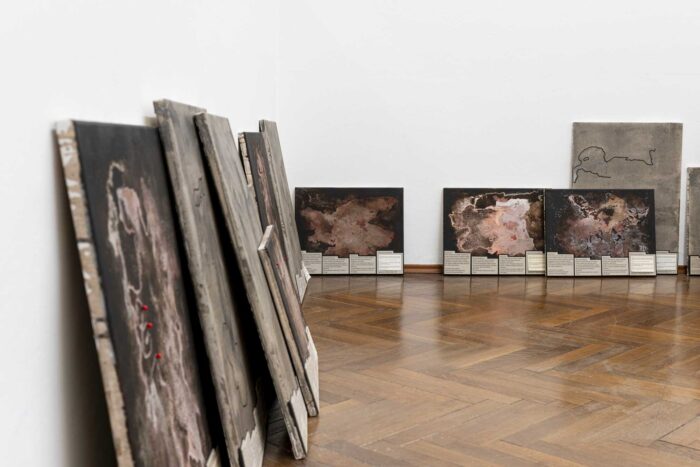
I would like to mention one of Zbyněk’s project that is part of the exhibition, based on Walter Benjamin’s “Thirteen Theses Against Snobs,” a mysterious and very little-known work by Benjamin that analyzes the difference between works of art and documents in order to criticize aesthetic conceit. Zbyněk, for you the work is a reflection on what can be the role of art under this terrible reality that is unfolding before our eyes, that is the destruction that has been taking place in Gaza. Could you expand on that, also in regards to the idea of placing Benjamin’s text alongside your drawings from the bombing you found in newspapers?
Is it better to document rather than to create anew? Where does art fail and where does it win? Can art intervene in the realm of knowledge and emotion? What is the role of contemporary artistic creation in shaping on the one hand collective memory and contemporary political awareness on the other? How do you understand your artistic practice and position in relation to these ideas?
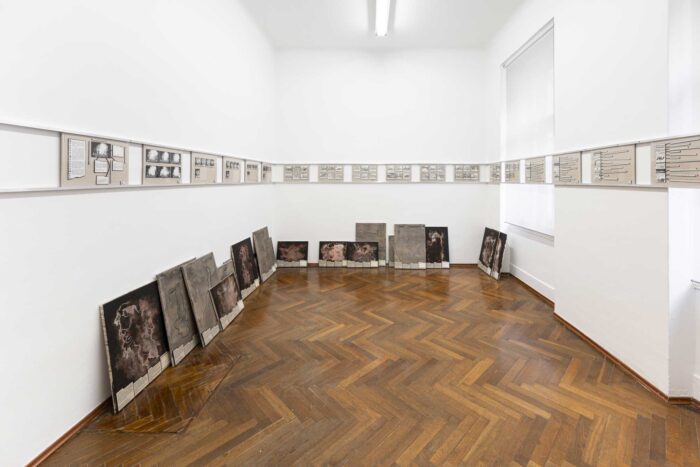
ZB: In recent years, I have been thinking about artistic representation and its political significance, where ideology, propaganda, and the role of art meet. In his aphorisms, Benjamin brilliantly expressed how art often neutralizes and aestheticizes reality. For me, it was a partial study and update of his observations. The juxtaposition of drawings of the ruins of bombed Gaza with text creates tension and ambivalence. Where is the boundary between political meaning and aesthetic neutralization? It is as if it needs to be constantly reset and renewed for art to be meaningful.
In the exhibition text you mention the book A History of Bombing by Sven Lindqvist, which is an overview and interrogation of the cultural and political dimensions of war and explosive force from the sky. The book also underlines the moral and humanitarian implications of a century defined by bombing and violence from above. At a time when we are faced with unimaginable barbarity and artificial intelligence technology having become firmly established in the wars in Ukraine and Gaza, the issues of the use of AI presents new moral issues and ethical questions in war. As journalist Yuval Abraham reports in his article A mass assassination factory: Inside Israel’s calculated bombing on Gaza, while Hamas fires rockets, Israel uses bombs that select their targets with the help of artificial intelligence. According to intelligence sources, “nothing happens by accident, […] When a 3-year-old girl is killed in a home in Gaza, it’s because someone in the army decided it wasn’t a big deal for her to be killed—that it was a price worth paying in order to hit [another] target. We are not Hamas. These are not random rockets. Everything is intentional. We know exactly how much collateral damage there is in every home.” Despite ongoing United Nations discussions, international regulations on military AI are not likely in the near future.
Can artists help shape a morally acceptable digital social world by critically reflecting on the ethical challenges that arise in a rapidly digitalizing more-than-human intelligence world?
ZB: I think artists are actually doing that, but developments in this area are accelerating in such a way that I don’t know if it will elicit an appropriate response, remedy, or correction in human society.
I recently read the book Exocapitalism, in which the authors view contemporary capitalism as an inhuman economic system where the main actor is an autonomous infrastructure of software, finance, and data, which reproduces itself. Isn’t it too late? Such an actor does not need art and does not need self-reflection; it only wants to increase efficiency. War, then, may be less a tool for exposing and solving human problems and more a tool of an algorithm for which humanity is merely a substrate to be exploited by any means available.
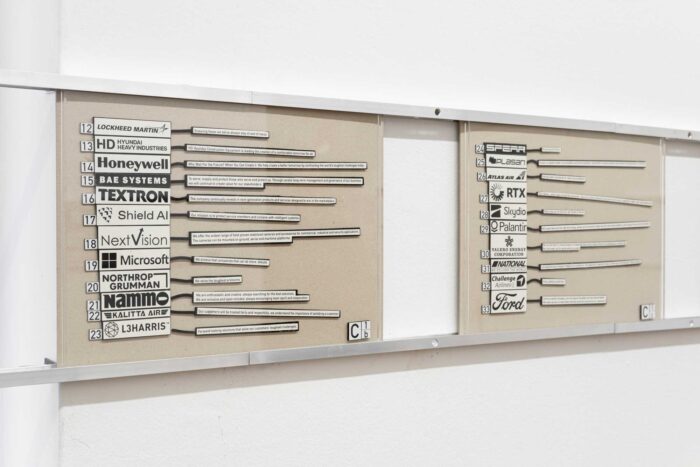
I think that artists could turn to the chaos of war and spark empathy, dialogue, moral issues, and resistance, challenge propaganda and keep human stories alive. In your artistic work you have often dealt with war, destructions and military issues, as in your exhibition Out of Control, and in works such as Bone Setting (2020), where you also refer that the boom of digital technology is founded upon the development of weaponry systems. Moreover, your recent work Oracles / Protocols (2023-2025) is an attempt to analyze the problem. What can be the power of art in anti-war advocacy? Would you also like to discuss the Protocols series?
ZB: Yes, I have long been convinced that the current capitalist world, whether democratic or undemocratic, is preparing for a major war or series of conflicts. Today, it is easy to share this idea, but I was obsessed with it during the pandemic. Rather, I transferred the emotional tension I felt and projected it into the study of the militarization of society, especially American society. The work you mention is one of those that emerged during this period. I remember encountering a lack of understanding as to why I was focusing on the militarization of the US and its doctrine when there were other aggressors in the neighborhood. But when you study American military doctrine over time, you realize that it is the backbone of US ideology. It was difficult to even discuss this before, as it was considered an outdated way of thinking about imperialism, but today there is a Department of War, so what more can be said?
Oracles / Protocols are once again provoked by a frightening reality, in this case not as a hidden threat, but as its brutal manifestation. At the beginning, there was speculation, and probably a reluctance to aestheticize this barbarism, but I couldn’t find the right language to express it, without it being just an expression of my personal feelings and attitudes. While studying ancient mantic techniques, it occurred to me that some of my artistic abilities could be used to predict bombing and when it would occur. I didn’t mean it literally. I was more interested in the impact of the determination: that it is a work of art that pretends to be a proactive oracle, or perhaps it is just an oracle that looks like a work of art. I made over 40 such “predictions,” and it was very unpleasant; it was easy to succumb to the feeling that when I made a prediction, the IDF would actually bomb. So I stopped making them. Ironically, the IDF has already bombed everything it could and has found more covert forms of terror.
The Protocols were my attempt to understand it all, to discuss the destruction more analytically, i.e., the extent of the destruction, the processes behind it, the role of ideologies, capital, technology, Hamas’s policies, and the current Israeli leadership. I didn’t come up with anything deeply investigative, but I think it helps to frame what is actually happening and how it can be portrayed.
Vangelis, all the titles of your works in the exhibition The Workshop of Events (even the title of the show itself) feature the word event:
No Event for Monday, December 16, 2024 (2025), This event has now ended (LANA) (2023), No event for Sunday, May 23, 2021 (2022). You look at small events in order to understand larger political events and create situations for debates, considerations, reflections, ruminations, and maybe revelations. What do you consider an event? How do you decide which event is interesting for you? After treating an event in your work does it remain open or does it end? It seems to me that rather than offering a closure, the event proposes a mutable framework for engaging with the present. Are you interested in the impact that this treated event can have to your audience?
VV: The current ways we consume events through continuous streams of images and information have made the notion of the event increasingly unstable, in the way visibility is managed and meaning is constantly rewritten.
I’m interested in the threshold between event and non-event: what is recognised as an event, what fails to register, and who decides. What becomes of an event in an age of endless circulation, reframing, and repetition? How do we distinguish the event from its mediation, attention from consumption? For me, an event is not something fixed but something unsettled, something that can be reconstructed and re-entered through the materials and frames that carry it. This is why I build systems of observation and translation, not to provide finality, but to keep the event open as a framework through which an established order that decides what is common, sayable, and worthy of attention can be challenged.
The phrase “this event has now ended” borrows the language of platforms and interfaces, where closure is an administrative gesture: the entry expires, the feed moves on, the item is archived. But political and social events rarely end in that way. Using this phrase as a title is a way to question that status, and to keep the event available as a mutable framework that can be taken up again, reconsidered, and argued over in the present, as contexts change. Similarly, the “no” in front of “event” is a way to shift perception, not to instruct but to prompt the viewer to ask what is excluded from the category of what counts as an event.
Do you underline the importance of paying attention to algorithmic data that seems to surround us innocently? How does datafication shape our understanding of the present?
VV: I’m interested in how algorithmic data and its visual languages can appear neutral, almost innocent (for example, flight-tracking traces, ship-draft readings, or temperature colour scales), while quietly acting as a filter that makes some realities readable and others recede. In my work, I use data less to explain what happened than to test how an event can be read when it is translated into these formats. I draw on and combine material from existing systems to challenge how an event becomes an image, whether as a timeline, pattern, or a seemingly “technical” depiction.
Datafication shapes our understanding of the present by turning complex political realities into legible outputs: numbers, maps, rankings, alerts, timelines. These formats often feel immediate and objective, but they also narrow the field of what counts as real to what can be tracked, compared, and displayed. This process reorganises perception around what is measurable, privileges patterns over context, and shifts political questions into technical ones.
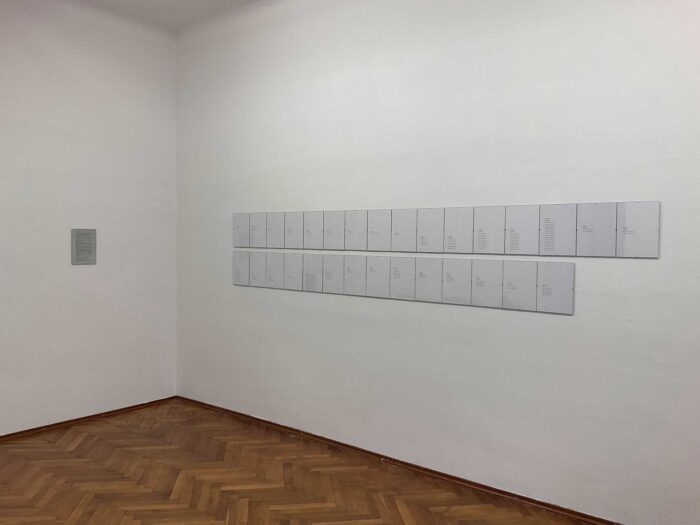
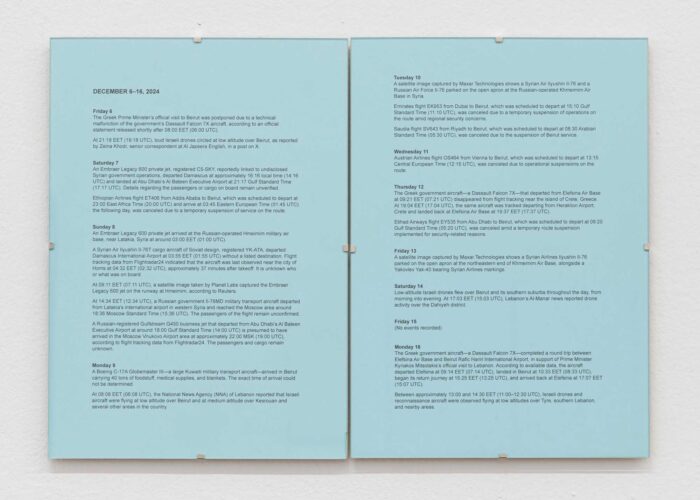
In your work No Event for Monday, December 16, 2024 (2025) you present two parallel timelines. The first one is a textual timeline that traces a series of diplomatic, military, and aviation-related events that occurred during the postponement period of the Greek Prime Minister’s visit to Lebanon (from 6 to 16 December) focusing primarily on unusual flight activity and surveillance operations across the Eastern Mediterranean. As you mention in your text, much of this unusual flight activity has been linked to the rumored escape of Bashar al-Assad to Russia, Syria’s traditional ally, where Assad was granted political asylum by the Russian government. However, this is never explicitly mentioned in the timeline.
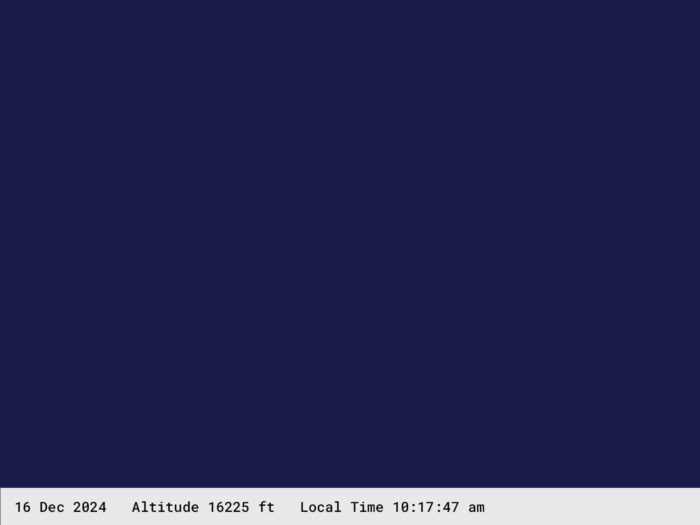
The second timeline is in a video format and reconstructs the Elefsina-Beirut flight by visualizing temperature fluctuations along the route in real time. You make use of publicly available flight tracking data, the image of the video translates estimated temperature changes (calculated from altitude, regional climate, and historical weather data) into color transitions. The color scheme used to represent these temperature changes follows established conventions in aviation and meteorological data visualization, resulting in a color-based depiction of temperature variation across the flight path. What does this project tell us about the relations between Greece, Lebanon, and Syria and what about Greece in a time when the country is seeking to redefine its role within the new geopolitical landscape?
Rather than giving specific perspectives, you are making space for your viewers to project their own perceptions. I am wondering if in order for a viewer to interpret and perceive your work, it presupposes that they have some knowledge of Greek political history and the geopolitical landscape? Is the textual accompanying information an integral part of your work in order to provide visitors with the essential information? What kind of connections do you expect the viewer to make?
VV: In the midst of the current war involving Iran and the wider regional escalation around it, it has become clear that the Eastern Mediterranean and the wider Middle East remain zones of overlapping ambitions, including energy corridors, infrastructure, mobility governance, and influence over regional politics. Against this backdrop, the context that No Event for Monday, December 16, 2024 (2025) engages with is reactivated, bringing Greece’s repeated repositioning of foreign and economic policy back into the conversation. That policy has shifted from 1980s “Global South” solidarity, and ties with leaders of the Non-Aligned Movement, to a 1990s consolidation of an EU/NATO orientation, and, since the late 2000s, to a stronger investment in energy diplomacy and security alliances with regional actors such as Israel. The postponed December 2024 visit to Beirut sits within that longer arc, at a moment when the current escalation is once again testing Athens’s regional role.
Specialized knowledge is not a prerequisite for entering the work. The textual material is not supplementary; it is an integral part of the project, and of my method. It is there to allow relations to form between elements that might otherwise appear ordinary or opaque, and to provide the minimum structure for something to be read as an event without fixing a single interpretation. The text sets a frame, but it leaves the work of interpretation to the viewer. Yet interpretation is never neutral. It entails political positions and ideologies, and it is shaped by unequal access to information and by how information is managed. This concerns both those who produce and manage information and those who use it, including me as an artist and, ultimately, the viewer of the work.
In No Event for Monday, December 16, 2024, the official diplomatic account (postponement, “technical malfunction,” rescheduling) is set alongside its wider geopolitical context through two parallel timelines, one textual and procedural, the other visual and technical. Together, they aim to keep the incident open to multiple readings, so it can be approached not only as a headline but as an intersection of systems such as diplomacy, logistics, and aviation. In the video, flight-tracking data, used to model temperature changes along the Elefsina-Beirut route, is translated into a continuous field of gradual colour transitions and placed side by side with the political account as a methodological move, meant to destabilize how the event is understood and narrated. I hope this makes space for a more poetic dimension of the work to emerge, where the temperature visualization becomes an experience in itself.
The work on gradual colour transitions by Vangelis brings to my mind a work by Zbyněk which makes reference to the naming of colour scales and more specifically the coded history of the industrial age.
For your project The Jevons Paradox you mention, “if we were to interpret the present situation only through the symbolic representation using dominant nomenclature, we are living in the age of RAL.” Can you talk about this work and this paradox of environmental economics, namely the Jevons Paradox you refer to?
ZB: I see it as a good association. The RAL era, as I have named it, refers to Central Europe, pointing to economic subordination and the distribution of power and the consequences that follow. When someone focuses on something, on a phenomenon or detail, they may see surprising trajectories and connections that they were unaware of, yet which fundamentally influence their life. This is what I focused on in the series of prints Jevons’ Paradox. It is named after the English economist William Jevons, who described a phenomenon in economics whereby technological progress that brings greater efficiency in the use of a particular resource paradoxically increases the consumption of that resource due to greater demand, instead of the expected decline in consumption. It was formulated almost 200 years ago and regularly manifests itself in the form of better steam locomotives, diesel cars, or even light bulbs and, today, batteries. This is a real dark shadow on any form of techno-optimism. My work points to this and at the same time historicizes it through a local view of coal mining, and the production of colors and color scales.
In a time when nuclear programs are at the center of debate, the prospect of a nuclear war is absolutely terrifying as that would mean a global devastation and can lead to self-destruction. It might be interesting to recall what US President Reagan said at the height of the Cold War, “A nuclear war cannot be won and must never be fought. The only value in our two nations possessing nuclear weapons is to make sure they will never be used. But then would it not be better to do away with them entirely?”
Here, I would also stress on the impact of war on the environment. We should remember that genocides go hand in hand with ecocides. While Russia’s war in Ukraine has reached the fourth year, it caused a major ecological and humanitarian catastrophe as it is not only targeting the population and civilian infrastructure, but also nature. Ecosystems suffer from physical and chemical pollution, threatening natural areas and the existence of many species. Russia’s intensive and deliberate ecocide is an urgent issue that has not been sufficiently addressed. Basically, the environment as well as the climate crisis has been forgotten.
While wars are a central theme of your work, is this something that has preoccupied your practice?
ZB: I would rarely agree with Reagan, but you’re right—it’s worth recalling that his efforts were directed toward dialogue and disarmament. Today, it’s as if we’re on the opposite wave of rising armament and escalation.
We lack a policy of planetary thinking. It seems that it is even on the decline, if it was ever taken seriously. Even at a time when the US considered the climate crisis a real shared problem, they excluded their military from all their climate commitments. The military isn’t counted toward decarbonization, that would threaten their military dominance. Yet the US military produces approximately 182 million tons of emissions annually, comparable to the entire Dutch economy over the same period. I have no doubt that the Russian or Chinese military are not far behind. It’s terrifying. Everyone is largely aware of the problems, but they secretly hope that someone else will solve them for them: nothing will be resolved at our expense. It’s terrifying, but today we’re in a phase where this mindset openly dominates. I hope it will be a short period.
Reagan’s motivation for disarmament was a belief in American exceptionalism and neoliberalism. Perhaps good decisions must be based on absurd convictions with wide ranging consequences. Can one even wish for that much today? I fear we are on the brink of destruction, that almost anything would be good enough to stop it.
I have always felt that the language of art is special in some way, that it can convey experiences, knowledge, and feelings in a different way than other human activities. This is reflected in the sincerity with which I approach it. Art can only deal with itself, address aesthetic issues, and often offer good answers through this. But I don’t think that’s enough. For me, it is a social tool of influence and politics. It may be on the opposite side of the political spectrum from war, for example, but it can be just as influential. It is a very sophisticated tool for understanding reality, and it is necessary to use it while avoiding the danger of falling into self-absorbed snobbery. So, it’s not just wars that concern me as an artist. I’m interested in all manifestations of social life, and its political expressions. But also, necessarily, in art itself and its conditions. I have to know this tool well, otherwise it will be useless.
Vangelis, I believe timing is an important aspect for the perception of your works. I go back to specific works to rethink them in a specific time and place, based on the political developments or what I am interested in during that time, but also what I can see and read in your work every time. The facts are there but maybe the way I look at something differs. Do you think your works invite this kind of re-reading over time? How do shifting political contexts affect their reception and interpretation? With that in mind, how can the project This event has now ended (LANA)—created three years ago in relation to the 2022 Iran-Greece naval incident involving the tanker Lana—be read today?
VV: A work is often “read again” by history itself. Later events reactivate it, and the same material can come to mean something else. I’ve seen this clearly with Allagi (1981), a project that refers to the first nine months of Socialist Party governance. When it was first shown in 2007, the Metapolitefsi was still widely perceived as a successful democratic transition. After the 2009 financial crisis, however, that same period was publicly re-read in a far more critical light, increasingly blamed for many of the country’s political and institutional failures. The work’s reception shifted accordingly.
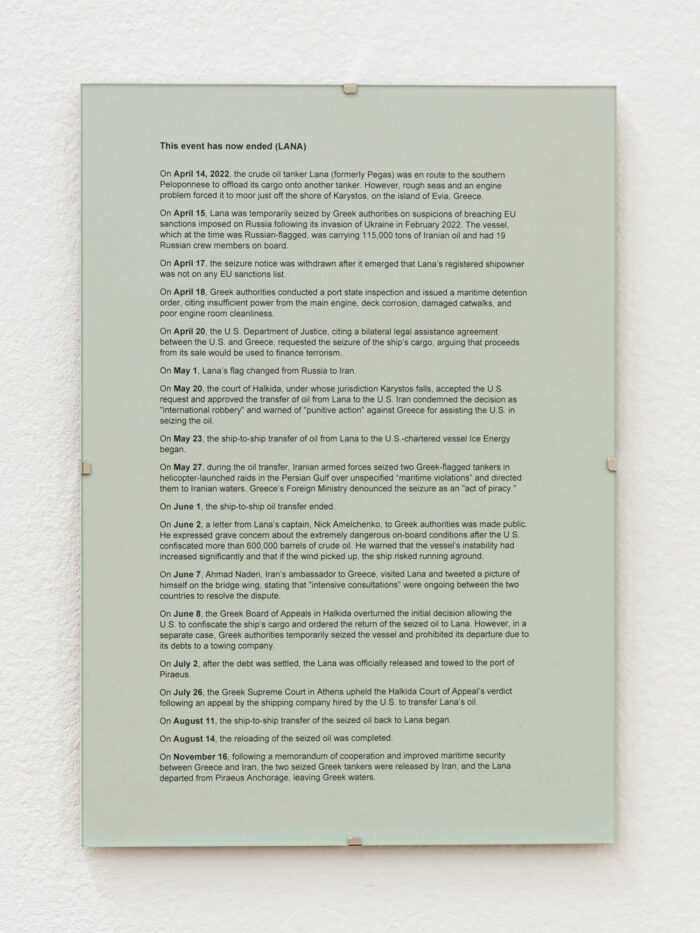
This event has now ended (LANA) takes as its point of departure the 2022 Iran-Greece naval incident involving the Russian-flagged tanker Lana, impounded in Greece while carrying Iranian oil. A standoff followed after the U.S. seized part of its cargo, and Iran detained two Greek tankers in response. Drawing on research from the press, social media, and marine-tracking platforms, the work presents two parallel timelines: one mapping the political developments of the case, and another tracking changes in the ship’s draft over the same period. Despite the “ended” status implied by the title, maritime incidents rarely end cleanly. What the Lana episode exposed—sanctions enforcement, energy supply chains, jurisdictional grey zones, and back-and-forth pressure at sea—has only become more visible since 2022, as states continue to test and tighten the mechanisms of interdiction, seizure, and reprisal. As the geopolitical context shifts, different layers of the same event come into focus, because the structures the incident brought to the surface remain active.
Zbynek, you recently mentioned to me that you are working on a new video work that is about hope. We live in changing times and I feel that it is difficult to make specific statements and have concrete ideas and thoughts about the future, but should you have an idea for hope for the future what would that be?
I recently heard Fred Moten saying that “anti-fascist living is for people who are scared to do communist living.” This suggestion got stuck in my mind. What are your thoughts? Would you like to anticipate something about your new work?
ZB: The idea of communism was feared even when it did not exist. When Marx and Engels proclaimed it, there was no movement, it was just an idea. Even today, when it has been defeated, it does not exist, yet it is constantly ostracized. It is a very dangerous idea for the current order based on private property. This is the basis of my new fictional documentary set in the 1970s, a time when the socialist bloc existed and claimed to be moving towards communism. The documentary features discussions about the future and unlikely speculations that socialist states will disappear and what a declaration of an end to history other than communism might look like. The consensus was that this would lead to absolute destruction. It is the end of history as outlined by capitalism. The film does not explicitly define any form of hope, but returns to the specter that began to haunt Europe in the Communist Manifesto, as a possibility to rethink a common future that would not be death.