
A Sonic Pilgrimage
On “Organum Multiplum”: a musical project by Villa Lontana
Through a series of performances unfolding across four churches, Organum Multiplum explores the pipe organ as an instrument in which historical memory and contemporary sound practices intersect. Curated by Vittoria Bonifati, the project by Villa Lontana brings together international artists whose works experience spatiality through sound, tuning systems and minimalism. Moving beyond liturgical function, the organ emerges as an instrument capable of reshaping affective modes of listening and collective presence.
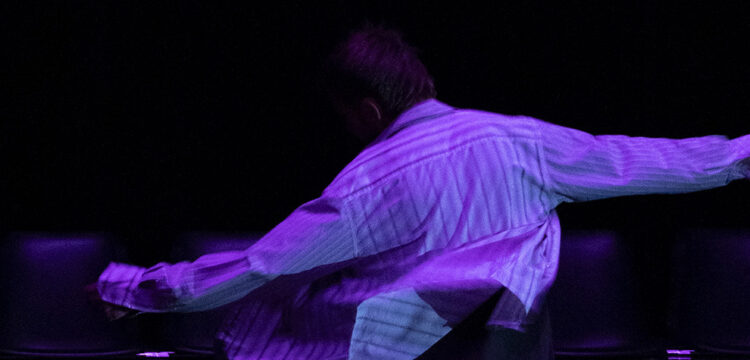
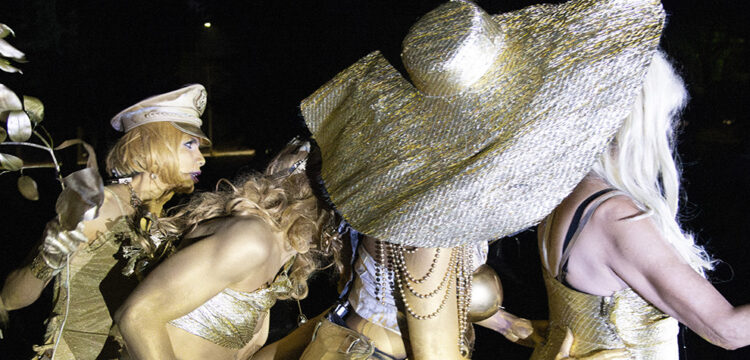
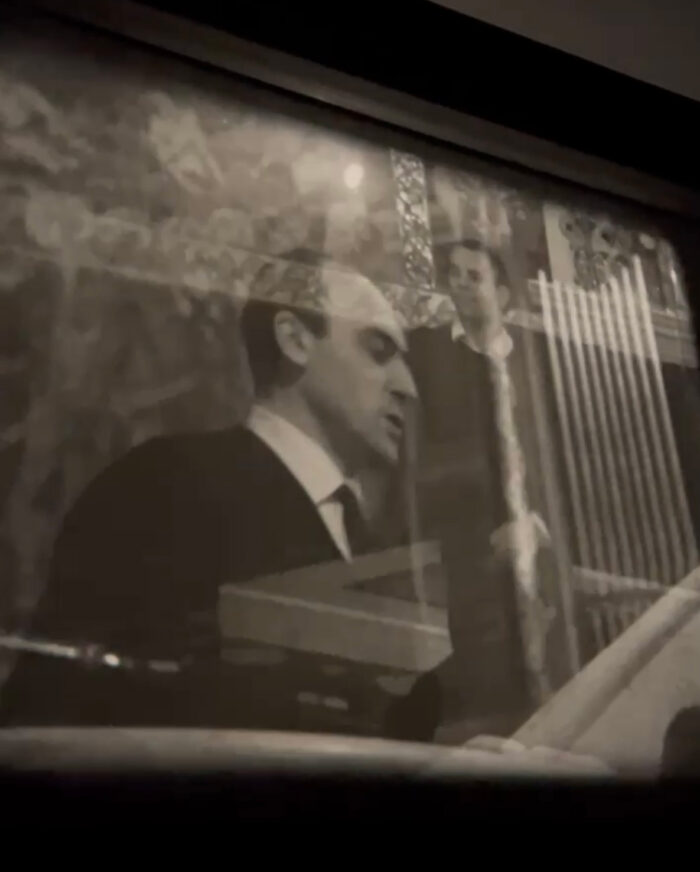
Spring 1966. A loose circle of musicians and instrumentalists find themselves in Rome. Most of them are American, drawn together by a shared interest in free improvisation: music made with acoustic and electronic instruments, self-built circuits, and spur-of-the-moment assemblages. They’re young, anti-academic, anti-bourgeois, and driven by an open, exploratory spirit. That same year, following a concert of new experimental music organized by Alvin Curran and Frederic Rzewski in the crypt of St. Paul’s Within the Walls—an Anglican church in the Monti district—they decided to gather under a shared artistic identity: M.E.V.: Musica Elettronica Viva. One year later, 1967, Alfredo Leonardi, one of the most seasoned and influential filmmakers in Rome’s countercultural cinema scene of the ’60s and ’70s, seizes the momentum of this emergent scene by making Organum Multiplum: a 14-minute 16mm film in which experimental cinema and sonic avant-garde practices converge, drawing the viewer into the M.E.V. experience and its deep attachment to electronic sound.
Today, the legacy of this early movement spirals back into the present as a living vibration. Yet, rather than claiming continuity with the explosive, noise-driven experimentations that characterized the early M.E.V., it frames a different form of attention, one more oriented toward an aesthetic of depth. Duration, variations and timbres that retune what the group once described as an “impenetrably mysterious” [1] city into the frequencies of the present. Paying homage to Leonardi’s film—less as a historical citation than as a revitalized ripple—Organum Multiplum resurfaces as the title of Villa Lontana’s musical project: a program curated by Vittoria Bonifati which, more than half a century later, brings a new constellation of international artists to Rome—many of whom never performed in the city before—to celebrate and investigate the pipe organ, its timbral extension, and its spatial potentialities. A constellation formed by Maxime Denuc, Jonathan Fitoussi, and Sarah Devachi; Kali Malone, accompanied in the second part of the concert by Stephen O’Malley; and Ellen Arkbro and Hampus Lindwall, who played both individually and with Hanne Lippard for the Italian premiere of the project for two organs and voice How Do I Know If My Cat Likes Me? (Blank Forms, 2025). Through their performances, the artists guide the audience into the breath of four different churches across the city, orienting listening toward meditation, microtonality, and minimalism, while opening new approaches to a millennial sonic tradition whose relevance is neither nostalgic nor self-evident.
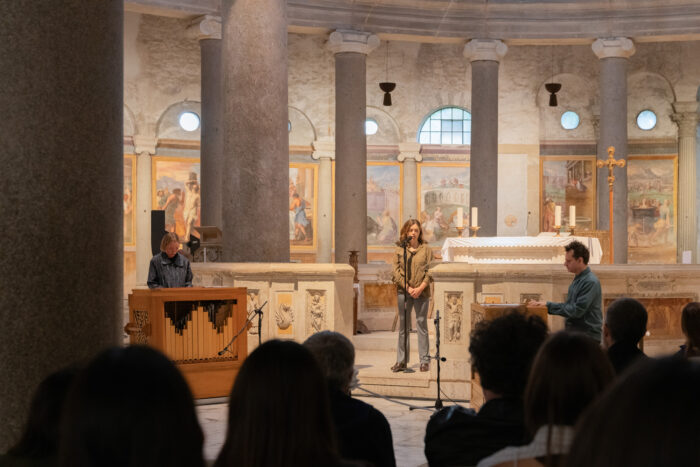
Described as a sonic pilgrimage in the year of the Catholic Church’s Jubilee, the festival unfolds in three chapters, each articulating a distinct relationship between the pipe organ, by far the oldest of all keyboard instruments, [2] and contemporary compositions. Here, the pilgrimage is not understood as a devotional act, but as a practice of spatial and temporal displacement; an invitation to move through sound to negotiate one’s relation to the present. If aesthetic evolutions respond to historical, political, and social transformations, the recent renewed presence of contemporary organ music in church spaces reflects the contemporary urge to find new forms of bliss, spirituality and closeness in a time marked by systemic collapse and extensive destruction. In the ritualistic search, sites of worship are reframed, cease to appear as static monuments, and emerge, on the contrary, as vibrant infrastructures; concert halls in which the social dimension of the musical experience is modulated by Organum Multiplum’s call to gather together and tune on new affective tones.
Gathering in the wombs of religious holy houses has historically meant receiving the spoken doctrine delivered from a position of authority. Yet, as Fred Moten lucidly observes in his speech at the Trinity Church (NY, 2020), something resides in the deep, simple secret of being in co-presence. This kind of encounter “it’s not really about a preacher talking to a congregation” but about a “mutual waiting, listening and attending to one another;” a gesture rooted in “the gift and blessing of our gathering in humble thanksgiving for our gathering.” A gathering that in Moten’s words, becomes a form of fellowship, of collecting. A form of receiving that is a taking at the same time. So, we receive the sound and take the time, our time, to listen to the organ’s harmony with our bodies, through the bodily memory of our bones. In the acoustic architectures, extemporary chamber for the frequencies of the present, words dissolve, leaving space for the organ’s breath to unfold.
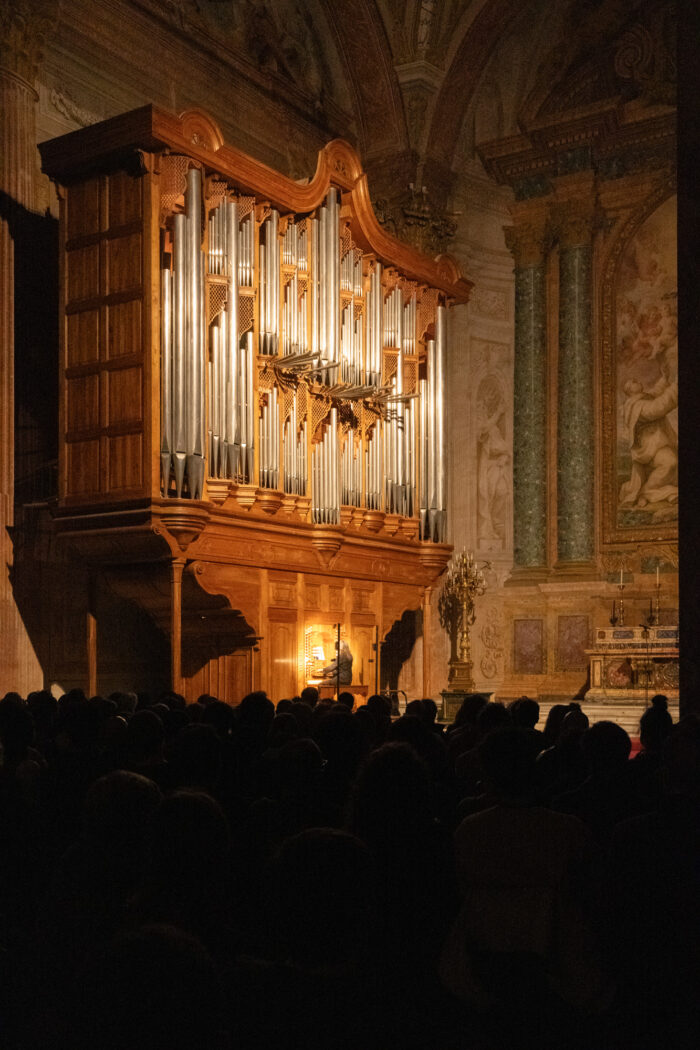
Once associated with outdoor political and secular festivals of ancient Rome, the pipe organs became, by the 13th century, the only instrument permitted inside Christian churches, gradually assuming a central liturgical function throughout the Middle Ages. [3] This privileged position encouraged a technical evolution that, by the 18th century, made it the most sophisticated of all musical machines, while simultaneously cultivating the richest sacred instrumental repertories in Western music. Over time, this complex mechanism—capable of combining pitches, timbres, and airflows into sculpted resonances—came to be understood not only as a liturgical emblem but as a technological ancestor of modern sound synthesis. Its ability to generate and shape frequencies through engineered processes, rather than direct physical excitation, conceptually aligns it with the logic of electronic music. This lineage has been increasingly acknowledged by contemporary composers, who turn to the organ precisely for its proto-synthesizer qualities: its vast dynamic range, modular structure, and capacity to produce sustained, spatial, and harmonically dense textures that unfold over time.
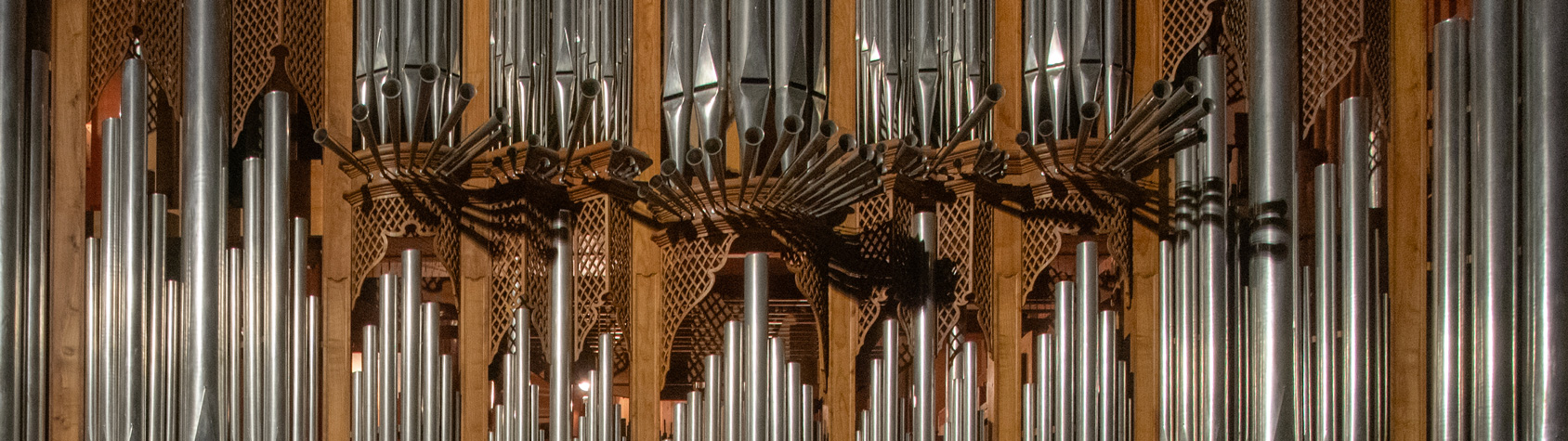
Within Organum Multiplum, the organ is reactivated as a historical machine whose religious and cultural meanings coexist with experimental approaches to sound. Organ music is marked not only by symbolic significance rooted in its liturgical history and its capacity to elevate listeners toward the divine, but also by a distinctive spatial dimension: its monumental scale has always been inseparable from the architectural structures that host it. Physically embedded into the very skeleton of churches, organs are not simply instruments to be played but environments to be inhabited. Surrounded by its intricate machinery of keys, pedals, pipes, and ranks, the organists play the instrument from within, rather than addressing it as an external object. Their performative presence is consequently absorbed by its monumental scale, resisting the kind of visual spectacularization that has characterized musical performances for more than two centuries, from the virtuoso figures of the Romantic era to the contemporary pop stars. Here, there is no frontal stage, no hierarchies of attention, no separation.
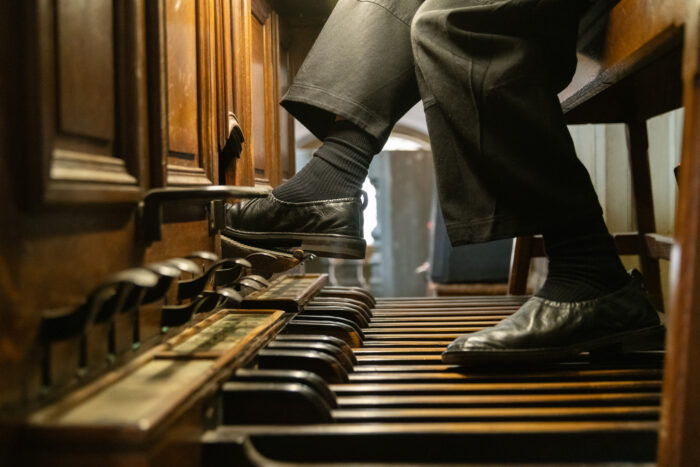
At the Church of San Luigi dei Francesi, for instance, the French Romantic organ built by Joseph Merklin in 1881 and considered the first modern organ ever built in Rome, is positioned on the gallery above the entrance portal. The spatial arrangement requires the audience to sit below, without direct visual contact with the source of the sound. Yet, it is precisely through this displacement that the haptic force of each note reinforces the sonic presence of those inhabiting the instrument: Hampus Lindwall, Maxime Denuc, and Sarah Davachi. With their distinct approaches, each of them reveal specific timbral qualities and acoustic nuances of the organ, which are amplified by the absence of their visual presence. In the withdrawal of the image, their individual poetics sound even more powerfully. Hampus Lindwall, for whom this was his second performance on this historic instrument, presents an improvised version of his own composition. He plays the Merklin with febrile energy in what is described as “post-internet organ music”: a practice that generates a tension between liturgical memory and sonic innovation. Maxime Denuc transforms the organ into a natural synthesizer through the robots he places on the instrument’s keyboard, creating hypnotic patterns that combine classical harmonies with new timbral explorations. Sarah Davachi, by contrast, foregrounds extended durations and modal harmony; in the slow and prolonged notes, the perception of time folds and unfolds, fostering a form of listening structured around contemplation and suspension.
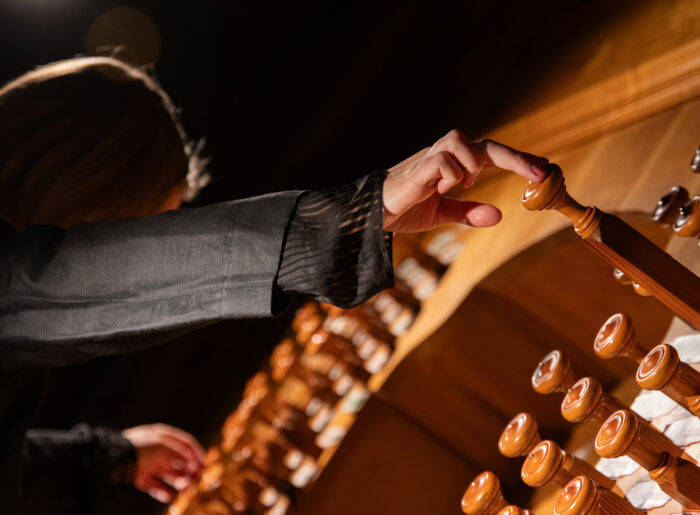
A different spatial and visual configuration shapes the performances of Ellen Arkbro and Kali Malone at the Basilica of Santa Maria degli Angeli e dei Martiri, where the Barthélemy Formentelli organ—the largest in Italy, built according to the French Baroque tradition—is positioned laterally within the Chapel of San Bruno, in proximity to the audience. This placement invites a sideways gaze onto the act of playing, making the ritual and tactile dimension of the performances newly perceptible, and revealing the profound intimacy between musicians and instrument. As in a choreography of space and harmony, hands and feet traverse the organ’s body, composing a score of gestures that foreground its physical presence. In Ellen Arkbro’s compositions, the exploration of natural harmonies and subtle tonal micro-variations centers on precision-tuned intervals. Her long-held tones slowly invite sustained attention and gradual perceptual shifts, while subtle internal tensions and harmonic interactions create moments of intensity and unease alongside stillness.
In Kali Malone’s performance, experimental reinterpretations of ancient polyphonic methods and historical tuning systems become portals to alternative perceptions of harmony. As tones accumulate and interact within architectural space, the music shapes a heightened state of attention in which structure, duration, and material vibration guide the listener toward introspective, contemplative, and deeply embodied modes of listening. Owing to the organ’s unusual position, these approaches are complemented by the subtle movements of the performers interacting with the instrument and by the collateral sounds—the pulling and pushing of stop knobs, the striking of pedals, the coupling of ranks—which, becoming audible, foreground the material presence of an instrument so often associated with ethereality.
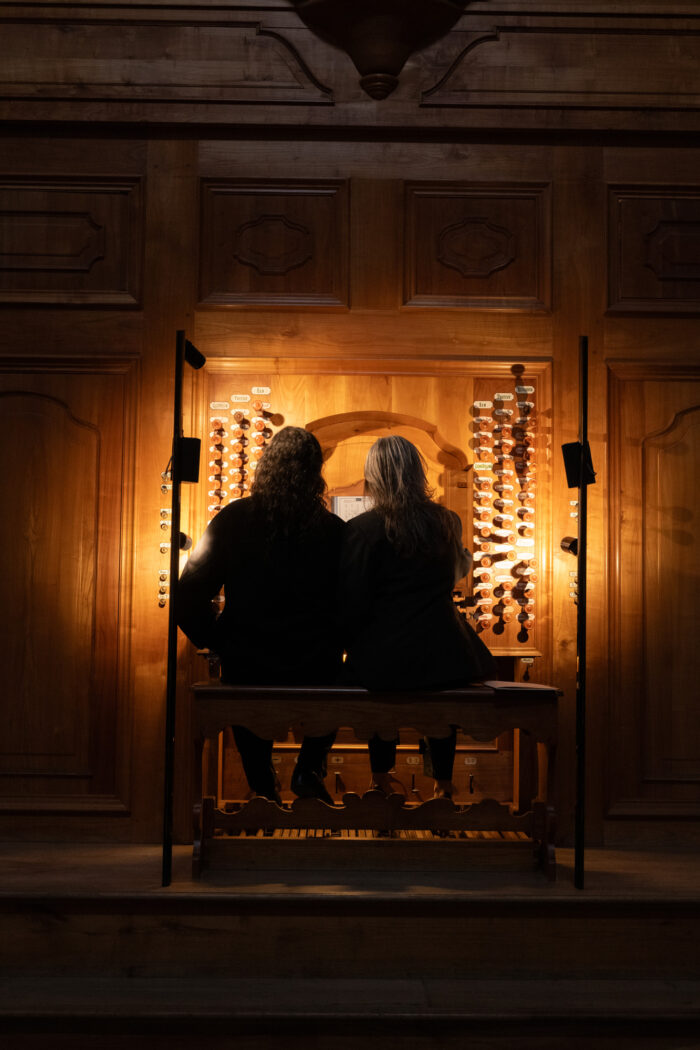
Through the convergence of historical techniques, embodied gestures, and contemporary technological approaches, the iterations of Organum Multiplum open a renewed understanding of the pipe organ beyond its liturgical function. Embedded within the architectural body of the church, it dissolves clear distinctions between space, performer, and audience. Sound circulates, generating a resonant chamber in which listening becomes a practice of co-presence, and the deep, vibrant sonorities of the musicians act as a medium for renewed attunement. We wait, take the sound, and give our breath in return. A form of fellowship emerges, grounded in vibration, duration, and collective dwelling. The organ thus thickens time and, in the trembling present, its performance becomes an occasion for encounter.
[1] David Bernstein, Conversations with Alvin Curran, in MARGONI TORTORA 2010: 109-201.
[2] Willi Apel, “Early History of the Organ”, in Speculum, Vol. 23, No. 2 (Apr., 1948), p. 192.
[3] Joseph P Swain, Historical Dictionary of Sacred Music, Rowman & Littlefield Publishers, 2016.