
A Matter of Ambience
Inhabiting the world with Calderoni/Caleo’s “temporale {a lesbian tragedy}”
temporale {a lesbian tragedy} will be presented at Angelo Mai (Rome) on 17, 18, 19 April 2026.
Time runs out, space less so.
Space renews itself, never truly empty at all.
—Antonella Anedda
In the age of sad passions, the stage can become a political space to challenge certain thoughts, a laboratory to test how materials, human and non-human bodies, words, and temperature can react. Although it is not a given, when this happens, a world with its own rules unfolds before our eyes. The works of Calderoni/Caleo are precisely this: functioning worlds which always speak of the present, even when they seem to project us into distant dimensions, from the present that surrounds us they tell us how we are, what alternatives we might be able to build.
If the exhausting kisses of Kiss have centered affect as a politics of the otherwise, in the reworked archive of The present is not enough, the 1980s New York of the piers, the images of Peter Hujar and that historical moment when everything seemed possible, became the place where desire is continually shaped and unravelled, where a politics of the gaze is re-examined—speaking of the present whilst always reflecting on the nature of both theatre and performance.
A film with an invisible frame, the ghost track of an LP, the photographs from Blow Up: these are the elements peeking through Calderoni/Caleo’s works, imperceptible connections that influence the structure, and a use of dramaturgical materials that deliver an embodied experience rather than presenting us with a manifesto.
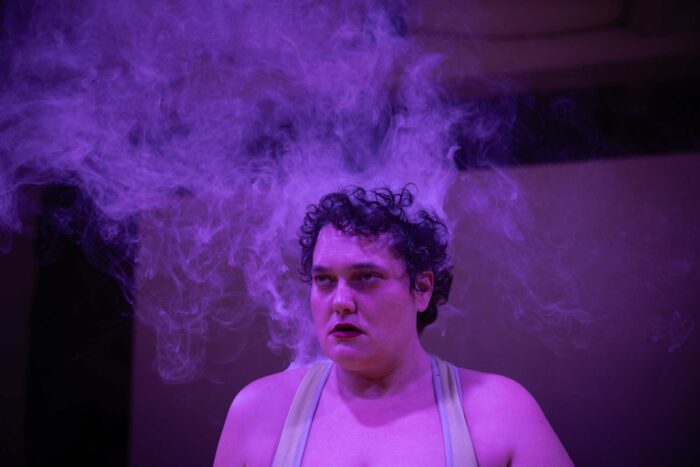
The duo’s latest work, Temporale {a lesbian tragedy}, which premiered at Santarcangelo Festival last summer—and I had the chance to see again at the Arena del Sole in Bologna during the Italian tour—is a single-shot sequence exploring the dark side of everyday existence.
Among the playwriting materials are Goethe’s writings on meteorology: “the study of meteorology, like many other things, leads only to despair,” we read in the epigraph of the programme. This despair is a dimension that runs through the entire work, allowing (even with a touch of lightness) a deep dive into small yet significant dramas, which act as a litmus test for an increasingly precarious present.
Bagnami, scioglimi, assorbimi, lasciatemi nella mia lingua (soak me, melt me, absorb me, leave me in my own language) are some of the lines from the Brevi Sonetti della Disperazione ( Short Sonnets of Despair) written by Ilenia Caleo and inspired by Goethe’s La forma delle nuvole (from Goethe’s Theory of Colours). These sonnets punctuate the work, as the performers’ voices arrive on stage from another place, like ghosts reminding us that a home is always inhabited by multiple temporal dimensions.
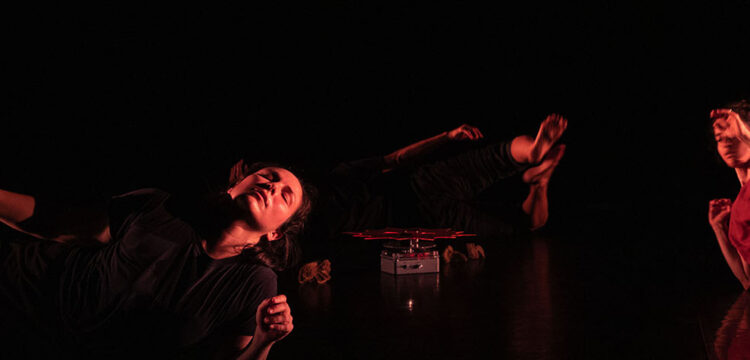
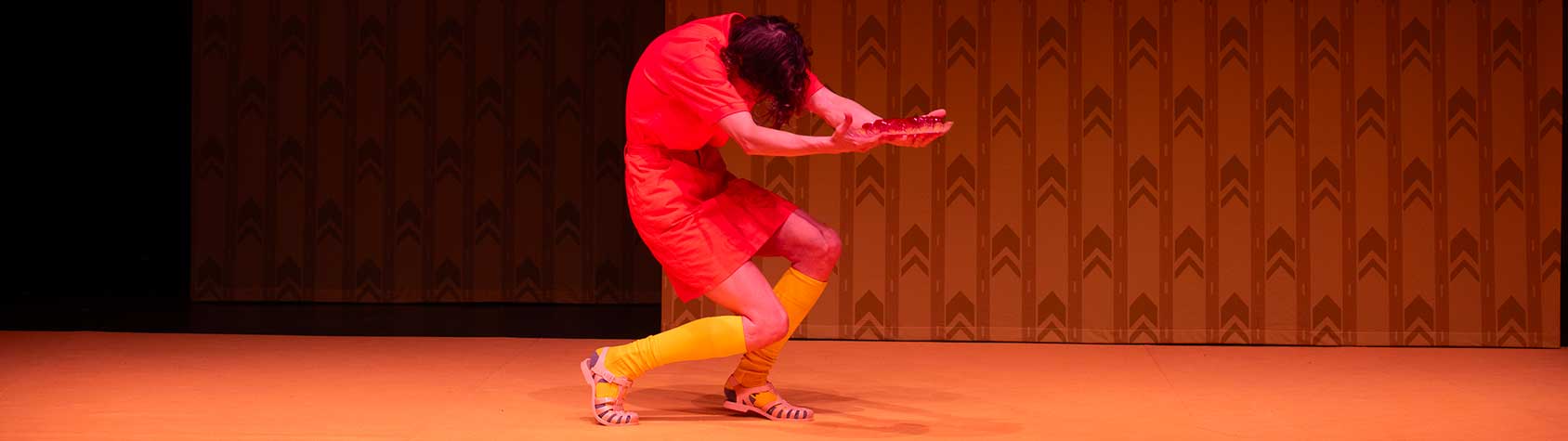
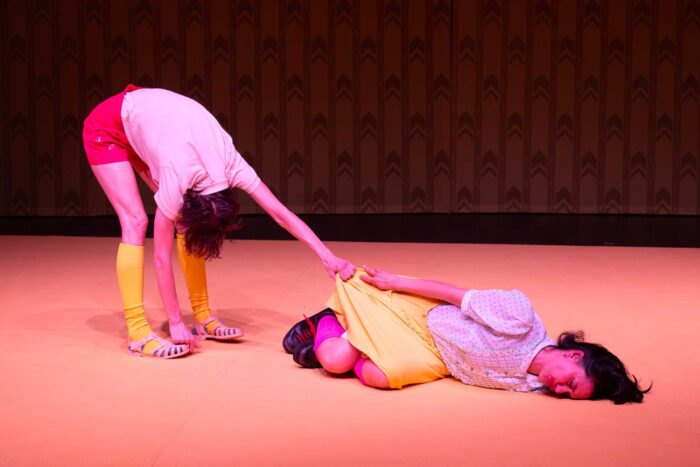
In fact, the stage evokes a setting that at first glance we might describe as “domestic”: a wall with yellow wallpaper of a vintage allure and, on the floor, a (still) yellow carpet, deliberately askew—one of the work’s glitches that immediately prompts a reflection on vision. Something is out of place, blurred; our perception is constantly called into question. Silvia Calderoni, Ilenia Caleo, Francesca Turrini, and Ondina Quadri take to the stage apparitions of hacked everyday actions, smoking heads, objects serving other functions: a ball pen can turn into a knife, a plastic shopping bag a refuge for the head, flickering red and sexy jellies plunging into a black vortex, all in a matter of seconds.
In this work, the study of meteorology is one way of investigating our existence in the world. A matter of ambience, “a spatialised feeling, a ‘something more’ in a more affective and bodily sense rather than an abstractly semantic one (…) the way the world is for us – that is, the kind of relationship we have with the world at every single moment and how we feel within it—is something we experience not objectively but atmospherically.” An atmospheric experience that is a chemical reaction, a non-psychological mode that suggests a divergent perspective on what happens in the everydayness of our lives.
If everything appears reassuring—the yellow of the walls, the pastel colours of the costumes, the clouds forming on stage—we instantly realise that nothing really is. The domestic space is merely an illusion because the yellow of the walls and the carpet is the yellow of the backrooms, an internet phenomenon linked to creepypasta horror stories. Empty by definition, these spaces are situated outside reality (or in another reality), interconnected and infinite, the setting for unease and born with something wrong, a fundamental glitch. The first photo of the backrooms, depicted precisely as a tilted room just as the carpet on stage, is slightly askew. If backrooms are liminal spaces, then Temporale is also a work about thresholds; the performers move on a subtle level that addresses the gut rather than the head, abandoning any form of narrative aside from what the audience reconstructs, beyond rationality, through the temperature of the ambiences that unfold. We question our chemical reactions to the world, while chemically responding to what happens on stage.
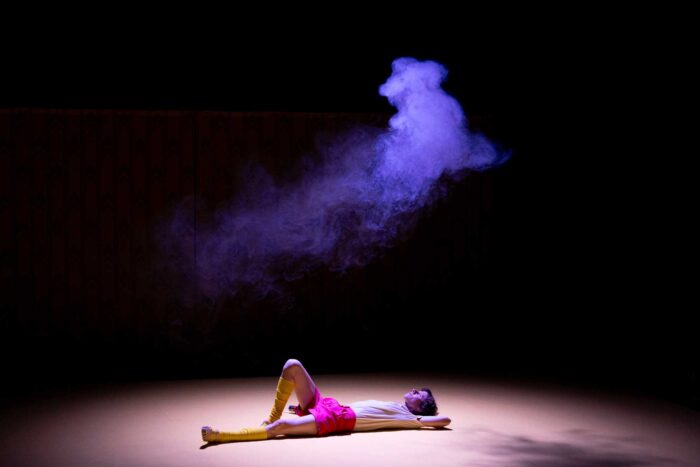
In one of the essays in You have a new memory, Aiden Arata discusses escape rooms as liminal zones that exist within other liminal zones and “function as oases of ambience; their purpose is existence itself, a space in which one can be and document the state of being.” This is what happens in Temporale: the images seem to emerge, rather than an event, they represent the very formation of the image, which persists only in the form of sensory memory, something that exists between a subjective and an objective image. Far from being a mere sequence of events, the scenes in Temporale construct an atmospheric environment we are infected with, for the eternal duration of an instant. The interacting elements provoke synaesthetic sensations, emphasised by Martina Ruggeri’s soundscapes, which do not merely accompany the work but act on stage as a further performative presence.
As in Turner’s paintings, Temporale also reveals an exploration of the sublime, understood as a striving to represent the unrepresentable; whilst in the Romantic painter’s works one is confronted with the most fearsome, violent yet at the same time seductive aspects of nature, in Calderoni/Caleo’s work the confrontation takes place both with the power of the ambiences and with the small daily horrors that are symptoms of the world we live in. The title is no coincidence: the atmospheric phenomenon of a storm is characterised by the presence of electrical phenomena within which a cloud known as a cumulonimbus forms, like the one that appears on screen at the start of the work, standing out from others for its strong vertical development, as it is generated under conditions of severe atmospheric instability. Far from being an exceptional state, atmospheric instability is all around us; here the electrical charge becomes a political issue.
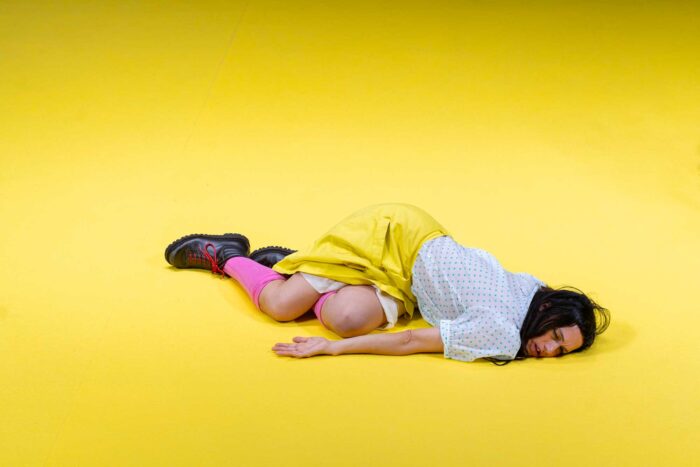
Like Calderoni/Caleo’s other works, Temporale inhabits the crevice between representation and enactment—one of the most fascinating yet challenging areas contemporary art grapples with: remaining within a script whilst constantly summoning a stage presence that possesses a performative quality. The uncanny, the Gothic horror, the scenes evoking the aesthetics of David Lynch’s Twin Peaks seem to distance themselves from the utopian visions in some of their other works; after all, we live in a world that offers little room for utopia. Yet in reality, even the nightmarish reality of Temporale leaves room for a reflection on the alternative. It is a possibility of inhabiting the world outside the continuous performativity of the self, leaving space also for our weaknesses, tremors, and blurred affections to construct a layered space which is never a refuge, but a way of confronting the problem and making it collective. This is not merely a theatrical outcome but also a reflection of the work in the studio that I had the opportunity to follow as part of the Artists in ResidenSì artistic residency at Atelier Sì – Bologna, the place where the initial reflections for this text first emerged. It is what Jill Dolan writes in Utopia in Performance that informs this line of thought. Quoting Frederic Jameson, Dolan states that “the force of the utopian text… is not to bring into focus the future that is coming to be, but rather to make us conscious precisely of the horizons or outer limits of what can be thought and imagined in our present.”In this conception of the utopia as processual—and thus not seeking a better world in the future but acting upon the present—the modes of artistic work cannot be separated from the performative “outcome.” The modes of production within a system increasingly on the brink of collapse are central to “dream and enact new and better pleasures, other ways of being in the word, and ultimately new worlds.”
temporale {a lesbian tragedy}
by Silvia Calderoni and Ilenia Caleo
with Silvia Calderoni, Ilenia Caleo, Ondina Quadri, Francesca Turrini
sound atmosphere Martina Ruggeri
Sonnets of Despair by Ilenia Caleo, inspired by J.W.Goethe’s The Shape of Clouds
translation Paola Bono
organization and care Elisa Bartolucci
residencies: PARC Firenze; BASE Milano; Residenza Centrale Fies, con il sostegno di Passo Nord; Atelier Sì – Bologna, Lavanderia a Vapore Torino, Istituto di Cultura italiano, Paris; in collaborazione con AMAT e Comune di Pesaro per RAM – Residenze Artistiche Marchigiane
co-productions: VIELNURVIEL (Ghent); Motus Vague; Emilia Romagna Teatro ERT / Teatro Nazionale
thanks to: Alessandra Indolfi, Roberta Indolfi, Paola Granato, Eva Bruno, Vilma Carlini, Ulisse Poggioni