
A Black Flag Floats
A conversation with Canadian choreographer and performer Ula Sickle
Canadian choreographer and performer Ula Sickle, whose work has been hosted in many international institutions and festivals, will present in Bologna the durational performance RELAY, on Thursday, December 4, 2025 invited by Xing, a long-standing live arts organization. The event is a new Hole, an interstitial and communal format launched by Xing in 2021, which will be located in the Salone Banca di Bologna at Palazzo de’ Toschi, a historic building that once housed Bologna’s Central Post Office.
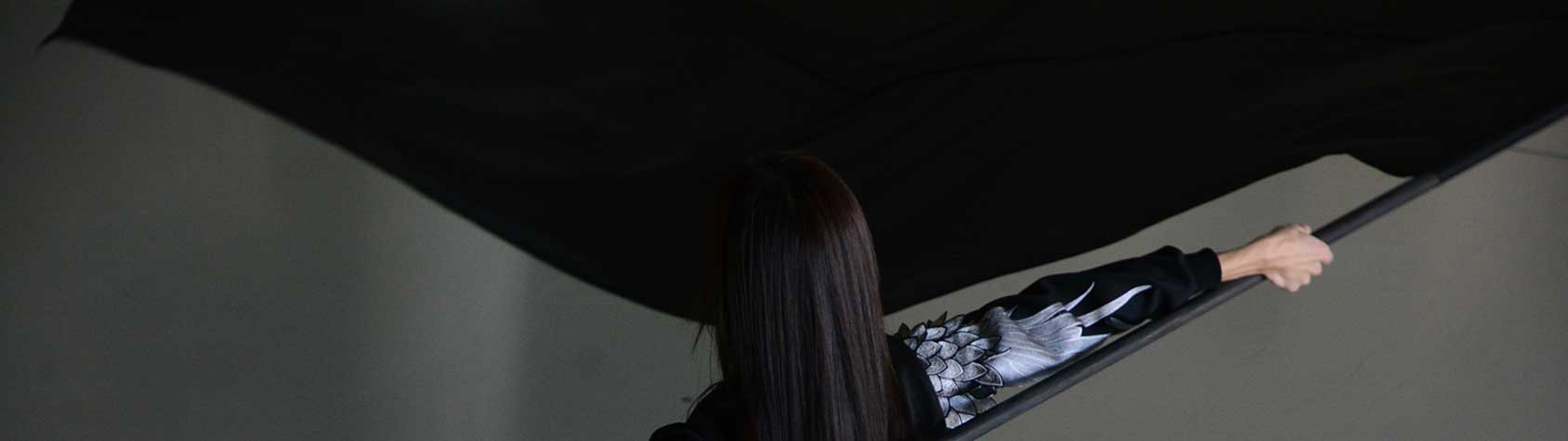
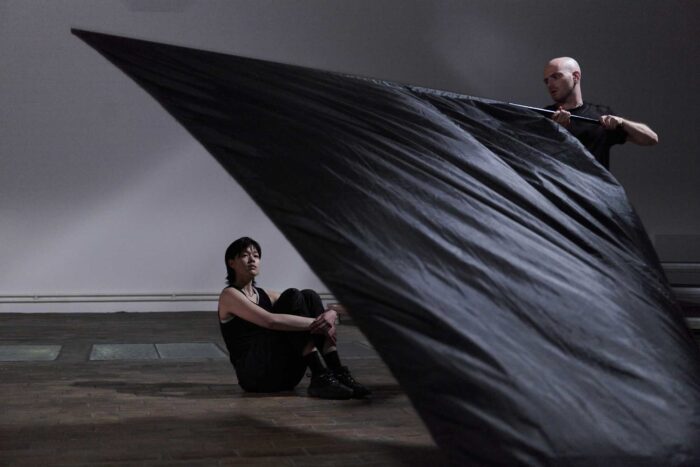
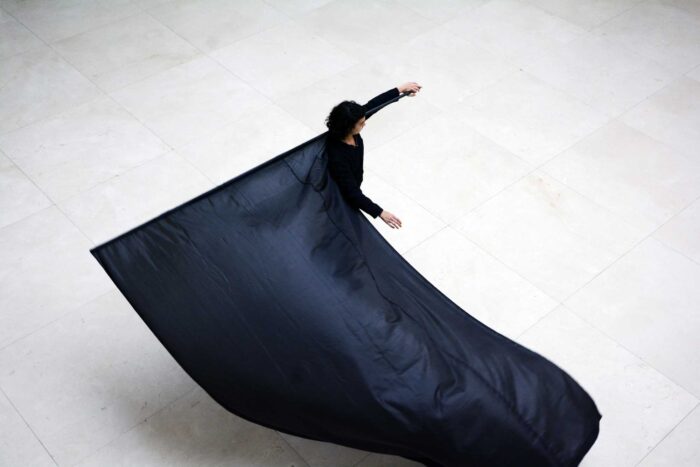
Ula Sickle choreographs four performers and a flag. Its material presence in the space, its waving, transforms into an incantation that sharpens the senses. RELAY offers an extended experience of art based on time and perception to the observers, refining the relationship between the gaze and all forms of presence in a space.
In RELAY, a durational performance of yours, a black flag floats in continuous motion, and it is kept in motion by several performers for five hours on end. Its movement and the flapping of the fabric become both choreography and sound. Why did you choose a black flag? In a moment of many protests taking place around the globe, what does it mean? Which is your intention?
Ula Sickle: A black flag can have many significations; it is hard to pin it down to one concrete meaning or source. For this performance, I wanted to work with a symbol that was charged but that still had a certain openness. A flag is typically a symbol of national identity and allegiance, while a black flag has, historically at least, been linked to oppositional movements (anarchy, pirating, resistance) but also rituals of mourning and loss. Politically speaking, it has been used by the right as by the left, so there is a certain ambiguity.
In RELAY the flag is kept in continuous motion for hours on end, passing from performer to performer, it turns in slow motion acquiring many different significations. It passes through images of victory and defeat, as the flag is sometimes held high and at other times moves low to the ground or is held horizontally. This continuous spiraling movement produces a kaleidoscopic range of imagery that recalls famous paintings or art historical references. Ultimately it is the effort of the performers who relay each other over the long duration that becomes the central aspect of the work. To maintain this continuous motion, the performers need to work together. The sustained motion is only possible through collaboration.
RELAY was originally commissioned in 2018 by the Brussel’s Nuit Blanche, as a reflection on 50 years after the student and worker uprisings of 1968. I wanted to recall this historical moment in time through a poetic gesture, but also to reflect on a certain feeling of inertia, 50 years later. As French theorist Chantal Mouffe has said in an interview, the protestors of 68 didn’t achieve all their aims, but many of the freedoms gained during that period have subsequently been lost. We find ourselves going out onto the streets again for the same reasons. A protest is not a singular event, but an ongoing process. How not to exhaust ourselves?
RELAY was also inspired by protests that have been taking place in Poland since 2016 in defense of women’s rights, and particularly the right to abortion, which is severely limited in Poland. The performance was conceived shortly after a residency at the Ujazdowski Castle Center for Contemporary Art in Warsaw, where every Friday protests were occurring down the road from the museum in front of the government offices. Originally called “czarny protest” or black protest, and later “strak kobiet” or women’s strike, the color black referenced the refusal to work but also symbolized the color of mourning for those rights already lost. I never would have guessed that Roe vs Wade would be overturned in the US a few years later, and that the issue would come up for debate again in other European countries. Around 2020 the Black Lives Matter movement spread from the US to Europe and we have had numerous protests in recent years for the climate crisis and in support of besieged territories like Ukraine and Palestine.
Could you explain your idea of “choreography”? And of “dance”?
I am interested in an expanded notion of choreography that includes non-human movement, such as the movement of a flag, but also social movements and processes, including the choreographies of resistance and protest. RELAY clearly reflects this double interest; the flag becomes the central performer or “dancer.” And yet the movement of the flag is sustained by a relay of bodies, passing the flag from performer to performer; this is the choreographic principle of the work, one that is the result of individual effort, as well as the collective effort of the group.
Is the durational format linked to a kind of becoming?
RELAY can last anywhere from four to eight hours, depending on the number of performers. The overall movement of the piece is extremely slow and this influences the quality of the time-space you enter as an audience. Something happens over the long duration that is difficult to achieve in a one-hour format. The longer you stay the more your body rhythm slows down, so time seems to stretch out. You can spend 15 minutes or 2 hours with the piece however it isn’t necessary to remain for the full duration. It is also interesting to know that when you leave, the work is continuing without you.
There is a slow accumulation that occurs in the performance, from the start to the end, that is only visible if you spend a longer moment or return to it several times over the duration. The individual exchanges give way to group exchanges, and the visible presence of the performers, who stay longer in the space as the work unfolds. The audience becomes a part of this accumulation as well. But it isn’t linear, there is an ebb and flow to it. I don’t mind that people come in and out, often the space gets full towards the end as people get curious to see how it will end.
How do you deal with resistance in your artworks and vision?
I often try to resist expectations, for instance the imperative to be entertaining, the singularity of authorship or meaning, what I call the logic of “aboutness.” I am more interested in shaping a moment of being together that has a certain openness, one that includes the audience. RELAY is more of a practice than a performance. It will be different every time; I cannot control how it will unfold exactly. There is a time score, a physical practice and an underlying choreographic principle, but then it is also up to the individual participants. The meaning of the work is somewhere floating between the symbol and the emphasis the performers decide to give to it and is ultimately produced by the spectators. I guess I am resisting the artwork as something to be quickly and easily consumed. Our current economy is so attention driven, it promotes multitasking and distraction. In RELAY, the duration resists quick consumption. I’d rather think of the work as creating a sense of shared-time and place, a feeling of temporary community.
What about being part of the Hole format that Xing is practicing after the COVID activating non-dedicated places as a temporary redefinition of a public space? How do you see live arts in the frame of our contemporary society? What are the “social” needs for that art form today?
I am intrigued by the Hole format. I like the site-specificity, the use of public space, and the fact that it creates an exception; a temporary occupation of a place that usually has a different use. In contrast to fixed bronze statues erected in cities to celebrate famous men or historic events, RELAY can be seen as a temporary monument or an act of public sculpture. That is why it makes sense to perform the piece outside of an institution, and in public space. It contains the gestures of grand history, the triumphs as well as the defeats. But it also contains infinite micro-histories. It is both epic and against the epic. As an experience, it can be both solitary and communal. One also drops out of the flow of one’s day, to experience a different time-space. It is a “hole” in that sense.
How important is sound in your work? In Bologna RELAY is accompanied live by audio-visual artist Ofer Smilansky following the original sound design by musician Yann Leguay. It’s very interesting that using amplified stroboscopic lights ’they” produce both sound and lighting for the piece. It’s a kind of live-media. You also made some iterations with other musicians coming from very different backgrounds. Why this choice of re-playing the choreographic score with different interpretations?
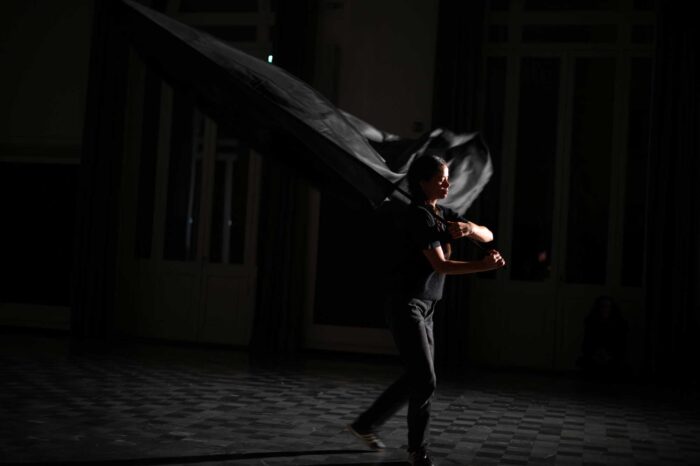
RELAY was originally created with French sound artist Yann Leguay. The work is lit by four stroboscopic lights that are also amplified with contact microphones, so they simultaneously create the sound score. The mechanism of the strobe light, the small chemical explosion that is set off with each flash, is amplified, so what you hear is this series of small explosions. The sound the lights produce can be modulated in terms of rhythm, intensity and frequency or tone. Sound and light are thus intimately connected; sound is shaped by altering the lighting and vice versa. Yann and I developed this approach in another work of mine called Light Solos, which took different light sources as the central performer. RELAY usually begins in daytime and continues into the night; the stroboscopic lighting becomes more intense as the daylight fades. As the lighting intensifies, it alters your perception of the flag’s movement. The continuity you perceive is broken down into a series of still images produced by the flashing lights.
We have had three other sound artists interpret the work, Aymeric de Tapol, Raphaël Hénard and Ofer Smilansky, who is performing with us in Bologna. Each artist has a different approach to the score. Raphaël plays the piece like a minimalist techno set with a very long extended crescendo. Ofer has automated certain aspects so he can work more with frequency and tone. The work, both choreographically and on a sound level is an open-score composition that is interpreted by the specific performers who perform it.
In RELAY and in your work at large, the ever-changing performative body turns into a multi-faceted landscape, in which the human performer’s bodily materiality is acted upon by other materialities. Objects, human physical movement, lighting, sounds, time are on the same level…
Part of having an extended choreographic approach is that choreography is not limited to human bodies but is open to different kinds of actors acting upon each other. My interest in sound is also linked to this, as I am interested in how frequencies and resonance affect bodies. Choreography and sound production are always intimately linked in my work, and ideally the sound is produced live during the performance in dialogue with the choreography or by the performers themselves.
Among the formats of presentation of your artistic work you have also conceived some “choreographic exhibitions”? What are their features?
The exhibition format allows for a certain proximity and scale that isn’t possible on stage. And is also durational, in the sense that most exhibitions take place during the opening hours of the institution versus according to show times. The first museum show I made was Free Gestures at the Ujazdowski Castle in Warsaw in 2018. The work was presented over three weeks, six days a week for five hours each day. It was performed by a cast of ten performers, working in shifts. For the exhibition I asked five fiction writers to write texts for the performers that would be performed live. Using first person narration, I asked each writer to reflect on how capitalist ideology inhabits our bodies and language in the intimate sphere of the everyday, and to reflect on what could be a possible counter gesture. The fact that the work took place in a gallery allowed us to focus on a smaller scale, working with everyday gestures and unamplified voices. The gallery spaces were empty except for a series of museum benches that were designed as shared objects to be used by both spectators and performers.
I recently presented A Choreographic Exhibition at NW Aalst, an arts venue in Belgium. The show brought together Free Gestures and several other live works as well as films and a sound installation. The exhibition occupied the entire art center, spreading over two floors of gallery spaces that also included a small cinema, the hallways and a part of the institution’s offices. The main focus of the exhibition was the tension between the individual and the collective. This tension was approached in a metaphorical way by foregrounding gestures. All these works, whether they live performances or videos or photographic images, have not so much to do with dance movement in the classical sense, but with gestures: of the hands firstly, but this notion gets a much wider meaning throughout the exhibition. Choreographic exhibitions are challenging formats in terms of audience attention, because they do not necessarily offer clear directives for how to watch, how long to stay or what to give your attention to first. I like this openness and the fact that an audience can find themselves wondering through the work instead of watching from a safe distance.
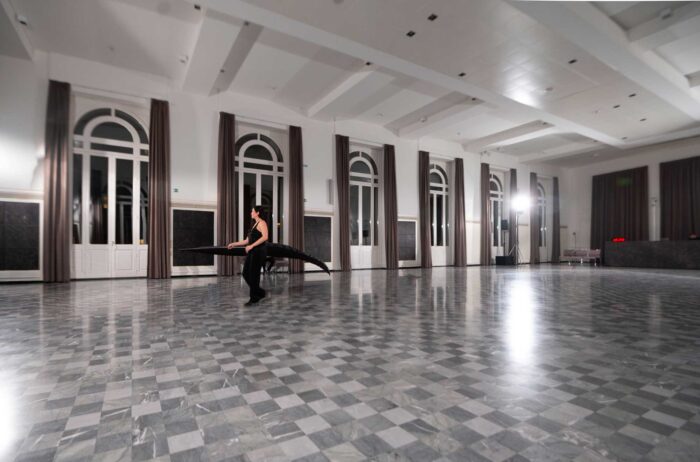
In the case of RELAY in an historical place like the salon of Palazzo de’ Toschi, completely naked, which is the expected positioning of the audience? Are they part of the ever-evolving force field? Or you imagine a fragmented fruition of in and out, mixing the inner experience with the frenzy of the city outside?
The venue and its location in the city determines to a certain extent how the work functions. It is interesting that we are occupying the Sala Convegni Banca di Bologna in the historic Palazzo de’ Toschi, a room that is normally used as a convention hall for public functions. We begin at 6pm and continue until 11pm, so I hope that an audience will accumulate after their working hours, arriving at different times and perhaps returning out of curiosity to see how the work will end. The central location allows for this merging of the intimacy of the interior space with the hectic circulation of the city.
You also performed an Unplugged version of RELAY for outdoors in different contexts. How does it change?
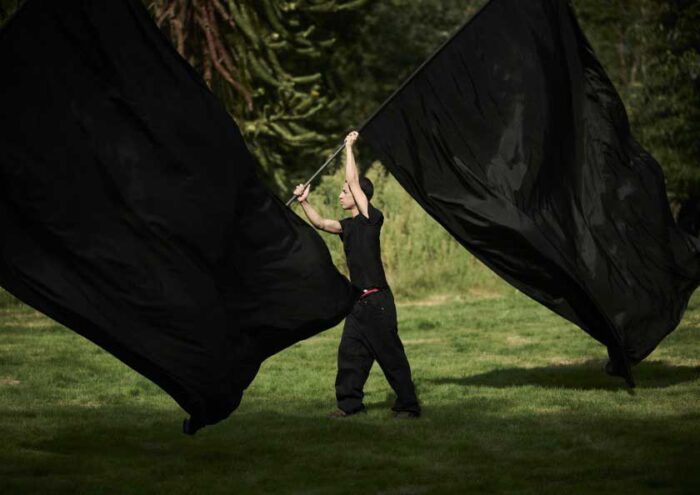
The unplugged version of the performance usually takes place outside on a public square or important location in the city. It is quite different then the indoor version, as it is without sound or lighting. And the physical practice is also quite different. In this version the performers partner with the wind to create the movement of the flag. Their bodies stand still shifting position, much like the tacking of a sailboat, to catch the gusts of wind so that the flag dances. Their stillness contrasts with the movement of the flag. In an extended version of the piece, three flags are held by a group of eight performers over a duration of four to five hours.
Since 2021, the unplugged version of RELAY is part of the art collection of the Flemish Community. What does it mean practically? How do you see the recent engagement of visual art institutions and museums in collecting live arts and performance art (like Tate collection)? Which is the “value” of a living experience?
RELAY (unplugged) became a part of the Flemish Community Art Collection in 2021 and is housed at the Middelheim Museum in Antwerp, which is a museum in the form of a sculpture park. The collection owns an edition of the flag, with specific rules for how it can be installed. To be shown publicly, it needs the live activation, which is the performance. The first time it was activated at Middelheim last summer, I worked with a group of local performers from Antwerp and Brussels. The installation took place in the museum’s gardens, and was performed just before the national elections, which saw an expected rise in voters voting for the right-wing Vlaamse Belang party. The colors of the party are yellow and black, therefore the symbolism of the black flag had a different resonance. The quiet stillness of the performers working in the sheltered space of a public park held both anticipation and a warning.
You are not interested in a closed company model. For your works you choose collaborators from a wide range of international performers and artists with whom you engage in dialogue. What characteristics best fit them? Which zones of interpretation do you want to explore (with them)?
The performers and collaborators I work with are always carefully cast and are integral to the work. I have been lucky to be able to work with amazing artists and performers who bring a lot to each project. RELAY has an open form which takes on a different quality with each iteration. Other works have a more fixed casting. Holding Present, for instance, a performance from 2023 that explores gestures from protests both past and present, was created with members of the Ictus music ensemble. They perform alongside a trio of dancers. The roles of musician or dancer are interchangeable, with the musicians participating in the choreographies and the dancers taking part in the musical score.
In a previous work, The Sadness, made between 2020-22, the performers wrote and performed their own songs about the climate crisis. In the process we learned about song writing and trained with a musical coach who works with pop and gospel singers. There is often an aspect of acquiring new skills or learning about something new. I like to be in a place of learning and exchange when I am making a new work. I hope this also translates into an openness towards an audience, with whom we want to share the experience of what we have learned in the process.