
1,311 Diamonds
Caitlin Berrigan and the ocean as a site of extraction, memory, and collective breath
Caitlin Berrigan’s sculpture and sound installation 1,311 Diamonds is one of 10 new commissions in the international group exhibition State of Wander: Towards Environmental Restoration, curated by Anna Bitkina at Paleis Het Loo, the 17th-century former summer residence of the Dutch royal family. The exhibition examines how Western museums and heritage institutions have historically shaped ideas of nature, tracing how systems of knowledge, representation, and privilege have reinforced notions of human dominance over the natural world and other species.
State of Wander: Towards Environmental Restoration is on view until 27 September 2026, with works by Caitlin Berrigan, Edward Clydesdale Thomson, Bryony Dunne, Clemens Driessen and Teodora Cecilia Buccilli, Antye Guenther, Terike Haapoja, Gayatri Kodikal, Marianna Maruyama, Jan Christian Schulz, and Rob Voerman.
The original text was first published in Italian in Exibart on May 27, 2026.
When an inhabited space is abandoned, its history does not abandon it. It is whoever decides what to do with that space who chooses how to treat that history: as discard—something to eliminate, something no longer to look at—or as remnant: a residue of value—material, symbolic, affective—that continues to speak.
The distinction between discard and remnant lies at the heart of Luciano Crespi’s beautiful book Stop City Now! Progetti di architettura dal finito al non-finito (LetteraVentidue, 2025), where he discusses it in relation to the architecture of the physical city.
But it also applies to memories—historical and collective ones, events that happened and were never publicly worked through: even when we choose no longer to look at them, they continue to inhabit not only abandoned places, but also those most frequented, most polished, most visited.
At Paleis Het Loo in Apeldoorn, in the Netherlands—the royal palace built in the seventeenth century by the House of Orange-Nassau, today one of the most visited museums in the country—this same mechanism becomes visible in State of Wander: Towards Environmental Restoration.
Running until 27 September, the exhibition has brought together ten international artists, designers, and scholars, inviting them to engage with the palace’s collection, architecture, gardens, and ecological histories as part of a reconsideration of the relationship between historical heritage and environmental crisis. The palace has its own history, and it is no ordinary one.
It was precisely in the seventeenth century—when Paleis Het Loo was being built as the summer residence of the House of Orange-Nassau—that the Dutch West India Company became one of the most prolific powers in the transatlantic slave trade, with the active participation of the royal family.
A recent study estimated that the House of Orange-Nassau derived the equivalent of around 600 million present-day dollars from enslaved labour in the colonies between 1675 and 1770. A memory long treated as something to be discarded—removed, unprocessed. Until, in 2023, King Willem-Alexander publicly apologised, while simultaneously commissioning independent research into his family’s involvement in the trade.
The exhibition opens in the very year in which the results of that research are expected. Of the ten participants, it is Caitlin Berrigan’s work that confronts the weight of that history most directly.
An American artist, writer, and researcher, Caitlin Berrigan—who holds a Master in Visual Art from MIT and completed a PhD at the Academy of Fine Arts Vienna in 2025—has long worked at the intersection of geology, capitalism, and the body, exploring how extractive technologies construct planetary hierarchies of power.
Her project Imaginary Explosions, a cosmology of science-fiction videos featuring transfeminist geologists communicating with the “desires of the mineral earth,” has been the subject of solo exhibitions at Art in General, New York, and JOAN, Los Angeles.
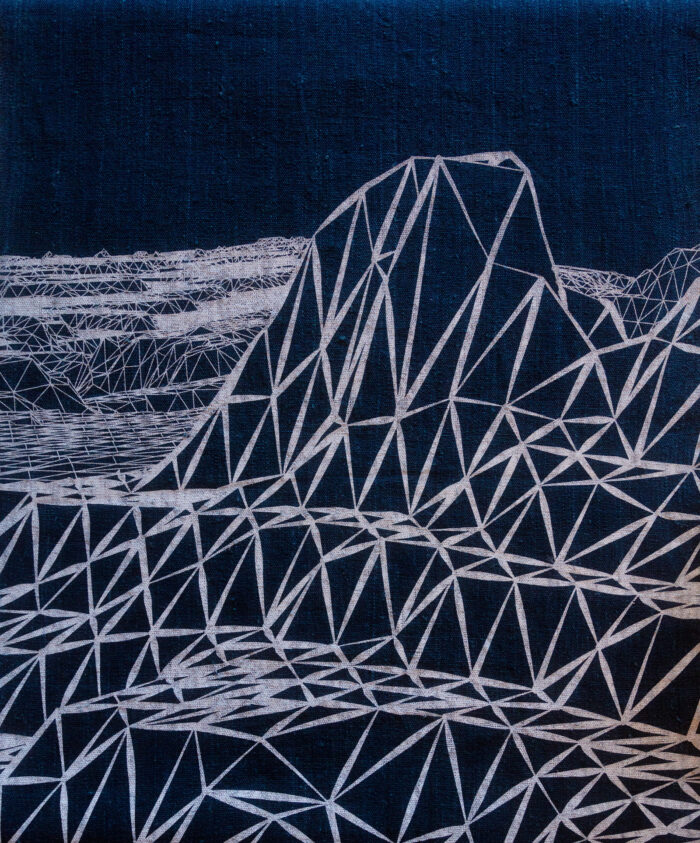
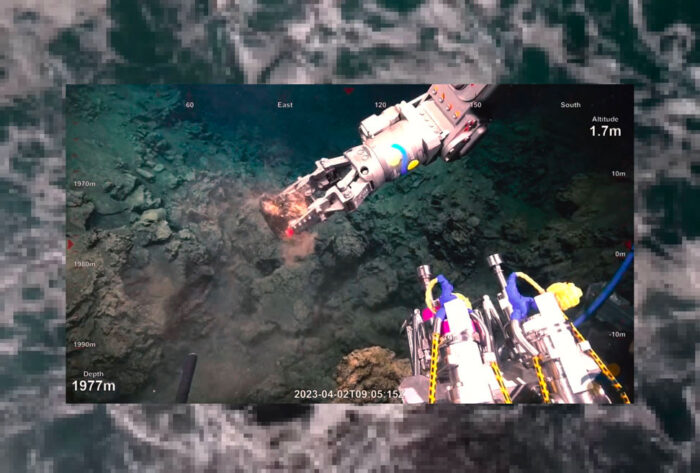
In A Voice Becomes a Mirror Plane Becomes a Holohedral Wand, presented in Montréal in 2024, Berrigan addressed deep-sea mining through a sonic landscape immersed in the frequencies of the ocean depths. In her work until that point, the ocean had been a speculative setting, almost science-fictional. At Paleis Het Loo, it becomes a historical document.
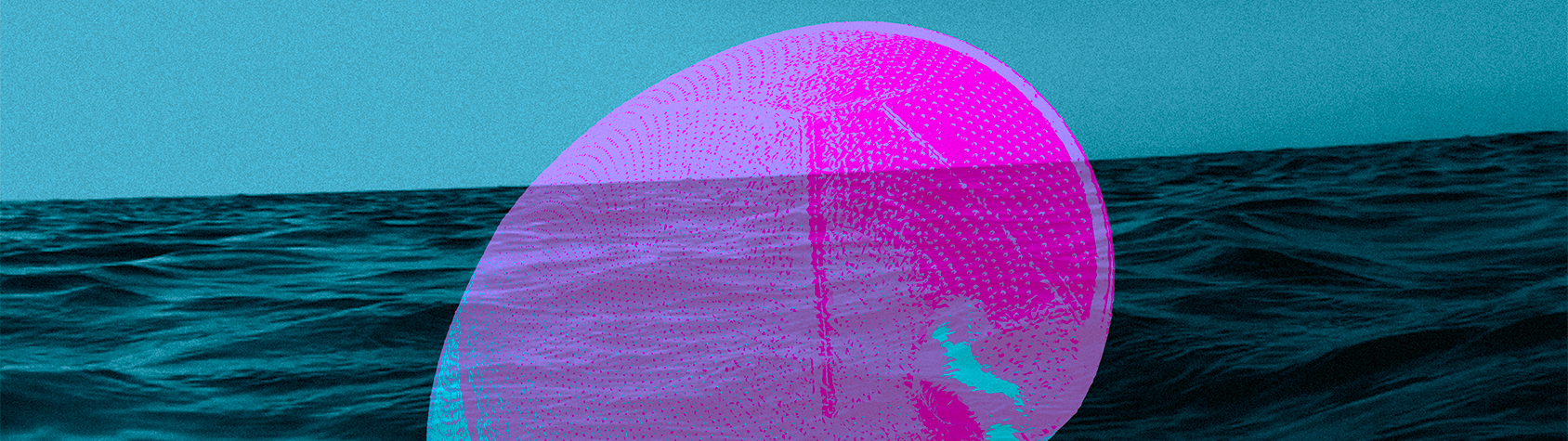
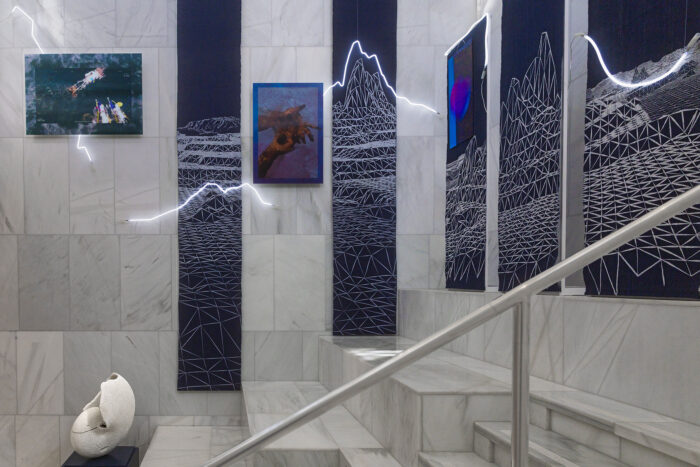
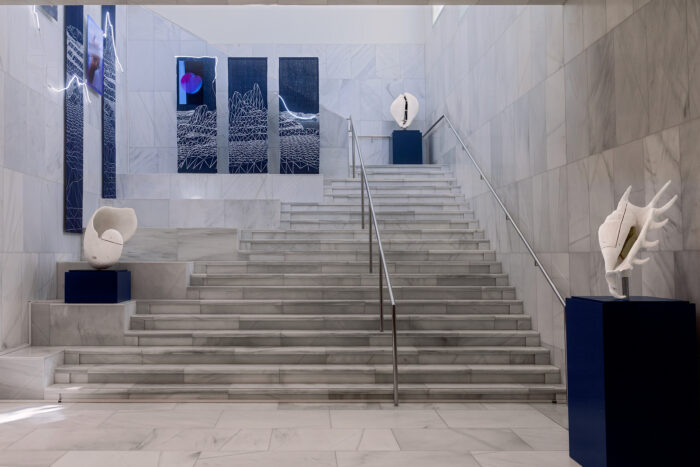
In the East Foyer of the palace, Berrigan presents a sculptural and sonic installation whose point of departure is the very floor beneath one’s feet: marble formed from calcified marine organisms, shells, foraminifera skeletons, sediments deposited on seabeds that no longer exist at the surface.
An involuntary geological memory, inscribed in stone, which Berrigan makes visible by placing it in relation to what was happening on those very oceans while the palace was being built: goods, spices, human bodies transported as things to be sold. The work is titled 1,311 Diamonds.
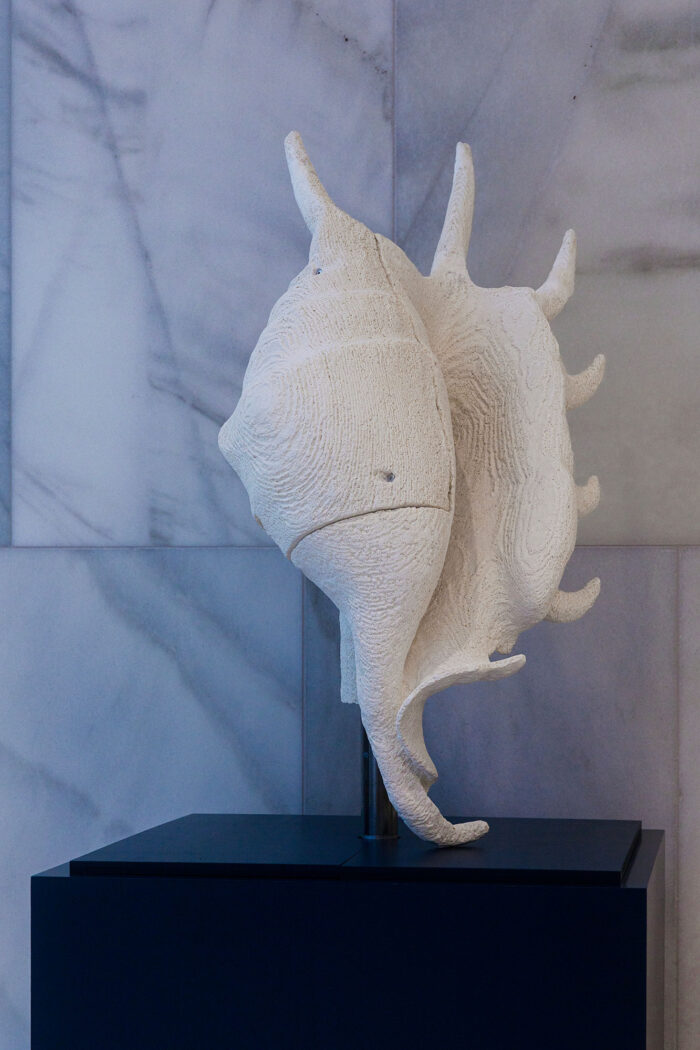
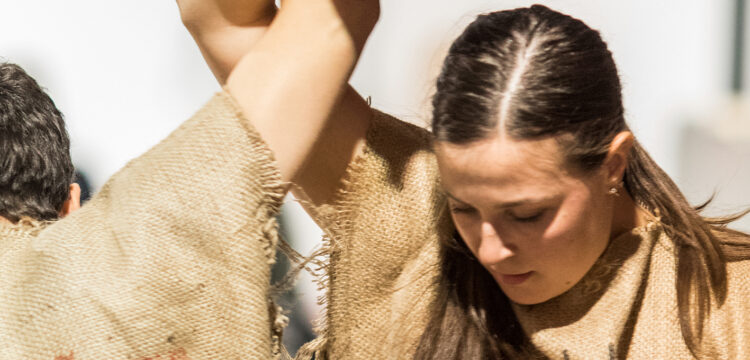
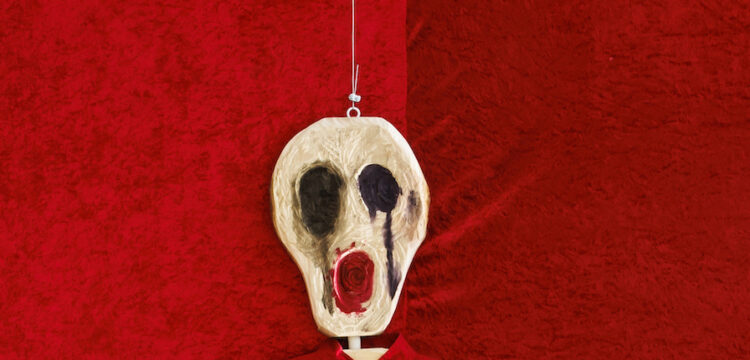
One thousand three hundred and eleven diamond forms occupy the space, alongside indigo textiles, shells, and sound recordings—the latter created in collaboration with the Oshun Swim School, led by Chandrika Francis: breathing exercises and voices recorded during swimming lessons, within a work whose horizon is the historical, bodily, and symbolic repair of a relationship with water marked by slavery, segregation, and the memory of the Atlantic crossing.
The number in the title is precise, insistent, almost like a notarial act. Something was counted. Someone was counted.
For this very reason, its meaning is not an informational detail: it shapes the way the work binds together measure, memory, and responsibility. I therefore wanted to ask Caitlin Berrigan what exactly that 1,311 represents: whether it refers to a quantity linked to historical data, to an extractive process, or to another form of counting. In her response, Berrigan explains that 1,311 is the number of diamonds which, according to reports from the time, were being transported in the seventeenth century aboard a Dutch merchant ship that sank in the ocean.
When an attempt was made to recover the wreck, the diamonds were not found; instead, the operation brought to light the remains of other transported goods, now held by the Rijksmuseum: pepper, porcelain, and exotic shells. Those diamonds, never recovered, return to the centre of the work for another reason as well: in the installation, Berrigan stages the planetary breath of the carbon cycle. Diamonds, after all, are a pure form of compressed carbon, easily transformed into money.
Sound, Berrigan continues, is also central to the work: not as an illustrative soundtrack, but as an element that inhabits and transforms the space—the sounds of movement through water, of breath, and of the voices of those descended from people who endured deportation into slavery. In this way, the ocean re-enters the palace—itself a representation of the wealth and collections born of colonial commerce—through three acoustic speakers reproduced from laser scans of shells recovered from the shipwreck.
The speakers were acoustically developed in collaboration with Samuel Hertz—composer, sound artist, and researcher whose work moves at the intersection of sound and climate change—and produced specifically for this work by Pietro Odaglia, researcher at ETH Zürich, who modelled and 3D-printed them directly in marble dust, chemically identical to the original shells.
This dialogue between the theme of the installation and extraction, understood as the operation that separates what remains from what is discarded and, in doing so, establishes a hierarchy, may therefore not be a technical detail, but one of the ways in which the work continues to place matter, loss, and what remains into relation with one another.
Bearing in mind his own work with construction waste transformed into structural elements, without cement and without newly extracted materials, I asked Pietro Odaglia whether the choice of marble dust—chemically identical to the original shells from the wreck—had been influenced by the discourse Berrigan constructs in 1,311 Diamonds.
“The marble powder used to 3D-print the diffusers comes from quarry fines, the residues produced during the extraction and cutting of stone at a quarry in Lasa, South Tyrol,” Odaglia explains, noting that these residues often account for more than forty percent of the material extracted. Despite the scale of this amount, they are generally treated as a burden to be sent to landfill rather than as a resource.
“Our research,” he continues, “has focused precisely on this kind of material, together with other locally extracted minerals, because of their abundance and underuse: material that has already been extracted and is asking to be brought back into circulation, rather than discarded a second time.”
In this way, “the choice forms part of a broader logic of circularity that has long guided our work and that we are now extending to demolition waste as well—another form of residual material that, until now, has largely been treated simply as waste.”
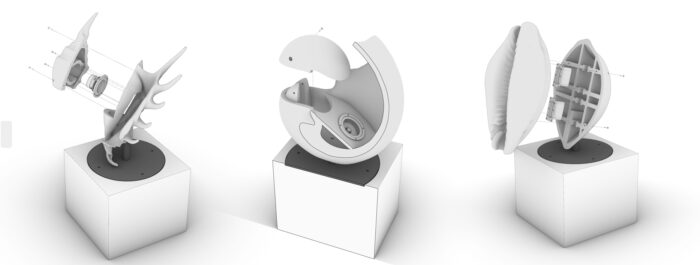
The material of the speakers is not, therefore, merely a background element: it accompanies the sound and brings it back to the point from which the work began—the ocean, the shells, what remains after extraction, after commerce, after loss.
Within an exhibition that invites us to rethink the relationship between historical heritage and environmental crisis, Berrigan’s work is perhaps the most unsettling—and the most necessary: because it forces the palace to reckon with what its history had kept outside, not only the profits of colonial commerce, but also the bodies and materials that made those profits possible.
The ocean, the dead, geological time. The palace looking at itself, finally, with an eye no longer belonging to the court. The memories we chose to treat as discard, and which instead continue to speak—becoming, in doing so, remnants capable of having a voice.